
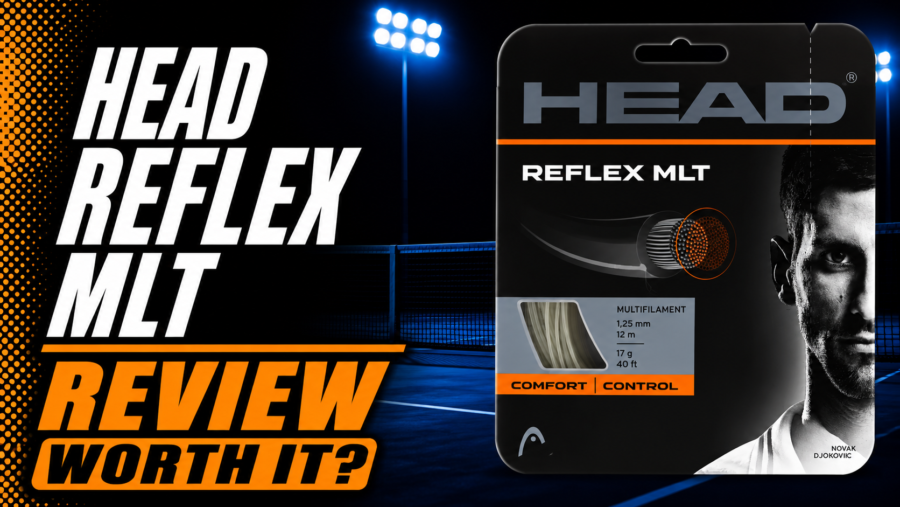
HEAD Reflex MLT is a premium multifilament tennis string designed for players who prioritize comfort, easy depth and a soft response. It sits above HEAD Velocity MLT in the brand’s comfort-oriented range, with a more elastic construction and a plusher overall character.
HEAD builds Reflex MLT from a large bundle of fine nylon fibers held within a flexible resin. An anti-friction surface helps the strings move across one another, giving the string more useful spin potential than its smooth, round appearance might suggest.
The result is best suited to beginners, intermediates, doubles players and experienced competitors who no longer want the firmness of polyester. It is also a sensible option for a soft full bed or the comfort-focused half of a hybrid. The Tennis String Finder can help compare it with other multifilaments.
HEAD Reflex MLT Rating
| Category | Rating |
|---|---|
| Power | 8.5/10 |
| Spin | 7.5/10 |
| Comfort | 9.5/10 |
| Control | 7.5/10 |
These ratings compare Reflex MLT with the wider tennis-string market. It is powerful and exceptionally comfortable, while its control and physical durability remain below those of firm polyester.
HEAD Reflex MLT Specifications
| Specification | Details |
|---|---|
| String type | Multifilament |
| Composition | Nylon microfilaments in a flexible resin matrix |
| Profile | Round |
| Surface | Smooth anti-friction finish |
| Gauges | 15 / 1.40mm, 15L / 1.35mm, 16 / 1.30mm and 17 / 1.25mm |
| Color | Natural |
| Set length | Approximately 12m |
| Reel length | Approximately 200m, depending on market |
Gauge and package availability can differ by region. The 1.30mm and 1.25mm versions are the most relevant options for many standard adult rackets.
Material and Construction
Reflex MLT uses a multifilament construction rather than one solid polyester strand. HEAD describes thousands of fine filaments embedded in a resin matrix. Independent product information identifies the material as nylon and describes approximately 1,300 individual fibers.
Those fibers flex together at impact, allowing the ball to sink into the stringbed more than it would with a typical polyester monofilament. This produces the pocketing, easy rebound and reduced impact harshness associated with a premium multifilament.
The string has a round profile and does not use geometric edges to grip the ball. Its anti-friction surface instead supports sliding between the mains and crosses. When the finish is fresh, that movement can help the mains return after impact and contribute to spin.
The exterior also protects the fiber bundle from immediate abrasion. It cannot eliminate fraying or notching, however. As the coating wears, the strings can become rougher, move out of position and eventually expose individual fibers.
HEAD Reflex MLT Performance
Power
Reflex MLT provides easy power across a wide range of swing speeds. Its flexible fibers and elastic resin return more energy than a control polyester, helping compact and moderate swings produce depth without exceptional racket-head speed.
The power is progressive rather than completely uncontrolled. Independent playtesting has placed it among the livelier multifilaments while still finding enough predictability for confident groundstrokes and serves.
Fast, flat hitters may find the launch too generous in a powerful racket or open pattern. A thicker gauge, slightly firmer setup or more control-oriented string may suit those players better.
Power rating: 8.5/10
Spin
Reflex MLT generates strong spin for a multifilament. The round profile does not bite the ball through edges, but the low-friction exterior helps the strings slide and recover while the surface remains in good condition.
This makes it more spin-capable than many soft strings whose outer wraps lock quickly. Players using sound topspin mechanics should find enough rotation for controlled rally balls, slices and kick serves.
It still cannot match a shaped polyester for heavy, repeated spin. Fraying and notching eventually reduce movement, so its spin response can change before the string actually breaks.
Spin rating: 7.5/10
Control
Reflex MLT offers respectable control for such a lively string. Its consistent response and ball pocketing can help with placement, touch shots and changes of direction at moderate swing speeds.
Control depends strongly on the racket and setup. In a dense pattern or lower-powered frame, the added depth can be useful. In an open, powerful racket, the launch may become demanding for a player who takes full cuts at every ball.
The thicker gauges provide a calmer response. Players who need polyester-level containment should not expect Reflex MLT to behave like a firm monofilament.
Control rating: 7.5/10
Comfort and Feel
Comfort is the defining strength of Reflex MLT. The flexible multifilament bundle cushions impact and provides a soft, pocketing response, including on shots that miss the center of the stringbed.
Its feel is plush rather than sharply crisp. This character works well for volleys, drop shots and doubles exchanges, where the player may value ball pocketing and touch more than a rigid response.
No string can prevent or treat an injury. Players with persistent elbow, wrist or shoulder pain should seek qualified medical guidance and consider the entire setup, including racket weight, technique, workload and tension.
Comfort rating: 9.5/10
Durability and Tension Maintenance
Physical resistance to breakage is moderate. Reflex MLT is more protected than a very delicate multifilament, but heavy topspin and open patterns can abrade the exterior, cause fraying and cut through the fiber bundle.
The 1.35mm and 1.40mm versions provide additional material for frequent breakers. The 1.30mm option offers a practical balance for most players, while 1.25mm favors response over longevity.
Useful playability duration is a separate issue. Independent evaluation indicates good tension consistency for a powerful multifilament, but the surface can notch and the strings may stop returning before they snap. Replacement is reasonable when launch becomes erratic, the stringbed feels excessively loose or the fibers are heavily frayed.
Choosing the Right Gauge
| Gauge | General characteristics |
|---|---|
| 15 / 1.40mm | Maximum physical resistance and the most controlled response |
| 15L / 1.35mm | Extra durability with slightly more response than 1.40mm |
| 16 / 1.30mm | Best general balance of comfort, control and durability |
| 17 / 1.25mm | More power, pocketing and spin access with faster wear |
The 16 / 1.30mm version is the safest starting point for most adult players. Frequent multifilament breakers can move thicker, while players using dense patterns can consider 1.25mm for greater liveliness.
Full Bed or Hybrid Setup
Full Bed
A full bed provides the clearest expression of Reflex MLT’s comfort, power and pocketing. It suits players moving away from polyester, recreational competitors and anyone who wants easier depth without a harsh impact.
The setup can be lively in a powerful racket. A thicker gauge or a tension adjustment within the racket manufacturer’s range can improve predictability.
HEAD Reflex MLT in the Mains With Polyester Crosses
Reflex MLT mains preserve much of the soft feel and power. A smooth polyester cross can reduce launch and add directional control.
The polyester cross will usually notch the softer mains, shortening physical life. A round cross is generally less abrasive than a sharply shaped one.
Polyester Mains With HEAD Reflex MLT Crosses
Polyester mains dominate spin and control, while Reflex MLT crosses add pocketing and reduce the stringbed’s overall firmness. This setup suits established polyester users who want a more forgiving response.
It remains a polyester-led hybrid and should not be described as equivalent to a full multifilament bed for comfort. The soft crosses can also wear quickly against shaped mains.
General Tension Guidance
Reflex MLT can start near a player’s established nylon or multifilament reference. Players replacing polyester should account for its greater elasticity and higher launch rather than copying the same setup automatically.
Lower tension increases pocketing, power and launch. Higher tension produces a firmer trajectory, but excessive tension can remove some of the comfort that makes the string worthwhile.
Racket head size, pattern, gauge and swing speed all matter. Stay within the racket manufacturer’s recommended range and make small changes between restringing jobs. The Tennis String Tension Calculator provides broader starting guidance.
Who Should Use HEAD Reflex MLT?
Reflex MLT is best suited to:
- Beginners and intermediates seeking easy depth
- Players prioritizing comfort and pocketing
- Doubles and all-court players who value touch
- Former polyester users wanting a softer full bed
- Players with compact or moderate swings
- Hybrid users needing a premium soft component
Who Should Avoid HEAD Reflex MLT?
Reflex MLT is less suitable for:
- Frequent multifilament breakers
- Advanced hitters needing maximum polyester control
- Heavy topspin players relying on sustained snapback
- Players who prefer a crisp, rigid impact
- Buyers seeking a budget synthetic gut
- Anyone expecting a string to resolve an existing injury
Pros and Cons
| Pros | Cons |
|---|---|
| Exceptional comfort | Premium price for a multifilament |
| Easy power and depth | Less break-resistant than polyester |
| Plush pocketing and touch | Can become lively in powerful rackets |
| Good spin for a multifilament | Spin declines as the surface notches |
| Four gauge options | Natural is the principal color |
| Useful in full beds and hybrids | Not designed for maximum-speed polyester users |
HEAD Reflex MLT Compared With Other Strings
Reflex MLT vs HEAD Velocity MLT
HEAD Velocity MLT is firmer, less expensive and more control-oriented. Reflex MLT is the better choice for maximum comfort, easier power and a more premium pocketing sensation.
Reflex MLT vs HEAD Velocity MLT Power
HEAD Velocity MLT Power also emphasizes easy depth. Reflex MLT feels more refined and plush, while Velocity MLT Power offers a lower-cost route to a lively multifilament response.
Reflex MLT vs Wilson NXT
Wilson NXT is another premium multifilament built around comfort and power. Both suit non-breakers, and the final choice is likely to depend on preferred feel, price and local availability.
Reflex MLT vs Tecnifibre NRG2
Tecnifibre NRG2 is similarly powerful and comfortable, with a highly elastic multifilament construction. Reflex MLT counters with useful low-friction movement and four official gauge options.
Final Verdict
HEAD Reflex MLT is a premium comfort string for players who want easier depth, soft pocketing and a forgiving response. Its nylon microfilament bundle, flexible resin and anti-friction exterior create an effective balance of power and category-leading comfort.
The compromises are typical of a lively multifilament. It will not contain full swings like a firm polyester, and heavy topspin can wear through its exterior. Physical condition and useful playability should therefore be monitored separately.
The 16 / 1.30mm gauge is the most versatile starting point. Reflex MLT is particularly convincing as a full bed for a non-breaker or as the soft component in a carefully selected hybrid.
Frequently Asked Questions
Is HEAD Reflex MLT a polyester string?
No. It is a nylon multifilament made from many fine fibers held in a flexible resin matrix.
Is Reflex MLT arm-friendly?
It is highly comfortable relative to the wider string market, but no string can prevent or treat an injury.
Does Reflex MLT generate spin?
It provides good spin for a multifilament because its smooth surface supports string movement while fresh. It does not equal a shaped polyester for maximum rotation.
Which gauge should most players choose?
The 16 / 1.30mm version offers the best general balance of comfort, control and physical resistance.
Is Reflex MLT suitable for a hybrid?
Yes. It can serve as the soft main or cross, although contact with polyester will normally accelerate notching and wear.