
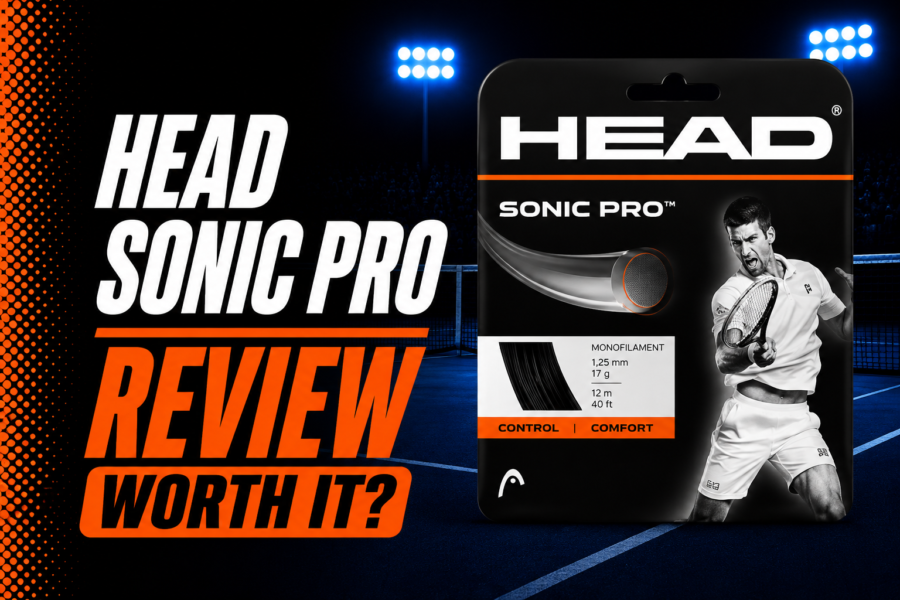
Head Sonic Pro is a round co-polyester tennis string designed to provide control and physical durability without the extremely firm response associated with many traditional polyester strings. HEAD positions it as an all-round option for club players who want a relatively comfortable monofilament.
The word “comfortable” requires context. Sonic Pro is softer and more forgiving than many firm, control-focused polyester strings, but it is still significantly less arm-friendly than natural gut, multifilament or synthetic gut.
Its smooth, round profile creates a predictable response and allows the strings to move and snap back after contact. It does not generate the aggressive surface bite of shaped polyester, but its spin potential is better than its shape might suggest.
Sonic Pro is best suited to intermediate club players and experienced polyester users who want balanced control, useful spin and a slightly livelier response than a low-powered competition string. Players who are unsure whether polyester suits their game can use the Tennis String Finder to compare it with softer alternatives.
Head Sonic Pro Rating
| Category | Rating |
|---|---|
| Power | 6/10 |
| Spin | 7.5/10 |
| Comfort | 6.5/10 |
| Control | 8/10 |
These ratings consider Sonic Pro within the broader tennis-string market. Its comfort and power are relatively good for a polyester, but they remain moderate when compared with softer and more elastic string materials.
Head Sonic Pro Specifications
| Specification | Details |
|---|---|
| String type | Co-polyester monofilament |
| Composition | Refined co-polymer polyester formulation |
| Shape | Round |
| Surface | Smooth |
| Common gauges | 17 / 1.25mm and 16 / 1.30mm |
| Colors | Black and White |
| Set length | Approximately 12m |
| Reel length | Approximately 200m |
| HEAD classification | Team |
| Intended player | Club player seeking control, comfort and durability |
| Main benefit | Comfort within a polyester construction |
Gauge, color and package availability can differ between countries and retailers.
Material and Construction
Head Sonic Pro uses a single co-polyester monofilament. Unlike multifilament strings, it is not constructed from numerous small fibers. The string consists of one solid strand designed to provide a controlled and physically durable response.
HEAD describes Sonic Pro as having a soft molecular construction. This refers to the formulation used to make it more elastic and forgiving than many traditional polyester strings. It should not be interpreted as meaning that Sonic Pro is as soft as natural gut or multifilament.
The string has a round, smooth profile. It does not have sharp edges designed to grip the ball mechanically. Instead, its spin potential comes primarily from lateral string movement, snapback and the player’s racket-head speed.
HEAD does not identify a separate textured surface or spin coating for the standard Sonic Pro. Its response is mainly determined by its co-polyester formulation, smooth surface and round construction.
The smooth profile also makes Sonic Pro less abrasive against another string in a hybrid. This can make it a practical cross string when paired with natural gut or multifilament.
Sonic Pro should not be confused with Sonic Pro Edge or Sonic Pro Tour rPET. Those are separate shaped strings designed to produce more direct ball bite. Standard Sonic Pro is the round version and offers a more neutral, predictable response.
Head Sonic Pro Performance
Power
Sonic Pro provides low-to-moderate power across the complete tennis-string market. However, it is slightly livelier than many firm polyester control strings.
The string can provide enough response to help an intermediate player generate depth without making the launch excessively unpredictable. This is one reason HEAD markets it toward club players with compact or shorter swings.
That positioning still needs perspective. Sonic Pro does not create the effortless depth of natural gut, multifilament or a powerful synthetic gut. Players must provide adequate racket-head speed and clean contact to activate the stringbed.
Its livelier polyester response can be useful for players who find strings such as Luxilon 4G or other firm control polys too demanding. In a powerful racket or open string pattern, however, some players may prefer a firmer or lower-powered alternative.
Power rating: 6/10
Spin
Sonic Pro provides good spin potential for a round polyester string. Its smooth surface allows the main strings to slide across the crosses and return toward their original position after impact.
This snapback can help generate topspin and slice when combined with sufficient racket-head speed. The thinner 1.25mm gauge should provide slightly easier string movement and ball access than the thicker version.
Because Sonic Pro is round, it does not produce the same direct surface bite as a shaped polyester. Strings such as Solinco Hyper-G, Head Lynx Tour and Babolat RPM Blast are more suitable for players who prioritize maximum spin.
Sonic Pro instead provides a balanced type of spin that works particularly well for players who combine flatter drives with moderate topspin. Its spin potential may decline as the string loses elasticity and its snapback becomes less efficient.
Spin rating: 7.5/10
Control
Control is one of Sonic Pro’s strongest qualities. Its polyester construction limits excessive stringbed deformation and helps create a crisp, predictable launch.
Players who generate their own pace should be able to accelerate through the ball without receiving too much uncontrolled power from the strings. This makes Sonic Pro suitable for redirecting pace, driving through shorter balls and maintaining directional accuracy during faster rallies.
The response is not as firm or locked-in as the most demanding control polys. Sonic Pro has slightly more liveliness and pocketing, which makes it more accessible but can produce a marginally higher launch in powerful rackets.
Control is strongest while the string remains fresh and responsive. As tension and elasticity decline, the launch can become less consistent even if the string has not physically broken.
Control rating: 8/10
Comfort and Feel
Sonic Pro is relatively comfortable by polyester standards. Its softer formulation creates more pocketing and less shock than many stiff monofilaments, particularly when it is not installed at excessive tension.
The initial response can feel crisp and firm. As the stringbed settles, it may develop a slightly softer and more dampened sensation. This gives Sonic Pro a useful balance between direct feedback and forgiveness.
However, its comfort should not be overstated. Sonic Pro remains a polyester monofilament and cannot provide the elasticity, shock absorption or easy depth of natural gut and multifilament.
Players with current elbow, wrist or shoulder discomfort should generally avoid a full bed of Sonic Pro. A softer string material should be considered before attempting to solve discomfort through tension changes alone.
Comfort rating: 6.5/10
Durability and Tension Maintenance
Sonic Pro provides strong physical resistance to breaking. Its monofilament construction should withstand repeated friction and impact better than most multifilament and natural-gut strings.
The thicker 1.30mm gauge offers the greatest break resistance. It should be the better choice for players who regularly break 1.25mm strings or use an open string pattern that produces significant movement and notching.
Physical durability is not the same as useful playability duration. Sonic Pro can remain unbroken after it has lost a meaningful amount of tension, elasticity and snapback.
Its tension maintenance is approximately average for a relatively lively co-polyester. An initial tension reduction is normal, followed by a period of more stable performance. With continued use, the response can become less lively, more muted and increasingly firm.
Signs that Sonic Pro needs replacing include:
- The strings remaining out of position after contact
- A noticeable decline in snapback
- Reduced control or an inconsistent launch
- A dead or unusually rigid response
- Increasing discomfort
- Deep notching at the string intersections
Players should replace Sonic Pro according to its condition and performance rather than waiting for it to break. The guide on how often to change tennis strings explains the main factors that affect replacement frequency.
Choosing the Right Gauge
Sonic Pro is commonly offered in 1.25mm and 1.30mm. The correct option depends on the desired balance between response, spin access and break resistance.
| Gauge | General response | Best suited to | Main trade-off |
|---|---|---|---|
| 1.25mm | More responsive, slightly livelier and easier to move | Players prioritizing feel, spin access and ball pocketing | Lower physical durability |
| 1.30mm | Firmer, more stable and more resistant to breakage | Frequent string breakers, open patterns and powerful hitters | Slightly less feel and spin access |
The 1.25mm version is the most balanced starting point for players who do not regularly break polyester. It allows slightly easier string movement and should provide a more responsive feel.
The 1.30mm version is more appropriate for players who prioritize durability and stability. It can also help control the livelier response of a powerful racket or very open string pattern.
Gauge should be changed before making several other adjustments. Testing both gauges at a similar tension makes it easier to identify which difference comes from string thickness.
Full Bed or Hybrid Setup
Full Bed
A full bed of Sonic Pro provides the clearest expression of its controlled, crisp and relatively comfortable polyester response.
This setup is most appropriate for intermediate and advanced players who already know that they can use polyester comfortably. It offers good control, useful snapback and stronger break resistance than softer string materials.
Players moving from a firm polyester may find Sonic Pro slightly livelier and more forgiving. Players moving from multifilament may instead notice a substantial reduction in easy power and comfort.
Sonic Pro in the Mains With Softer Crosses
Using Sonic Pro in the mains with a softer multifilament or synthetic-gut cross preserves much of its control and physical durability while making the overall stringbed more forgiving.
Because the mains normally have the greatest influence on performance, the setup will still feel predominantly polyester-based. The softer crosses can add some power, pocketing and comfort, but they will not transform it into a fully arm-friendly setup.
A string such as Wilson NXT can be used in the crosses when additional comfort is desired. The softer crosses may notch or fray faster than Sonic Pro, particularly for players who generate frequent string movement.
Softer Mains With Sonic Pro in the Crosses
Installing natural gut or multifilament in the mains with Sonic Pro in the crosses creates a more powerful and comfortable hybrid.
The softer mains provide most of the feel, pocketing and easy depth. Sonic Pro crosses reduce some of the launch and add control, physical durability and a smoother surface for the mains to move against.
Its round profile makes Sonic Pro more suitable for this role than an aggressively shaped polyester, which can cut into softer mains more quickly.
A premium setup could combine Babolat Touch VS Natural Gut mains with Sonic Pro crosses. This arrangement would prioritize power, comfort and tension maintenance while retaining some polyester control.
General Tension Guidance
Sonic Pro should always be installed within the tension range recommended by the racket manufacturer.
Because it is a polyester monofilament, it is commonly installed at a lower tension than natural gut, multifilament or synthetic gut. The lower-to-middle part of the racket’s recommended range is a sensible starting area for many players.
A lower tension generally produces:
- Easier depth
- Greater pocketing
- A more forgiving response
- A higher launch angle
- Potentially easier string movement
A higher tension generally produces:
- A firmer response
- A lower launch angle
- Less accessible depth
- Reduced pocketing and comfort
Higher tension does not automatically create more control or spin. Excessive tension can make Sonic Pro feel unnecessarily firm and prevent the player from generating sufficient depth or string movement.
Players using a powerful racket or open string pattern may prefer a slightly firmer setup. Players using a dense pattern, smaller head or lower-powered racket may benefit from a more forgiving starting tension.
When testing Sonic Pro, avoid changing the gauge, tension and hybrid configuration simultaneously. Adjusting one major variable at a time makes it easier to understand how each change affects performance.
The Tennis String Tension Calculator can provide a more individualized starting point.
Who Should Use Head Sonic Pro?
Sonic Pro is particularly suitable for:
- Intermediate and advanced club players
- Players seeking a balanced polyester rather than an extreme spin string
- Experienced polyester users who want a slightly softer response
- Players with compact or moderate swings who still want polyester control
- Flatter hitters who use moderate topspin
- All-court players who value predictable response
- Players who regularly break multifilament or synthetic gut
- Players seeking a smooth round polyester for a hybrid
- Players who find very firm control polys too demanding
The string is especially useful for someone who wants to enter the polyester category without immediately selecting one of the firmest or most aggressively shaped options.
Who Should Avoid Head Sonic Pro?
Sonic Pro may be unsuitable for:
- Beginners who need maximum easy depth and forgiveness
- Players with current elbow, wrist or shoulder discomfort
- Players who want the power of natural gut or multifilament
- Heavy-spin players seeking maximum surface bite
- Advanced hitters who prefer an extremely firm and low-powered response
- Players who rarely restring and expect polyester to remain playable indefinitely
- Players who prioritize long-term tension maintenance over break resistance
- Anyone selecting it solely because it is described as a “soft” string
Players with very slow swings may struggle to create consistent depth with a full bed. A multifilament or synthetic gut will generally provide more accessible power and comfort.
Head Sonic Pro Pros and Cons
| Pros | Cons |
|---|---|
| Above-average comfort for a polyester | Still significantly firmer than multifilament or natural gut |
| Predictable control | Does not provide maximum shaped-string bite |
| Good spin potential for a round string | Power remains modest across the wider string market |
| Slightly livelier than many firm control polys | Tension and useful playability decline before breakage |
| Strong physical resistance to breaking | Can become dead or less responsive with continued use |
| Smooth surface works well in hybrids | Only two commonly available gauges |
| Suitable for club and intermediate players | Not recommended for players with current arm discomfort |
| Available in 1.25mm and 1.30mm | Less locked-in than the firmest control polys |
Head Sonic Pro Compared With Other Tennis Strings
Head Sonic Pro vs Head Lynx Tour
Head Lynx Tour is a firmer, shaped co-polyester designed to emphasize spin, control and stability.
Lynx Tour is the stronger choice for fast-swinging players who want more ball bite and a lower-powered response. Sonic Pro is round, livelier and more forgiving, making it more accessible for general club play.
Choose Sonic Pro for balance and relative comfort. Choose Lynx Tour for stronger spin, firmness and control on aggressive swings.
Head Sonic Pro vs Head Lynx Touch
Head Lynx Touch uses a more complex co-extruded construction intended to combine polyester control with additional feel and comfort.
Lynx Touch produces a more dampened and cushioned response. Sonic Pro has a crisper, more traditional monofilament feel and may offer a slightly more direct connection with the ball.
Players prioritizing comfort and pocketing may prefer Lynx Touch. Players wanting a simpler, crisper and physically durable round polyester may prefer Sonic Pro.
Head Sonic Pro vs Solinco Hyper-G
Solinco Hyper-G is a shaped polyester built around spin and control.
Hyper-G provides more direct ball bite, a firmer response and a more controlled trajectory for aggressive topspin players. Sonic Pro feels more neutral and slightly livelier, with a smoother response for flatter hitting and hybrid use.
Choose Hyper-G for maximum spin emphasis. Choose Sonic Pro for a more balanced and less aggressive polyester response.
Head Sonic Pro vs Babolat RPM Blast
Babolat RPM Blast uses a shaped profile and a spin-focused surface treatment to produce greater bite and a more controlled response.
RPM Blast is better suited to advanced players who generate high racket-head speed and want stronger spin potential. Sonic Pro provides more accessible power and above-average polyester comfort, but it does not offer the same aggressive grip on the ball.
Sonic Pro is the more forgiving option. RPM Blast is the more specialized spin-and-control option.
Head Sonic Pro vs Luxilon Element
Luxilon Element is designed to provide a softer, more muted alternative to traditional firm polyester strings.
Element prioritizes pocketing, dampening and comfort within the polyester category. Sonic Pro feels somewhat crisper and provides a more conventional round co-polyester response.
Players seeking maximum polyester comfort may lean toward Element. Players wanting a balanced combination of crisp control, durability and moderate liveliness may prefer Sonic Pro.
Final Verdict
Head Sonic Pro is a balanced round co-polyester that combines predictable control, useful spin and strong physical durability with a more forgiving response than many traditional polyester strings.
It does not lead the category in any extreme performance area. Shaped strings offer more direct spin, firm control polys provide a more locked-in response, and softer string materials deliver substantially more power and comfort.
Its strength is the way it combines several useful qualities without becoming excessively demanding. The 1.25mm gauge provides the best balance of response and spin access, while the 1.30mm version prioritizes stability and resistance to breaking.
Sonic Pro is a sensible option for intermediate club players, flatter hitters and experienced polyester users who want a round, relatively comfortable control string. It can work in a full bed or as the polyester component of a hybrid.
Players should still monitor its condition carefully. The string can remain physically intact after its tension, elasticity and useful response have declined.
Frequently Asked Questions
What type of string is Head Sonic Pro?
Head Sonic Pro is a co-polyester monofilament tennis string. It is made from one solid strand rather than the numerous bonded fibers used in multifilament strings.
Is Head Sonic Pro round or shaped?
Standard Head Sonic Pro has a smooth, round profile. It should not be confused with Sonic Pro Edge or Sonic Pro Tour rPET, which are separate shaped products.
Is Head Sonic Pro a soft string?
It is relatively soft for a polyester monofilament. However, it is not as soft or forgiving as natural gut, multifilament or synthetic gut.
Is Head Sonic Pro arm-friendly?
Sonic Pro provides above-average comfort within the polyester category, but describing it as completely arm-friendly would be misleading. Players with current arm discomfort should generally choose a softer material.
How powerful is Head Sonic Pro?
It provides low-to-moderate power across the overall string market. It is slightly livelier than many firm control polys but requires the player to generate most of the pace.
Does Head Sonic Pro generate good spin?
Yes. Sonic Pro provides good spin for a round string through string movement and snapback. It does not produce as much direct bite as aggressively shaped polyester strings.
Does Head Sonic Pro provide good control?
Control is one of its strongest qualities. Its co-polyester construction creates a predictable response that allows experienced players to swing confidently.
Is Head Sonic Pro suitable for beginners?
A full bed is not the best choice for most beginners because it provides less easy power and comfort than synthetic gut or multifilament. It may suit a developing intermediate player who has sufficient swing speed and no arm discomfort.
Which Head Sonic Pro gauge should I choose?
The 1.25mm gauge provides more response, feel and spin access. The 1.30mm gauge provides greater stability and physical resistance to breaking.
Can Head Sonic Pro be used in a full bed?
Yes. A full bed provides a consistent combination of control, snapback and durability. It is best suited to players who already know that they can use polyester comfortably.
Can Head Sonic Pro be used in a hybrid?
Yes. It can be used in the mains with a softer cross for a predominantly polyester response, or in the crosses with natural gut or multifilament mains for greater power and comfort.
Is Head Sonic Pro a good hybrid cross?
Its smooth, round profile makes it a practical hybrid cross. It should be less abrasive against natural gut or multifilament mains than a sharply shaped polyester.
How well does Head Sonic Pro maintain tension?
Its tension maintenance is approximately average for a relatively lively co-polyester. It can lose useful elasticity and response before it physically breaks.
How do I know when Head Sonic Pro needs replacing?
Replace it when control becomes inconsistent, the stringbed feels dead or unusually firm, snapback declines, the strings remain displaced or discomfort begins to increase.
Is Head Sonic Pro the same as Sonic Pro Edge?
No. Standard Sonic Pro is round. Sonic Pro Edge is a separate shaped string designed to provide more direct spin and ball bite.
Is Head Sonic Pro the same as Sonic Pro Tour rPET?
No. Sonic Pro Tour rPET is a separate shaped product. Its construction and performance emphasis differ from the standard round Sonic Pro.
Is the black version different from the white version?
HEAD offers Sonic Pro in both black and white. Gauge, tension, racket and string age will generally have a greater effect on performance than the color choice.