
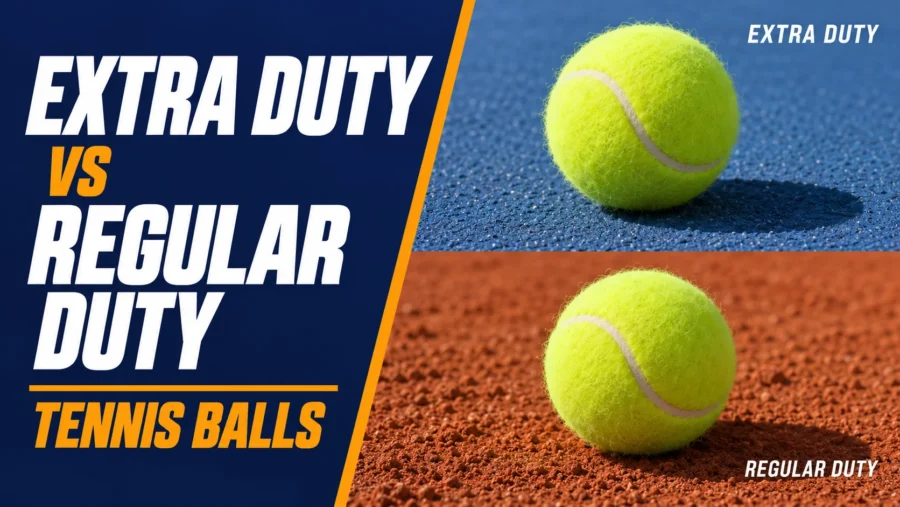
Extra-duty tennis balls are generally the better choice for abrasive hard courts, while regular-duty balls suit clay and many smoother indoor surfaces. The main difference is the felt covering and how it handles wear, loose court material and repeated impacts.
Choose according to the surface beneath your feet, not simply whether you play indoors or outdoors. Extra duty is not a higher quality grade, and it does not automatically mean a ball has more pressure, weighs more or bounces higher.
Extra Duty vs Regular Duty at a Glance
| What matters | Extra duty | Regular duty |
|---|---|---|
| Main purpose | Resist wear on abrasive courts | Perform on softer or less abrasive surfaces |
| Usual starting point | Acrylic hard courts | Clay and suitable indoor surfaces |
| Felt construction | Typically a more substantial, wear-resistant covering | Typically a thinner covering, with construction suited to the intended surface |
| Main trade-off | Can develop an unwanted fluffy feel on a less abrasive court | Can lose feel quickly on a rough hard court |
| Ball quality | Depends on the model | Depends on the model |
| Pressure retention | Depends on the core and product | Depends on the core and product |
The duty label helps narrow the choice, but the manufacturer’s surface recommendation is more useful than the word “extra” alone. Two balls with the same duty designation can still have noticeably different feel and longevity.
What Actually Changes in the Felt?
The felt is the fabric covering bonded around the rubber core. Manufacturers vary its fibers, thickness and construction to influence how the ball performs and wears.
Wilson describes its extra-duty covering as thicker and more loosely woven, allowing it to withstand the shearing action of abrasive courts. Its regular-duty covering is thinner and more tightly woven, helping control fluffing on softer surfaces.
Other manufacturers may emphasize different fiber blends or treatments. Do not assume that every extra-duty ball contains an identical percentage of nylon, or that every regular-duty ball has the same wool content.
“Thicker” and “denser” are also not interchangeable descriptions. A more substantial covering can have a different weave without being more tightly packed.
This distinction matters when comparing prices. A premium regular-duty ball can be designed for demanding match play, while a cheaper extra-duty ball may simply offer an economical hard-court covering.
Which Ball Should You Use on Each Surface?
Abrasive hard courts
Start with extra duty on a typical textured acrylic hard court. Its covering is intended to cope with the repeated rubbing and impacts that remove felt during play.
For example, Penn positions Pro Penn Marathon+ Extra Duty specifically for hard-court use. That is a surface recommendation, not evidence that every extra-duty product lasts longer than every regular-duty product under all conditions.
Regular-duty balls can still be used for recreational hard-court tennis. If you prefer their response, accept that the covering may wear sooner and judge whether the shorter useful playing time is worth it.
Clay courts
Regular duty or a dedicated clay-court ball is the usual starting point. Penn’s Championship Regular Duty is intended for soft courts, including clay, while Dunlop’s ATP Tour Regular Duty is also designed for clay use.
Clay creates a different problem from hard-court abrasion: loose particles can stick to the cloth. A ball may become dirty or change its feel even when the covering has not worn away badly.
Extra-duty balls are not automatically unusable on clay, but they may develop more fluff than you want. If the ball starts feeling cumbersome, compare it with a regular-duty or clay-specific model before assuming the court or your racket setup is responsible.
Indoor courts
An indoor acrylic court can still be abrasive enough to suit extra duty. A roof changes the playing environment, but it does not turn a hard-court coating into a soft surface.
For less abrasive indoor surfaces, regular duty can be appropriate. Dunlop specifically describes its ATP Tour Regular Duty felt as suited to clay and indoor courts with lower abrasion.
Ask the club which ball works well on its particular installation if you are unsure. Understanding how tennis court surfaces differ helps separate the venue’s location from the material that affects the ball.
Grass, synthetic surfaces and mixed use
Regular duty can be a reasonable starting point on natural grass, but follow the recommendation for the actual ball and venue. Specialized grass and synthetic surfaces do not all require the same product.
An all-court ball is another option when you move between surfaces. Dunlop Fort All Court, for example, is marketed for use across court types rather than requiring buyers to choose between regular- and extra-duty versions.
That does not make an all-court ball inferior by definition. Compare how it performs on your courts; the absence of a duty label is not proof that a ball lacks a suitable felt construction.
Are Extra-Duty Balls Slower or Heavier?
Regular-duty balls often feel quicker through the air than extra-duty alternatives, particularly when the latter develop a more pronounced nap. However, the exact model and its condition matter, so the duty label alone cannot predict a fixed speed difference.
Flight speed and bounce height are separate characteristics. Felt influences the ball’s interaction with the air, while the rubber core, pressure, temperature and impact conditions also influence its response.
Nor is extra duty a separate legal weight class. Standard regulation tennis balls fall within the same 56.0–59.4g range, approximately 1.98–2.10oz, regardless of the manufacturer’s duty wording.
A ball that feels “heavy” during hitting is not necessarily heavier on a scale. Conversely, moisture and clay pickup can genuinely affect its mass during use.
Small changes in the covering are part of why players inspect tennis balls before serving. That does not mean choosing one duty type will automatically add a measurable amount of speed to your serve.
Which Type Lasts Longer?
On an abrasive hard court, extra duty usually offers the better starting point for felt durability. But a ball’s useful life has at least two separate limits: the condition of its covering and the quality of its bounce.
Pressurized balls gradually lose gas through the rubber. A durable covering does not prevent that process, so a ball can look healthy while feeling flat.
The reverse can happen too. A ball may still rebound reasonably well but have badly worn, uneven or heavily fluffed felt that makes it unsuitable for a competitive session.
There is no reliable rule that extra-duty balls last twice as long, or that a particular duty label guarantees a set number of matches. Your court, hitting intensity and expectations determine when the change becomes unacceptable.
Replace the set for match play when the balls feel noticeably flat, become inconsistent or develop substantial cover damage. If you keep older balls for solo tennis practice, separate them from your match balls and avoid mixing very different bounce levels in the same drill.
Do Not Confuse Duty With Pressure or Altitude
Extra duty and regular duty describe the surface-oriented covering. Pressurized versus pressureless describes a different aspect of the ball’s construction, while high altitude identifies a separate playing requirement.
A high-altitude ball can also have extra-duty felt. One part of that description addresses the elevated venue, while the other addresses the court surface.
Do not buy a normal extra-duty ball and expect it to solve altitude-related changes in flight and rebound. Follow the event’s ball specification or the recommendation for the particular high-altitude product.
Which Balls Do Professional Tournaments Use?
Professional tennis does not have one universal duty choice. Events use designated balls, and the precise product matters more than a general claim that professionals prefer regular or extra duty.
The ITF’s approval requirements cover measurable properties such as size, mass, rebound, deformation and durability. Passing those requirements does not make all approved balls feel identical, or mean every approved model is suitable for every event.
For tournament preparation, find out the exact ball and version the organizer will supply. A familiar brand name on the can is not enough if its regular-duty and extra-duty versions behave differently on your court.
How to Make the Right Choice Before Buying a Case
Start with the manufacturer’s recommendation for your main surface, then buy a small quantity before committing to a case. The guide to the best tennis balls for each court surface provides model suggestions once you know which type you need.
For a useful comparison:
- Use fresh balls. Comparing a newly opened can with a week-old set confuses felt choice with aging.
- Keep the conditions similar. Use the same court and a comparable session rather than judging one type in cool weather and another in heat.
- Check beyond the warm-up. Notice whether the ball stays consistent as the session progresses.
- Record what ends its useful life. Is the felt wearing out, the ball becoming too fluffy, or the bounce fading while the cover still looks sound?
- Compare cost per satisfactory session. A cheaper can is not necessarily better value if you replace it much sooner.
For most players, extra duty on abrasive hard courts and regular duty on clay or suitable smoother surfaces is the right place to begin. Keep the product that maintains the response you want on your actual court, rather than treating “extra duty” as an automatic upgrade.