
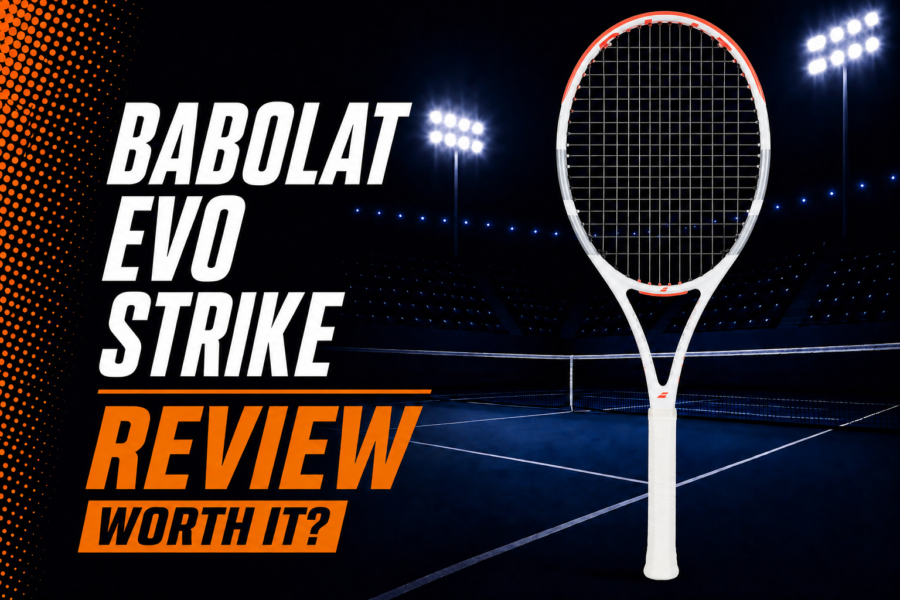
The Babolat EVO Strike Gen2 is the 2024 second-generation, control-oriented model in Babolat’s more accessible EVO family. It combines a 102 in² head, 290 g unstrung weight and 16×19 pattern with a hybrid square-and-elliptical frame shape, aiming to give improving players more precision than the power-focused EVO Drive without the demands of a Pure Strike competition frame.
This exact version is important because Babolat increased the EVO Strike from 280 g to 290 g for Gen2 and retained a 320 mm unstrung balance. It also introduced C² Evo Feel and Flex Adapt alongside the established Control Frame and Woofer systems, so specifications or technology descriptions from the first generation should not be carried over.
The EVO Strike is not a Pure Strike despite the family resemblance in its name and styling. Its larger 102 in² head, lighter finished weight and comfort-oriented construction target recreational intermediates and progressing players with medium to long swings, while the Pure Strike range is built for faster, more competition-focused strokes.
Babolat EVO Strike Gen2 Score
| Category | Score |
|---|---|
| Power | 7.5/10 |
| Spin | 7.5/10 |
| Control | 8.5/10 |
| Comfort | 8/10 |
These scores are editorial estimates based on the racket’s verified specifications, construction, target player and comparison with other modern frames. They describe expected tendencies, not personal testing or guaranteed outcomes, and the string setup and player’s technique can shift each category.
Babolat EVO Strike Gen2 Specifications
| Specification | Details |
|---|---|
| Head size | 102 in² / 660 cm² |
| Length | 27 in / 68.5 cm |
| Unstrung weight | 290 g / 10.2 oz, with stated ±7 g tolerance |
| Strung weight | Approximately 303 g / 10.7 oz, retailer measured |
| Unstrung balance | 32 cm / 12.6 in, with stated ±0.7 cm tolerance |
| Strung balance | Approximately 33 cm / 4 pts head light, retailer measured |
| Swingweight | Approximately 309, strung retailer measurement; Babolat lists 280 without stating the measurement condition |
| Stiffness | Approximately 66 RA, retailer measured; Babolat lists 70 RA with a ±3 tolerance |
| Beam width | 23 mm / 24 mm / 23 mm |
| String pattern | 16×19 |
| Composition | Graphite |
| Recommended tension | 50-55 lb / 23-25 kg |
| Grip | Babolat Syntec Evo |
Babolat publishes the nominal unstrung weight, balance, beam, pattern and material for Gen2. Strung weight, balance, swingweight and measured stiffness are approximate retailer figures, and actual finished specifications vary with factory tolerances, strings, grip size, overgrips, dampeners and protective accessories.
Design, Materials and Technologies
Head Size, Beam and Frame Geometry
The 102 in² head gives the EVO Strike a wider margin around the central contact zone than the 98 and 100 in² heads used by many advanced control rackets. This supports progression when spacing is not perfect, while remaining compact enough to avoid the very high rebound associated with some oversize frames.
Its 23-24-23 mm beam is narrower through the center than the 26 mm middle section of the EVO Drive. That slimmer profile contains some power and supports a more controlled response, but it is still wider and more supportive than a traditional 20 to 21 mm player-frame beam.
Control Frame Technology combines square beam sections, associated with stability and predictable response, with elliptical sections intended to move more dynamically. The result is a geometry positioned between a classic control box beam and a modern power frame rather than a copy of either one.
Weight, Balance and Swingweight
Gen2’s 290 g unstrung weight is 10 g heavier than the first EVO Strike. With strings, retailer samples average about 303 g, giving the frame enough substance for intermediate pace without reaching the 320 g-plus finished weights common in many 305 g competition rackets.
The 320 mm unstrung balance is distinctly head light, and the approximate 309 strung swingweight remains moderate. This distribution should help players prepare the racket and accelerate through contact while retaining enough inertia to keep the face from being displaced by every off-center strike.
The static and dynamic figures serve different purposes. A 303 g strung frame may sound substantial to a beginner, but the head-light balance and moderate swingweight make it easier to move than an equally heavy racket with more mass in the tip.
Materials and Construction
Babolat specifies a graphite construction. Graphite enables the manufacturer to shape flex, stiffness and weight distribution more precisely than a basic aluminum frame, but the material label alone does not establish feel or durability.
The EVO Strike uses a more developed comfort and geometry package than the simpler Boost Strike. It still avoids the advanced layup terminology and heavier specifications of the Pure Strike range, which keeps its design aligned with recreational progress rather than tour-style customization.
String Pattern
The 16×19 pattern provides room for string movement and a medium launch across the 102 in² head. This helps with net clearance and topspin while preserving more control than the unusually open patterns found in some power or beginner rackets.
Pattern count is only part of the response. The spacing within this head, the 24 mm center beam and the Control Frame geometry all influence launch, so the EVO Strike should not be assumed to behave exactly like another 16×19 frame.
Open spacing can increase string movement and wear compared with an 18×20 bed. Players who hit with fast spin should monitor notching and tension loss, particularly when using thin multifilament or natural gut.
Technologies
Control Frame Technology is the central geometry feature. Babolat says the blend of square and elliptical sections is intended to combine stability with a more dynamic response, which reasonably supports the EVO Strike’s middle position between accessible power and directional control.
C² Evo Feel places Babolat’s damping material in four areas of the frame. The manufacturer presents it as a way to absorb more impact energy and improve comfort; it should be understood as a vibration-management feature, not proof that the frame will suit every sensitive player.
Flex Adapt uses different flex characteristics in different frame zones, with extra flexibility through the shaft. Babolat links this to lower perceived impact intensity, though strings and contact quality remain at least as important to the final sensation.
Woofer manages the interaction between frame, grommets and strings. Babolat says the system extends the ball-and-string contact phase for control and comfort, while the practical takeaway is that the bed is designed to move as part of the frame system rather than act like a completely rigid surface.
Babolat EVO Strike Gen2 Performance
Comfort and Feel
The approximately 66 RA retailer measurement is notably lower than the 70 RA nominal figure within Babolat’s stated tolerance. Combined with C² Evo Feel, Flex Adapt and a moderate beam, it suggests a smoother, less rigid finished response than the official unstrung number alone might imply.
The 303 g approximate strung mass also gives the racket more substance at contact than very light recreational frames. It should feel relatively stable when the ball meets the center, though a miss near the edge of the 102 in² bed will still produce sharper feedback and reduced response.
String choice can change the picture completely. Multifilament or natural gut at moderate tension will generally emphasize comfort, while stiff polyester at the top of the range can make the bed feel firm; comfort is subjective, and no racket prevents or treats arm injury.
Comfort score: 8/10
Power
The 102 in² head, 16×19 bed and moderate beam supply useful rebound, so the EVO Strike is not a low-powered traditional player frame. Its head-light balance and approximate 309 swingweight favor acceleration, allowing an intermediate player to create depth without moving a very heavy hoop.
The narrower beam and control geometry restrain power relative to the EVO Drive. Players with medium to long swings should find a balanced response, while short, defensive strokes receive less automatic depth than they would from a wider-beamed power model.
Faster hitters can regulate the response with spin and a controlled string. Beginners with very slow swings may prefer a lighter, more powerful racket even though the EVO Strike has a forgiving head size.
Power score: 7.5/10
Control
Control is the EVO Strike’s defining advantage within the EVO line. The 320 mm unstrung balance, moderate measured stiffness and hybrid frame sections are intended to keep the face manageable and the rebound more predictable than on the EVO Drive.
The 102 in² head and open pattern still produce more launch than a dense 98 in² frame. That offers useful net clearance for improving players, but flatter hitters may need a controlled string and confident follow-through to keep depth consistent.
Directional accuracy ultimately depends on repeatable face angle, contact point and footwork. The EVO Strike provides a more controlled platform for those skills, not an automatic correction for rushed technique.
Control score: 8.5/10
Spin
The 16×19 bed gives strings enough room to move, and the approximate 309 swingweight is low enough for many intermediates to accelerate. These characteristics support topspin and slice without making the frame a dedicated high-launch spin specialist.
Players with a steep low-to-high path can use the 102 in² contact area to create safe net clearance. A smooth, lower-friction string or hybrid can assist snapback, but heavy spin still comes from swing speed and contact mechanics.
Spin score: 7.5/10
Maneuverability
The head-light 320 mm unstrung balance helps the 290 g frame move quickly enough for groundstroke preparation, serves and reaction volleys. Its approximate 309 swingweight is moderate and should be accessible to many adult intermediates.
It is less effortless to swing than the 270 g EVO Drive or a Boost Aero, especially late in a session. That extra weight is part of the stability-and-control tradeoff, so a player should confirm that it improves timing rather than causing the stroke to shorten.
Stability
At around 303 g strung, the EVO Strike carries more mass than most ultralight recreational frames. Control Frame geometry and the moderate swingweight are intended to keep the face composed through ordinary intermediate pace and controlled volleys.
It will not resist heavy incoming balls like a 320 g-plus frame with a much higher swingweight. Off-center contact still loses energy and can twist the hoop, although the 102 in² head provides a useful chance of staying within the responsive string area.
Performance by Shot
Groundstrokes
From the baseline, the EVO Strike suits medium to long swings that mix topspin with directional changes. The 16×19 pattern supplies enough arc for rally safety, while the head-light balance lets the player accelerate without the frame feeling excessively tip-heavy.
Flatter forehands and backhands benefit from the more contained beam and control geometry, provided the face is stable. Topspin strokes have useful margin, though they will not launch as aggressively as those from a dedicated spin frame.
On defense, the 102 in² head helps imperfect contact and the 303 g finished weight can redirect moderate pace. When the player is badly late, the EVO Drive’s lighter, more power-focused profile would be easier to flick back into the court.
Serves
The standard 27 in length and head-light balance favor a smooth service motion. The 16×19 pattern supports slice and kick variation, while the approximate 309 swingweight provides enough momentum for pace when the player completes the kinetic chain.
It is more placement-oriented than explosive. Servers who generate their own acceleration can aim confidently, but those relying on the frame for free speed may prefer the wider beam of an EVO Drive or Pure Drive family model.
Volleys and Net Play
The EVO Strike’s head-light distribution helps position the face during quick exchanges. Its 102 in² head offers more reaction margin than a 98 in² performance racket, and the strung mass supports controlled punch volleys.
C² Evo Feel and Flex Adapt are designed to manage the response on imperfect contact, but touch remains dependent on the string bed and the player’s hands. The moderate swingweight strikes a practical balance between quick movement and sufficient blocking stability.
Returns
The racket should be quick enough for compact first-serve returns and substantial enough to redirect ordinary pace. A head-light balance assists the short takeback, while the controlled launch helps keep blocks and drives from floating unpredictably.
Against second serves, the 16×19 bed supports a topspin attack or angled return. Players facing very heavy pace may want a higher swingweight, while players who are consistently late may benefit more from lower overall mass.
String and Setup Considerations
Babolat recommends Xcel or AddiXion, both choices that align with the frame’s accessible, comfort-aware target. A multifilament can add depth and soften the impact response, making it a practical default for recreational and improving players.
Synthetic gut offers a balanced, lower-cost option with moderate power and feel. Natural gut provides the greatest elasticity and tension maintenance, while its cost and sensitivity to abrasion may be unnecessary for players who are still determining preferences.
Fast-swinging intermediates can use polyester for lower launch, spin control and durability, but a full bed is not mandatory. A softer polyester, thinner gauge or hybrid with multifilament or natural gut can reduce firmness while preserving some snapback and control.
The Tennis String Finder can help compare materials by comfort, control, spin and durability. Use the Tennis String Tension Calculator for a general starting point within the verified 50-55 lb / 23-25 kg range, then refine gradually based on depth and impact response.
The open pattern may increase movement and notching, so string condition should be checked regularly. A sudden change in launch, excessive fraying or a dead, unresponsive feel can justify restringing even before visible breakage.
Build Quality and Durability
The graphite hoop and shaft are protected by a bumper at the top and grommets through the string holes. These replaceable components take much of the routine abrasion that would otherwise reach the frame or cut into string.
Normal use can produce paint scratches, chips and worn bumper edges. These marks are generally cosmetic, but the frame should be inspected more closely if a line crosses into the graphite, expands under string tension or follows a major impact.
Grommets can split or flatten during repeated restringing. A sharp or missing grommet should be replaced because direct contact between string and graphite can cause premature failure.
Replacement parts must match EVO Strike Gen2 rather than the first-generation EVO Strike, Pure Strike or Boost Strike. If the frame develops a crack, soft spot, unusual noise or separation around the handle, it should be assessed before further use.
Who Should Use It?
The EVO Strike Gen2 best suits progressing recreational players and intermediates with medium to long swings. It is for players who want more directional control and mass than a lightweight power frame, but who still benefit from a 102 in² head and moderate swingweight.
All-court intermediates, doubles players and balanced baseliners are natural fits. The frame supports topspin, flatter drives, volleys and serve placement without forcing the player into one highly specialized style.
It is also a logical transition racket for an adult moving beyond an ultralight beginner model. The player should be able to swing approximately 303 g repeatedly and value the added stability enough to accept slightly less effortless preparation.
Who Should Avoid It?
New beginners, juniors moving into a first adult frame and players with very compact swings may find 290 g unstrung more than necessary. A 255 to 275 g EVO or Boost model can provide quicker handling and easier defensive acceleration.
Advanced players who create high pace may want the smaller head, stronger control and higher swingweight of a Pure Strike. The EVO Strike’s 102 in² bed and accessible power can become too lively for very fast, flat swings.
Players seeking maximum free power should consider the EVO Drive or Pure Drive line. Those seeking maximum spin assistance should compare an EVO Aero, while anyone prioritizing an exceptionally plush response should evaluate strings and other comfort-focused frames rather than relying on technology names alone.
Pros and Cons
| Pros | Cons |
|---|---|
| Strong control-to-forgiveness balance for intermediates | Less free power than EVO Drive Gen2 |
| Head-light balance supports preparation | 290 g unstrung can be demanding for beginners |
| C² Evo Feel and Flex Adapt target a smoother response | Larger head launches higher than advanced control frames |
| Moderate swingweight suits varied all-court play | Not as stable against heavy pace as a competition racket |
Babolat EVO Strike Gen2 Compared With Similar Rackets
The Babolat Evo Drive Review covers the power-focused EVO alternative. EVO Drive Gen2 is 20 g lighter, has a wider 26 mm center beam and uses Air Handle Touch; it is quicker and easier to power, while EVO Strike Gen2 is more head light, more substantial and more controlled.
The Babolat Boost Strike Review describes a simpler, pre-strung option with a similar 102 in² head. The 2024 Boost has a more forward 330 mm balance and higher approximate strung swingweight despite being 5 g lighter unstrung, while EVO Strike adds Control Frame, C² Evo Feel and Flex Adapt for a more refined intermediate profile.
The Babolat Pure Strike Team Racket Review is the logical performance step. Pure Strike Team uses a smaller 100 in² head and competition-oriented construction for faster swings and tighter targeting, whereas EVO Strike provides greater margin and a lower technical entry point.
The Babolat Pure Drive Team 2025 Review covers a firmer, more power-driven 285 g alternative. Pure Drive Team offers easier explosive depth and a smaller 100 in² head, while EVO Strike favors controlled response, a 102 in² contact area and more comfort-oriented frame technologies.
Final Verdict
The Babolat EVO Strike Gen2 is a thoughtfully positioned intermediate racket that balances a forgiving 102 in² head with a head-light 290 g frame and control-focused geometry. Its moderate measured stiffness, C² Evo Feel and Flex Adapt features distinguish it from both the simpler Boost Strike and the more power-driven EVO Drive.
Its strengths are versatility, accessible directional control, useful spin and a finished weight that provides substance without reaching full player-frame territory. Its limits are lower free power than EVO Drive, greater physical demand than lightweight beginner frames and less precision or heavy-ball stability than a Pure Strike.
For a progressing player who wants one racket for baseline rallies, serves, returns and net play, EVO Strike Gen2 is the most balanced EVO choice. The main consideration is whether the player can move its approximately 303 g strung weight comfortably enough to benefit from the added control.
Frequently Asked Questions
Is the Babolat EVO Strike Gen2 suitable for beginners?
It can suit a strong, athletic beginner, but most new players will find a lighter EVO or Boost model easier. Its 290 g unstrung weight is aimed more directly at progressing recreational players and intermediates.
Is the EVO Strike Gen2 designed more for power or control?
It emphasizes control within the EVO family while retaining moderate power. The 102 in² head and 16×19 pattern add depth, while the narrower beam and Control Frame geometry keep the response more contained than EVO Drive.
Is the EVO Strike Gen2 comfortable?
Its approximately 66 RA measured stiffness and damping or flex technologies suggest a relatively smooth intermediate-frame response. Comfort remains subjective and depends strongly on strings, tension, grip size, technique and contact quality.
How is Gen2 different from the first EVO Strike?
Gen2 increases nominal unstrung weight from 280 g to 290 g and adds C² Evo Feel and Flex Adapt alongside refined frame sections. It is more substantial and designed for greater control and stability.
Can the EVO Strike Gen2 generate spin?
Yes. The 16×19 bed and moderate swingweight support topspin and slice, but it is a balanced control frame rather than a dedicated high-launch spin racket.
How demanding is its swingweight?
The approximate strung swingweight of 309 is moderate for an adult racket. It is accessible to many intermediates but less effortless than the lighter EVO Drive Gen2.
What strings suit the EVO Strike Gen2?
Multifilament and synthetic gut are sensible accessible choices, while natural gut provides maximum elasticity. Faster swingers can use a softer polyester or hybrid for lower launch and added durability without automatically choosing a firm full-polyester bed.