
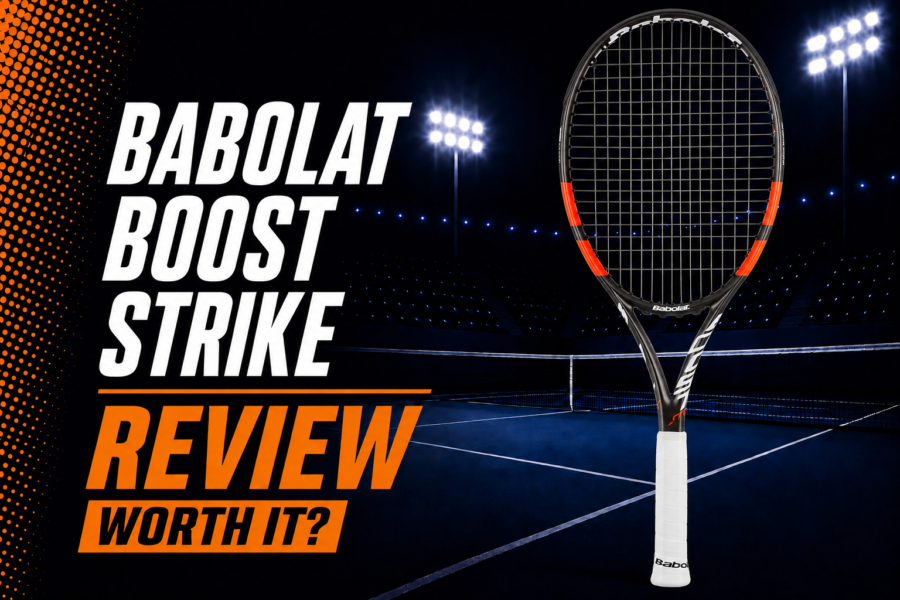
The Babolat Boost Strike reviewed here is the 2024, 285 g generation of Babolat’s pre-strung graphite racket for beginners, returning players and developing intermediates. It uses a 102 in² head, 16×19 pattern and 23-26-23 mm beam to prioritize accessible depth and straightforward handling at a lower technical threshold than Babolat’s Pure Strike performance family.
Generation identification matters because the previous Boost Strike weighed 280 g unstrung and had a 325 mm balance. Babolat’s current 2024 technical listing specifies 285 g and 330 mm, so measurements and conclusions from the older red-and-black version should not be mixed into this review.
Despite the Strike name and red detailing, this is not a Pure Strike and it is not the EVO Strike Gen2. The Boost Strike has a simpler graphite and Woofer construction, arrives pre-strung in most markets and targets easier recreational progression rather than the faster, fuller swings expected by Babolat’s competition rackets.
Babolat Boost Strike 2024 Score
| Category | Score |
|---|---|
| Power | 8/10 |
| Spin | 7.5/10 |
| Control | 7/10 |
| Comfort | 7.5/10 |
These scores are editorial estimates based on the verified 2024 specifications, construction, intended player and comparison with the wider racket market. They indicate relative strengths rather than tested guarantees, and strings, tension, swing mechanics and contact quality can change the result significantly.
Babolat Boost Strike 2024 Specifications
| Specification | Details |
|---|---|
| Head size | 102 in² / 660 cm² |
| Length | 27 in / 68.5 cm |
| Unstrung weight | 285 g / 10.1 oz, with stated ±7 g tolerance |
| Strung weight | Approximately 300 g / 10.6 oz, retailer measured |
| Unstrung balance | 33 cm / 13.0 in, with stated ±0.7 cm tolerance |
| Strung balance | Approximately 34 cm / 1 pt head light, retailer measured |
| Swingweight | Approximately 313, strung retailer measurement; Babolat lists 290 without stating the measurement condition |
| Stiffness | Approximately 68 RA, retailer measured; Babolat lists 70 RA |
| Beam width | 23 mm / 26 mm / 23 mm |
| String pattern | 16×19 |
| Composition | Graphite |
| Recommended tension | 50-55 lb / 23-25 kg |
| Grip | Babolat Syntec Uptake |
Babolat’s technical table provides the nominal unstrung weight, balance, beam and pattern, while approximate finished measurements come from retailer data for the same 2024 generation. Actual strung weight, balance and swingweight vary with manufacturing tolerances, the factory string, replacement strings, grip size, overgrips and dampeners.
Design, Materials and Technologies
Head Size, Beam and Frame Geometry
The 102 in² head provides more hitting area than a typical 98 or 100 in² performance frame without becoming a very large oversize design. It gives a beginner or returning player useful margin around the center and makes the racket less exacting when contact changes slightly from swing to swing.
The beam widens from 23 mm at the tip and shaft to 26 mm through its broadest section. That variable profile is designed to supply more stiffness and rebound than a thin box beam, supporting depth when the player has not yet developed a consistently fast swing.
The frame is standard 27 in length, so it does not gain power by adding reach or leverage. This keeps spacing familiar and avoids the extra swingweight that often accompanies extended rackets.
Weight, Balance and Swingweight
Babolat increased this generation from 280 g to 285 g unstrung and shifted the nominal balance from 325 mm to 330 mm. Those changes place a little more mass into the system and farther from the hand, which can support depth and face stability but also make the current model more substantial than its predecessor.
At approximately 300 g strung and 313 swingweight, the 2024 Boost Strike is not an ultralight adult racket. It remains manageable for many developing players, but the nearly even finished balance means it can feel more present through the hoop than a similarly weighted, strongly head-light frame.
Swingweight explains why the word light needs context. A 285 g unstrung frame can still carry moderate rotational inertia, so players should judge preparation speed through actual swings rather than the static number alone.
Materials and Construction
The frame is made from graphite rather than the aluminum or fused composite construction found in some inexpensive beginner rackets. Graphite allows the manufacturer to tune weight distribution and stiffness more precisely, but it does not automatically make the Boost Strike equivalent to the more complex layups in Babolat’s Pure lines.
The construction is intentionally simple. Babolat verifies graphite and the Woofer grommet system, but does not list the vibration-damping systems, multi-material layups or control-frame technologies used in the EVO and Pure Strike families.
String Pattern
The 16×19 pattern provides a relatively open bed across 102 in². This geometry supports a medium-to-high launch, accessible net clearance and useful string movement, all of which can help a developing player create depth without forcing every swing.
Spin still requires an upward or across-the-ball path. The open pattern makes that technique easier to express, but it cannot generate heavy topspin when the racket face and swing direction do not create rotation.
Strings may move and notch more quickly than in a compact 18×20 frame. Factory synthetic string offers a practical starting point, though frequent players should monitor tension loss, fraying and notching rather than waiting for the string to break.
Technologies
Woofer is Babolat’s frame-to-string interaction system around the grommets. The manufacturer says it allows a longer ball-and-string contact phase to support control and comfort; a reasonable construction-based interpretation is that the grommet response lets the bed move less rigidly than a completely fixed string path.
Woofer does not turn the Boost Strike into a soft frame by itself. The official 70 RA figure and approximate 68 RA retailer measurement indicate a fairly firm base construction, so string type and tension remain central to impact feel.
The absence of a long technology list is not necessarily a disadvantage for the target player. The important design elements are the graphite frame, variable beam, moderate swingweight, open bed and replaceable grommet protection, all of which have a clearer effect on use than unverified marketing language.
Babolat Boost Strike 2024 Performance
Comfort and Feel
The 102 in² head and Woofer system should give the bed a reasonably forgiving central response, while the approximately 68 RA measured stiffness points toward a crisp, relatively firm frame. It is likely to feel more direct than an EVO model built with dedicated handle or frame damping.
The approximately 300 g strung weight can help the frame resist being pushed backward at contact, which may feel more composed than an ultralight racket. That mass does not guarantee comfort, particularly when the ball meets the outer edge or the factory string has lost elasticity.
A synthetic gut or multifilament at a moderate tension will generally produce a softer setup than a full bed of firm polyester. Comfort depends on technique, timing, string, tension, grip size and the individual player, and the Boost Strike cannot prevent or treat arm discomfort.
Comfort score: 7.5/10
Power
Power is one of the Boost Strike’s main priorities. The 102 in² head, 26 mm center beam, open pattern and approximate 313 swingweight work together to produce easier depth than a compact, thin-beamed control racket.
The 2024 increase in weight and balance can add momentum when the player starts the swing early. It does not make power effortless on every shot, because late preparation with a moderate swingweight can leave the face behind the ball.
Compared with a Pure Drive, the Boost Strike uses a simpler construction and is not designed for the same advanced-speed response. It nevertheless gives beginners and returning players a useful platform for reaching the back court without needing tour-level acceleration.
Power score: 8/10
Control
The moderate weight and standard length help the player keep the face organized, while the 102 in² head provides a generous central area. Directional control is sufficient for developing rally patterns, but the open bed and wider beam produce more launch variation than a dense control frame.
Control will improve as the player develops repeatable spacing, swing direction and face angle. The racket can support that process, but its power-oriented geometry cannot replace technique or make rushed contact precise.
Faster intermediates may eventually find the response too lively or the near-even balance less quick than preferred. A more head-light 98 to 100 in² performance racket becomes relevant once the player consistently supplies pace and needs a lower launch.
Control score: 7/10
Spin
The 16×19 bed and 102 in² head provide useful space for string movement. A developing topspin swing should receive enough launch and net clearance to make brushing contact easier to repeat.
The approximate 313 swingweight gives the ball useful mass behind the spin, but the player must accelerate it. Players who want an even faster, more aerodynamically spin-focused frame may prefer a lighter Boost Aero, while the Boost Strike offers a more balanced power-and-control profile.
Spin score: 7.5/10
Maneuverability
The Boost Strike remains manageable for its intended audience, but it is no longer the 280 g, 325 mm model. Its 285 g unstrung weight, 330 mm balance and approximate 313 swingweight make it more substantial than many beginner rackets.
That can be beneficial for steady groundstrokes and blocks, yet players with limited strength or compact preparation may prefer a lower swingweight. The most useful test is whether the player can set the racket early and maintain the same swing after repeated games.
Stability
The extra five grams, more forward nominal balance and variable beam are intended to increase support relative to the older generation. The approximate 313 swingweight should resist moderate incoming pace better than an ultralight frame, especially on contact near the center.
A 102 in² head still twists when the ball meets the outer edge, and graphite construction alone does not eliminate that. Against advanced pace, the Boost Strike offers less torsional reinforcement and precision than a heavier performance model.
Performance by Shot
Groundstrokes
On forehands and backhands, the Boost Strike should help developing players create rally depth from medium swings. The head size and open pattern provide net clearance, while the finished mass rewards early preparation with a more stable path through contact.
Topspin groundstrokes fit the 16×19 layout, and flatter drives remain available when the player closes the face and swings through the target. Very fast swings may expose the higher launch, so improving players can use a more controlled string before assuming a new racket is necessary.
Defensive shots benefit from the lively head and moderate inertia, but a hurried wrist flick will not move the approximate 313 swingweight as easily as a 275 to 290 swingweight beginner frame. The player needs enough time to get the hoop behind the ball.
Serves
The standard length and open pattern support learning flat, slice and topspin serve shapes. The nearly even finished balance can add useful momentum through contact when the motion stays continuous.
Players with slower service motions may not exploit all of that inertia and could serve faster with a lighter frame. Placement should develop as toss and face control improve, while the racket supplies enough rebound to avoid forcing the motion solely for pace.
Volleys and Net Play
The 102 in² face is helpful during reaction volleys because it offers more area than a 98 in² player frame. The moderate mass supports punch volleys and blocks when the racket is prepared in front.
Its balance is less head light than many advanced all-court frames, so rapid face changes may feel slower in very quick doubles exchanges. Compact technique is more effective than taking a large backswing at the net.
Returns
The Boost Strike can block moderate first-serve pace with useful depth because of its strung mass and swingweight. Against second serves, the open bed gives a developing player enough launch to roll the return cross-court or through the middle.
Reaction speed is the tradeoff. Players who struggle to set the racket before contact may find a lighter Boost model easier, while those who prepare early can benefit from the 2024 frame’s added substance.
String and Setup Considerations
Most Boost Strike frames arrive pre-strung with a basic synthetic string, which is appropriate for an initial setup. The player can learn the racket’s launch and depth before replacing a usable factory bed purely for specification reasons.
Synthetic gut offers balanced power, feel and cost, while multifilament can add elasticity and a softer response. Natural gut provides excellent rebound and tension maintenance but may be difficult to justify for a beginner-oriented frame unless comfort and playability are priorities.
Full polyester is rarely necessary for a new or occasional player. A fast-swinging intermediate who breaks soft strings can consider a softer polyester or hybrid, but a stiff dead poly may reduce power and comfort without delivering a meaningful benefit at lower racket-head speed.
The Tennis String Finder can narrow materials according to comfort, spin, control and durability. The Tennis String Tension Calculator gives a general starting point, while the frame’s verified 50-55 lb / 23-25 kg range and the selected string’s behavior should guide the final choice.
The open pattern may wear multifilament or natural gut faster than a dense bed. Check for deep notching, fraying and sudden launch changes, and restring when the response becomes inconsistent rather than judging only by visible breakage.
Build Quality and Durability
The full graphite frame offers a more refined weight-to-stiffness structure than many aluminum beginner rackets. It is still vulnerable to impact damage and should not be scraped or struck against the court unnecessarily.
A bumper protects the top edge, and individual grommets shield the string from the frame holes. These parts wear through contact and stringing, but compatible replacement bumper-and-grommet sets can restore protection when the exact 2024 part is available.
Grey and red paint can chip or scuff without compromising the structure. A surface mark is different from a crack that travels into the graphite, an opening seam or an area that flexes abnormally under light pressure.
Inspect the frame and grommets whenever it is restrung and after a major collision. Do not continue using a racket with a suspected structural crack until it has been assessed, because string tension places a continuous load on the hoop.
Who Should Use It?
The 2024 Boost Strike is best for adult beginners, returning players, recreational competitors and early intermediates who want a graphite frame with more substance than an ultralight starter racket. It favors medium swing lengths and players who want easy depth, a useful contact area and a familiar 16×19 trajectory.
It can be especially suitable for a physically capable beginner who expects to progress and does not want to replace an extremely light frame quickly. The approximate 313 swingweight offers room to grow, provided the player can prepare it comfortably.
All-court recreational players can use it from the baseline, on serve and at net without the racket becoming highly specialized. Its strongest preferences are power and versatility rather than maximum precision, maximum spin or exceptionally soft feel.
Who Should Avoid It?
Players who need the quickest possible adult frame may find the 285 g unstrung weight and forward balance too demanding. A Boost Aero or lighter EVO model with lower swingweight would be easier to set during short swings and reaction shots.
Advanced, fast-swinging players may find the 102 in² head and wide beam too lively, while the simpler construction offers less tuned feedback than a competition model. They should consider a more head-light Pure Strike, Pure Aero or Pure Drive version matched to their preferred launch and power.
Players seeking the softest response should compare the EVO families with dedicated damping technologies. The Boost Strike’s Woofer system adds string-bed movement, but the frame itself is still relatively firm by measured stiffness.
Pros and Cons
| Pros | Cons |
|---|---|
| 102 in² head gives developing players useful margin | Current generation is more demanding than the older 280 g model |
| Variable beam and open pattern provide accessible depth | Nearly even strung balance can slow rapid preparation |
| Full graphite construction at a beginner-friendly level | Simpler feel and damping package than EVO models |
| Moderate swingweight offers room for progression | Fast hitters may want a lower launch and greater precision |
Babolat Boost Strike 2024 Compared With Similar Rackets
The Babolat EVO Strike Review covers the closest control-oriented progression option. EVO Strike Gen2 is only 5 g heavier unstrung but has a more head-light 320 mm balance, lower measured stiffness and Control Frame, C² Evo Feel and Flex Adapt technologies; it is more precise and refined, while the Boost is simpler and easier to buy ready-strung.
The Babolat Evo Drive Review describes a lighter, more comfort-focused alternative. EVO Drive Gen2 weighs 270 g unstrung, uses Air Handle Touch and is easier to accelerate, whereas the Boost Strike’s higher swingweight and near-even balance can provide more substance against pace.
The Babolat Boost Aero 2026 Review is relevant for a beginner who prioritizes speed and spin. Boost Aero is lighter and more maneuverable, while Boost Strike 2024 carries more mass, a less spin-specialized geometry and greater emphasis on balanced power and control.
The Babolat Pure Strike Team Racket Review covers a competition-oriented step up. Pure Strike Team has a smaller 100 in² head and more advanced layup, favoring faster swings and tighter targeting; the Boost Strike offers a larger contact area and a less demanding entry point.
Final Verdict
The Babolat Boost Strike 2024 is a substantial beginner-to-intermediate graphite racket built around a 102 in² head, 16×19 pattern and easy-depth beam. Its 285 g unstrung weight and approximate 313 strung swingweight give it more stability and progression potential than an ultralight starter frame.
That added substance is also the main limitation. The current version is not as quick as the older 280 g model or lighter Boost alternatives, and its relatively firm, simple construction does not provide the damping or precision of the EVO and Pure Strike lines.
It makes the most sense for a developing adult who can handle the swingweight and wants an uncomplicated, pre-strung graphite racket for varied recreational play. Before choosing it, confirm that the current 285 g generation moves comfortably, because the older model’s reputation for extreme maneuverability does not fully describe this update.
Frequently Asked Questions
Is the Babolat Boost Strike 2024 suitable for beginners?
Yes, especially for physically capable adult beginners who want a graphite racket with room to progress. Smaller or less strong players may prefer a lighter model with lower swingweight.
Is the Boost Strike designed more for power or control?
It leans toward accessible power while retaining adequate recreational control. The 102 in² head, 26 mm center beam and open pattern help depth, while the 2024 weight increase adds some face stability.
Is the Boost Strike comfortable?
Woofer is designed to let the string bed interact more with the frame, but the measured stiffness remains fairly firm. Comfort depends on string material, tension, technique, grip size and the individual player.
How is the 2024 Boost Strike different from the older version?
The current generation increases nominal unstrung weight from 280 g to 285 g and balance from 325 mm to 330 mm. It therefore offers more substance but can feel less immediately quick than its predecessor.
Can the Boost Strike generate spin?
Its 16×19 pattern and 102 in² head provide useful spin access. The player still needs an appropriate swing path and racket-head speed to produce meaningful topspin or slice.
How demanding is its swingweight?
The approximate strung swingweight of 313 is moderate, not ultralight. Many adult beginners can manage it, but players with short preparation should compare lower-swingweight alternatives.
What strings work well in the Boost Strike?
Synthetic gut is a balanced default, while multifilament can add comfort and power. Polyester is better reserved for faster hitters who need control or durability, preferably after considering a softer option or hybrid.