
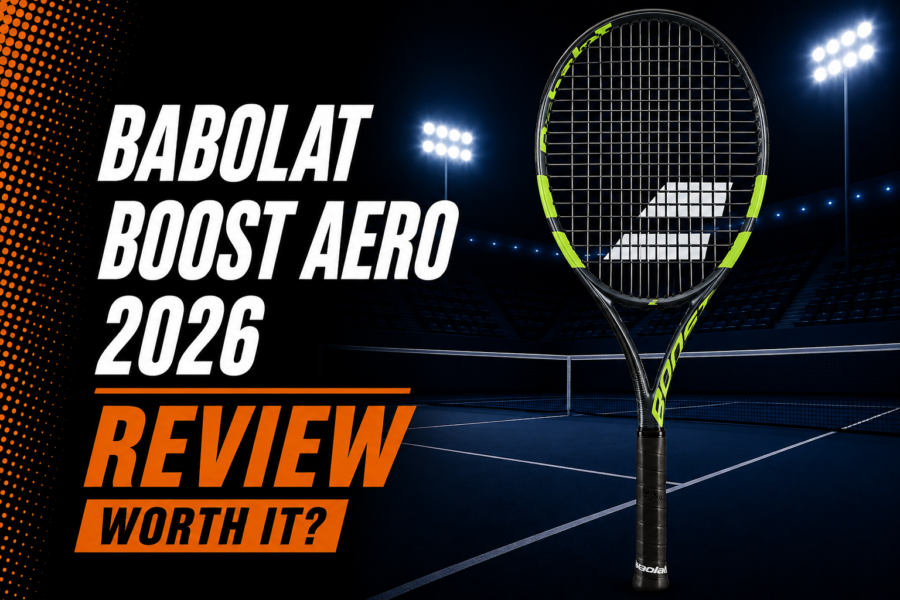
The Babolat Boost Aero 2026 is a pre-strung, full-size graphite racket created for beginners, casual adults and juniors progressing to a 27 in frame. The exact standard version uses a grey and fluorescent-yellow cosmetic, a 660 cm² / 102 in² head, 260 g / 9.2 oz official unstrung weight and a 16×19 string pattern.
This model sits in Babolat’s accessible Boost range rather than the competition-focused Pure Aero family. Its appearance is inspired by the Pure Aero Gen9, but its specifications and technology package are different: the Boost Aero is lighter, more forgiving and equipped with the Woofer System, without the Pure Aero’s full performance construction.
The standard 2026 model shares its mold and published specifications with the Boost Aero Pink 2026. The distinction is cosmetic, so players choosing between those two versions should select the color they prefer rather than expecting a different level of power, spin or control.
Babolat Boost Aero 2026 Score
| Category | Score |
|---|---|
| Power | 8/10 |
| Spin | 8/10 |
| Control | 7/10 |
| Comfort | 7.5/10 |
These scores are editorial estimates based on the Boost Aero 2026’s verified specifications, construction, intended player profile and market position. They describe its likely performance relative to other adult rackets and remain dependent on the player’s technique and complete string setup.
Babolat Boost Aero 2026 Specifications
| Specification | Details |
|---|---|
| Head size | 660 cm² / 102 in² |
| Length | 685 mm / 27 in |
| Unstrung weight | 260 g / 9.2 oz, official tolerance ± 7 g |
| Strung weight | Approximately 275 g / 9.7 oz, retailer-measured |
| Unstrung balance | 34 cm / 13.4 in, official tolerance ± 7 mm |
| Strung balance | Approximately 344.9 mm / 1 point head heavy, retailer-measured |
| Swingweight | 275 official listed figure with string state not specified; approximately 312 strung, retailer-measured |
| Stiffness | 68 RA, official tolerance ± 3; approximately 65 RA strung, retailer-measured |
| Beam width | 23 mm / 26 mm / 23 mm |
| String pattern | 16×19 |
| Composition | Graphite |
| Recommended tension | 23-25 kg / 51-55 lb |
| Grip | Babolat Syntec Uptake |
Babolat’s weight and balance figures are unstrung and include manufacturing tolerances. Retailer measurements provide a useful approximate picture of the finished frame, but strings, gauge, grips, accessories and normal production variation can alter strung weight, balance and swingweight.
Design, Materials and Technologies
Head Size, Beam and Frame Geometry
The 660 cm² / 102 in² head is slightly larger than the 100 in² heads used by most Pure Aero performance models. It gives developing players additional area around the center and can help maintain depth when timing or footwork produces less-than-perfect contact.
At 23 mm / 26 mm / 23 mm, the variable beam is broadest through the central hoop. That shape supports energy return and a stable-feeling throat-to-hoop transition, emphasizing accessible pace rather than the low-powered feedback of a narrow control beam.
The 102 in² head remains compact enough to teach normal adult-racket spacing. It is not an extreme oversize design, so the model combines useful forgiveness with a shape that can remain familiar as a player advances.
Babolat states that the visual design draws inspiration from Pure Aero Gen9. That statement concerns the model’s design language and should not be converted into a claim that it has the same aerodynamic shaft, layup or grommet technologies as the Pure Aero.
Weight, Balance and Swingweight
An official unstrung weight of 260 g / 9.2 oz makes the Boost Aero approachable for players learning full strokes. It supports early preparation, defensive reach and recovery between shots without requiring the strength needed to repeat swings with a much heavier frame.
The 340 mm official unstrung balance is close to the center of a 27 in racket. After stringing, a retailer sample measured 344.9 mm and 1 point head heavy, showing how strings in the hoop can shift the finished balance forward.
The difference between static weight and swingweight matters here. Although the frame is light, the same retailer sample measured about 312 strung swingweight, so the head carries useful momentum and may feel more substantial through contact than the 260 g label suggests.
This configuration can help power and stability on a centered strike, but it slightly reduces the ultra-quick pivoting associated with low-swingweight, head-light rackets. Players should assess repeated overhead and groundstroke acceleration rather than judging handling from static weight alone.
Materials and Construction
Babolat lists the frame as graphite. For an entry-level adult racket, graphite construction offers a more tunable and performance-oriented structure than basic aluminum frames, while keeping total weight low enough for its target audience.
The official specification does not list flax fibers, HTR reinforcement or other materials used in Babolat’s Pure ranges. Adding those claims would confuse this exact Boost model with more expensive families and would not be supported by the manufacturer page.
The racket is sold strung, but the official page does not make the factory string’s identity a central specification. Factory string is suitable for initial recreational play, yet restringing with a known material and tension may produce a more predictable setup after the original bed loses tension.
String Pattern
The 16×19 pattern provides space for string deflection and movement, helping the ball leave on a moderately high trajectory. In a 102 in² head, it supports easy depth and gives a developing player room to shape topspin when the swing travels upward through contact.
Spin does not result from the pattern alone. The player must generate sufficient head speed and brushing contact, while string surface, snapback, tension and wear all influence how much rotation reaches the ball.
An open pattern can also move and notch strings more quickly, particularly once the player begins swinging faster. A thicker gauge may improve durability, but it can alter response and comfort, so gauge should be chosen alongside material and tension.
Technologies
Woofer System is the verified technology on the current Boost Aero. Babolat describes it as a frame-and-string interaction design that extends ball-and-string contact, with the intended benefits of added control and comfort.
The practical inference is that the grommet interface allows the string bed to play an active role in energy return and response. The effect cannot be separated from the installed string, and it does not guarantee that a firm, worn or highly tensioned bed will suit every player.
The Boost Aero should not be credited with Spin Alpha, Air Handle Touch, Evo Flax, FSI Spin or NF²-Tech solely because related Babolat models use those names. Its simpler technology package is part of how it remains an accessible Boost model.
Babolat Boost Aero 2026 Performance
Comfort and Feel
The official 68 RA figure, with a ± 3 tolerance, indicates a moderately firm frame, while a retailer sample measured approximately 65 RA after stringing. That is not exceptionally stiff, but the low total mass means off-center impact may still transmit more reaction than it would through a substantially heavier racket.
The 102 in² head and Woofer System can make central contact more forgiving, particularly with a soft factory-style string or multifilament. Comfort is subjective and depends on technique, strings, tension, grip size and the individual player, so light weight should never be treated as proof of a gentle response.
Comfort score: 7.5/10
Power
The Boost Aero produces accessible pace through its broad beam, forgiving head and head-present finished balance. The approximate 312 retailer-measured strung swingweight supplies more momentum than the static weight implies, helping compact and medium swings reach useful depth.
Players with fast, long swings may need extra spin or a lower-powered string to manage the launch. The racket is built to reduce the effort needed by its target audience, not to provide the restrained response that an advanced hitter often wants.
Power score: 8/10
Control
Control is oriented toward rally consistency. The 102 in² head offers a dependable contact area and the moderate flex measurement helps avoid an excessively abrupt response, so developing players can focus on repeating a sound path.
The open pattern and lively beam provide less absolute precision than a smaller, denser or heavier control frame. Direction still comes from face angle and timing, and a fast flat hitter may find the launch window broader than preferred.
Control score: 7/10
Spin
The 16×19 pattern and low static weight support the racket-head speed needed for topspin and slice. The head is large enough to provide useful margin while a player learns to brush the ball and create safer net clearance.
The measured swingweight means the frame is not automatically effortless for every user, and no cosmetic inspiration can create rotation without technique. When the player accelerates effectively, however, the open bed offers a suitable platform for developing a spin-based game.
Spin score: 8/10
Maneuverability
At 260 g unstrung, the Boost Aero is easy to lift, prepare and recover relative to common 300 g performance frames. This supports late adjustments, compact returns and quick doubles exchanges, especially for players still building strength.
Its approximate 312 strung swingweight and slightly head-heavy measured balance give the hoop more presence than an ultra-light, head-light alternative. The result is a compromise between quick static handling and enough rotational mass to prevent the frame from stopping too easily on ordinary rally balls.
Stability
The 26 mm central beam and head-biased finished balance contribute to stability along the direction of the swing. A centered ball can benefit from the measured swingweight, giving the Boost Aero better follow-through than its low static mass might suggest.
Twisting on peripheral impact remains a potential limitation because total strung mass is only about 275 g and verified twistweight is unavailable. Against heavy pace, a heavier performance frame will generally provide more resistance to displacement, so the Boost Aero rewards early contact and compact blocking technique.
Performance by Shot
Groundstrokes
On groundstrokes, the Boost Aero suits compact to medium swings that need help with depth. The 102 in² head provides margin during movement, and the 16×19 pattern encourages a trajectory with enough net clearance for developing baseline consistency.
Forehands can use the frame’s easy acceleration and open pattern to build topspin, while two-handed backhands benefit from the combination of light static weight and useful hoop momentum. Flat drives require more measured targeting because the broad beam and open bed can send the ball long when face control is late.
Defensive groundstrokes are one of the stronger applications. The racket can be repositioned quickly on the run, and its accessible rebound helps a player recover depth without a large backswing.
Serves
The light chassis supports racket-head acceleration on first and second serves, while the open pattern can help shape slice and topspin when the service mechanics are established. The head-present swingweight also offers enough momentum to produce useful pace from smooth sequencing.
Players should avoid forcing the motion with the arm just because the frame is light. Placement and spin depend on toss location, coordinated rotation and clean contact, and the measured swingweight may still require a complete follow-through.
Volleys and Net Play
At net, the 102 in² head supplies a practical blocking surface and the low static weight helps with reaction volleys. Beginners in doubles can set the face early and use incoming pace rather than taking a long swing.
The frame is less settled on contact near the edge than a heavier racket, particularly against a fast passing shot. Touch also depends strongly on the factory string, so a softer or more responsive replacement bed may improve confidence on drop volleys and short angles.
Returns
The Boost Aero is easy to set behind second serves and permits an aggressive topspin return without excessive total mass. Against first serves, its measured swingweight can support a centered block if preparation is compact.
Off-center blocks expose the limit of the 275 g approximate finished weight. A player facing advanced pace regularly may prefer more mass, while beginners should benefit from the balance of reaction speed, head size and free depth.
String and Setup Considerations
Babolat recommends Xplore for the current Boost Aero, and the racket is supplied pre-strung. For many beginners, synthetic gut or multifilament remains a sensible replacement because it preserves easy depth and offers a more compliant response than a firm full bed of polyester.
Natural gut can provide excellent power, feel and tension maintenance, although its cost and environmental sensitivity may be unnecessary for casual play. A hybrid can balance control and comfort once a player has a clear reason to combine two materials.
Polyester becomes relevant when racket-head speed and string wear rise enough to justify its lower-powered response and durability. It should not be selected merely because professional players use it, since a stiff or highly tensioned polyester can make a light frame less comfortable and can reduce useful depth for a slow swing.
The official 23-25 kg / 51-55 lb range is general frame guidance. The Tennis String Finder can help compare materials, and the Tennis String Tension Calculator can help establish a starting tension that reflects the player’s level, desired launch and full setup.
Any restring changes the racket’s finished mass in the hoop. Overgrips, dampeners and protective tape add further weight, so balance and swingweight should be reconsidered if the racket begins to handle differently from the original factory configuration.
Build Quality and Durability
The graphite frame includes a conventional bumper and grommet strip to protect the hoop and strings. The bumper is intended to absorb routine scraping at the top of the racket, while grommet barrels prevent the strings from pressing against bare graphite.
Normal paint wear and shallow bumper scuffs are cosmetic. A crack through the frame, deformation, exposed fibers, a soft area or a split grommet that threatens the string requires closer inspection and may make continued play unsafe for the equipment.
Replacement bumper and grommet parts may be available, but the set must match the exact 2026 Boost Aero drilling pattern. Parts from a Pure Aero, Evo Aero or older Boost generation should not be installed without verified compatibility.
Durability varies with court impacts, stringing technique, storage and frequency of use, so a specific lifespan would be misleading. Regular inspection during restringing is the most reliable way to separate cosmetic aging from structural damage.
Who Should Use It?
The Boost Aero 2026 is best for beginners, recreational adults and juniors moving to a full-size frame who want power, spin access and a forgiving head. Compact to medium strokes benefit most because the frame supplies depth without demanding the speed or strength expected by heavier competitive rackets.
It also suits returning players who value manageable static weight and an easy rally ball. The user should still be comfortable with a head-present response, since the approximate strung swingweight is higher than the 260 g unstrung label might imply.
Players building a modern topspin game can use it to develop acceleration and net clearance. As technique and incoming pace increase, the Evo Aero or Pure Aero range may offer a more stable and controlled next step.
Who Should Avoid It?
Advanced players with long, fast swings may find the Boost Aero too lively and too light in total mass. A 285-305 g racket with a more head-light balance and smaller head can provide greater stability and precision against pace.
Players seeking an especially soft, muted frame may prefer the Evo Aero Gen2, whose flexible measurements and damping technologies place comfort higher in the design hierarchy. The Boost Aero is moderately firm and remains dependent on a suitable string bed.
Anyone who dislikes head weight should assess the finished frame carefully. Although the official unstrung balance is near even, retailer measurements show a slightly head-heavy strung setup and meaningful swingweight.
Pros and Cons
| Pros | Cons |
|---|---|
| 102 in² head provides useful forgiveness without extreme oversize dimensions | Open, lively response offers less precision for fast flat strokes |
| 260 g unstrung weight supports preparation and developing swing speed | Approximate 312 strung swingweight is more substantial than the static weight suggests |
| 16×19 pattern and manageable frame support spin development | Spin still depends on technique and an appropriate string setup |
| Graphite frame and Woofer System form a capable beginner platform | Low total mass can twist against heavy off-center impact |
Babolat Boost Aero 2026 Compared With Similar Rackets
The Babolat Boost Aero Pink 2026 Review is the same technical model in a grey and raspberry-pink cosmetic. Head size, weight, balance, beam, string pattern and published technology are the same, so there is no evidence-based performance reason to choose one color over the other.
The Babolat Evo Aero 2026 Review is the standard 275 g Gen2 version with a 320 mm unstrung balance. It is heavier but more head light, has an approximate 307 retailer-measured strung swingweight and adds Air Handle Touch, Evo Flax and Spin Alpha, making it more controlled, flexible and development-oriented for an intermediate player; the Boost is simpler, less expensive in positioning and easier to power with a compact swing.
The Babolat Pure Aero Team 2026 Review has a 100 in² head and 285 g unstrung weight within the performance Aero family. It asks for more developed acceleration and offers a firmer, more precise platform for competitive topspin, while the Boost Aero provides more head area and lower static weight for beginners.
The Boost Aero therefore occupies a clear place rather than serving as a cosmetic Pure Aero substitute. It is the accessible choice for learning full-size tennis, the Evo Aero is the intermediate comfort-and-spin bridge, and the Pure Aero Team is the more demanding performance option.
Final Verdict
The Babolat Boost Aero 2026 is a focused beginner and recreational racket with a useful combination of 102 in² forgiveness, low static weight, open string spacing and accessible depth. Retailer measurements show more swingweight than its 260 g label suggests, giving it meaningful hoop momentum while preserving manageable overall mass.
Its limitations are the predictable ones for this category. Advanced hitters may want tighter control and greater total mass, off-center stability is limited against heavy pace, and comfort depends on the string bed rather than lightness alone.
For a developing topspin-oriented player, it is a versatile first graphite adult frame that can support baseline, serve and doubles learning. The most important consideration is whether its slightly head-present finished handling suits the player, and whether the standard grey-yellow cosmetic is preferred over the otherwise identical Pink variant.
Frequently Asked Questions
Is the Babolat Boost Aero 2026 suitable for beginners?
Yes. Its 102 in² head, 260 g official unstrung weight and accessible power are designed for beginners, casual players and juniors progressing into a full-size adult racket.
Is the Boost Aero 2026 the same as a Pure Aero?
No. Its cosmetic takes inspiration from Pure Aero Gen9, but the Boost Aero has different specifications, materials positioning and verified technology, with a greater emphasis on low weight and accessibility.
Is it designed more for power or spin?
It supports both, with accessible power from the head and beam plus spin potential from the 16×19 pattern and manageable mass. Neither benefit replaces the need for sound swing mechanics.
Is the Boost Aero considered comfortable?
Its 102 in² head, moderate measured flex and Woofer System can support a forgiving response with an appropriate string. Comfort remains subjective and changes with technique, tension, material and grip size.
What is the approximate strung swingweight?
A retailer sample measured about 312 swingweight at approximately 275 g / 9.7 oz strung. That measurement is approximate and can vary because of strings and manufacturing tolerances.
What is the difference between the standard and Pink versions?
The verified difference is cosmetic: grey with fluorescent yellow for the standard model and grey with raspberry pink for the Pink model. Their official head size, weight, balance, beam and string pattern match.
What strings suit the Boost Aero 2026?
Babolat recommends Xplore, while synthetic gut and multifilament are practical choices for many developing players. Polyester or a hybrid is better reserved for players whose swing speed, control needs or string wear justify a firmer setup.