
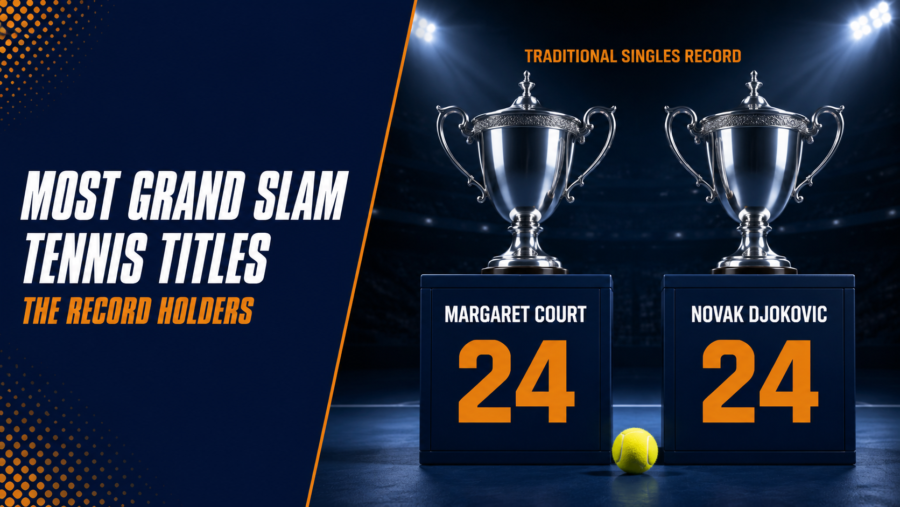
In the traditional women’s and men’s singles draws, Margaret Court and Novak Djokovic share the leading total with 24 majors each. Court holds the women’s record, while Djokovic holds the men’s record. Shingo Kunieda holds the overall singles record when wheelchair events are included, with 28 men’s wheelchair singles majors. These totals are current through Wimbledon 2026.
There is one important qualification: Court won 13 of her 24 singles majors before the Open Era began in 1968. Serena Williams owns the women’s Open Era record with 23, all won after professionals were admitted to the majors.
Grand Slam title records at a glance
In everyday tennis conversation, a major title is often called a Grand Slam title. The record changes depending on whether the question covers singles only, the Open Era only, or every discipline.
| Record | Player | Titles |
|---|---|---|
| Most traditional women’s or men’s singles majors | Margaret Court and Novak Djokovic | 24 each |
| Most wheelchair singles majors | Shingo Kunieda | 28 |
| Most women’s singles majors | Margaret Court | 24 |
| Most men’s singles majors | Novak Djokovic | 24 |
| Most women’s singles majors in the Open Era | Serena Williams | 23 |
| Most men’s singles majors in the Open Era | Novak Djokovic | 24 |
| Most majors across singles, doubles and mixed doubles | Margaret Court | 64 |
| Most men’s majors across all disciplines | Roy Emerson | 28 |
For the usual men’s and women’s singles question, the answer is Court and Djokovic. Across all singles disciplines, Kunieda leads, while Court leads the combined total across singles, doubles and mixed doubles in the traditional draws. Looking at separate records is more meaningful than treating every category as though it were the same competition.
Men’s Grand Slam singles title leaders
Djokovic moved ahead of Rafael Nadal and Roger Federer to become the men’s singles leader. His 24 titles include a record 10 Australian Opens, and he has won every major at least three times.
| Rank | Player | Australian Open | Roland Garros | Wimbledon | US Open | Total |
|---|---|---|---|---|---|---|
| 1 | Novak Djokovic | 10 | 3 | 7 | 4 | 24 |
| 2 | Rafael Nadal | 2 | 14 | 2 | 4 | 22 |
| 3 | Roger Federer | 6 | 1 | 8 | 5 | 20 |
| 4 | Pete Sampras | 2 | 0 | 7 | 5 | 14 |
| 5 | Roy Emerson | 6 | 2 | 2 | 2 | 12 |
| T6 | Rod Laver | 3 | 2 | 4 | 2 | 11 |
| T6 | Bjorn Borg | 0 | 6 | 5 | 0 | 11 |
| 8 | Bill Tilden | 0 | 0 | 3 | 7 | 10 |
Nadal’s 14 Roland Garros championships are the most singles titles won by anyone at one major. His clay-court dominance is explored further in Rafael Nadal’s journey to tennis greatness.
Federer’s eight Wimbledon singles titles remain the men’s record at that tournament. Wimbledon has produced many other unusual benchmarks, including several covered in the strangest records in Wimbledon history.
Why older men’s careers need context
Roy Emerson won all 12 of his singles majors during the amateur era, when leading professionals could not enter. Rod Laver turned professional after completing the 1962 Grand Slam and was then ineligible for the traditional majors until the Open Era began in 1968.
Laver lost five full seasons of potential major appearances during what should have been his prime. He returned to win all four in 1969, which is why a raw title table cannot settle every cross-era debate.
Women’s Grand Slam singles title leaders
Court leads the all-time women’s list by one title over Williams. The next group contains several players featured among the greatest women’s tennis players of all time, although a title count is only one way to compare careers.
| Rank | Player | Australian Open | Roland Garros | Wimbledon | US Open | Total |
|---|---|---|---|---|---|---|
| 1 | Margaret Court | 11 | 5 | 3 | 5 | 24 |
| 2 | Serena Williams | 7 | 3 | 7 | 6 | 23 |
| 3 | Steffi Graf | 4 | 6 | 7 | 5 | 22 |
| 4 | Helen Wills Moody | 0 | 4 | 8 | 7 | 19 |
| T5 | Chris Evert | 2 | 7 | 3 | 6 | 18 |
| T5 | Martina Navratilova | 3 | 2 | 9 | 4 | 18 |
| 7 | Billie Jean King | 1 | 1 | 6 | 4 | 12 |
Court won 11 singles majors in the Open Era and 13 before it. Her overall total remains the official all-time record, while Williams’ 23 is the benchmark for women in the Open Era.
Graf won all four majors and Olympic singles gold in 1988, the only calendar-year Golden Slam in singles. Navratilova owns the women’s Wimbledon singles record with nine, while Evert’s seven Roland Garros titles remain the women’s record in Paris.
Singles titles are not the same as total major titles
Most searches for “most Grand Slams” are asking about singles. Doubles and mixed doubles have their own draws, partners and records, so adding every discipline produces a different leaderboard.
Court won 64 recognized major titles: 24 in singles, 19 in women’s doubles and 21 in mixed doubles. That total includes two shared Australian mixed doubles championships. Navratilova is second overall with 59, made up of 18 singles, 31 women’s doubles and 10 mixed doubles titles.
Emerson holds the men’s combined record with 28 majors, split between 12 singles and 16 doubles titles. John Newcombe is next with 26 across singles, men’s doubles and mixed doubles.
Those totals do not mean a doubles trophy is worth less. They simply answer a different statistical question from the singles leaderboard.
A Grand Slam is also a specific achievement
Strictly speaking, “the Grand Slam” means winning the Australian Open, Roland Garros, Wimbledon and the US Open in the same calendar year. Winning one of those tournaments earns a major title, even though fans commonly call it a Grand Slam title.
Only five players have completed the calendar-year Grand Slam in singles:
- Don Budge in 1938
- Maureen Connolly in 1953
- Rod Laver in 1962 and 1969
- Margaret Court in 1970
- Steffi Graf in 1988
A Career Grand Slam is different. It means winning all four singles majors at least once over an entire career, without requiring the victories to come in the same year.
Djokovic, Nadal and Federer all completed the Career Grand Slam. Carlos Alcaraz joined the men’s group at the 2026 Australian Open, becoming the youngest man to complete it.
Why era comparisons are difficult
The Open Era started in 1968, allowing professional and amateur players into the same major draws. Before then, players who turned professional could be excluded from the four championships, while international travel was slower and more expensive.
The Australian Championships were especially difficult for many overseas players to attend. Draw sizes, seeding systems, equipment, court preparation and recovery support also changed substantially over time.
Modern players face deep international fields at four heavily attended events. Earlier champions dealt with different surfaces and, in some cases, majors played on grass at three of the four venues. The differences among tennis court surfaces help explain why winning across all four remains such a test.
Ranking records add another limitation. The ATP computer ranking began in 1973 and the WTA ranking followed in 1975, so modern No.1 statistics cannot be applied neatly to older champions. A guide to how the tennis world ranking works explains what those rankings measure today.
Which player leads at each major?
The overall leaders are not necessarily the most successful players at every individual tournament. Nadal’s 14 Roland Garros titles are the clearest example of specialization at one venue.
For historical records, it is also necessary to distinguish the current Open Era events from their amateur-era predecessors. The US Open’s history and records explain how the American major changed names, venues and surfaces before reaching its modern form.
| Major | Men’s singles leader | Women’s singles leader |
|---|---|---|
| Australian Open | Novak Djokovic, 10 | Margaret Court, 11 |
| Roland Garros | Rafael Nadal, 14 | Chris Evert, 7 |
| Wimbledon | Roger Federer, 8 | Martina Navratilova, 9 |
| US championships, all eras | Bill Tilden, Richard Sears and William Larned, 7 each | Molla Mallory, 8 |
The US Open’s Open Era leaders are different. Jimmy Connors, Pete Sampras and Federer share the men’s record with five, while Evert and Williams share the women’s record with six.
The bottom line
In the traditional men’s and women’s singles draws, Court and Djokovic are tied for the lead with 24 majors. Across all singles disciplines, Kunieda leads with 28 wheelchair singles majors. Djokovic is the men’s leader, Court is the women’s all-time leader, and Williams is the women’s Open Era leader with 23.
Court also holds the combined record across singles, doubles and mixed doubles with 64. Whenever a Grand Slam record appears, check the discipline and era before comparing the number with another player’s total.
Frequently asked questions
Who has won the most men’s Grand Slam singles titles?
Novak Djokovic leads men’s tennis with 24 major singles titles through Wimbledon 2026. Rafael Nadal is second with 22, followed by Roger Federer with 20.
Who has won the most women’s Grand Slam singles titles?
Margaret Court holds the all-time women’s record with 24. Serena Williams holds the women’s Open Era record with 23.
Who has won the most titles at one Grand Slam tournament?
Rafael Nadal won Roland Garros 14 times, the singles record at any one major. Court’s 11 Australian singles titles are the women’s record at a single major.
Does Olympic gold count as a Grand Slam title?
No. Olympic tennis is a separate competition and does not add to a player’s major total. It becomes relevant to terms such as Golden Slam and Career Golden Slam.
Do doubles titles count toward a player’s singles record?
No. Singles, doubles and mixed doubles records are tracked separately. They can be added to discuss total major titles, but that combined number should always be labeled clearly.