
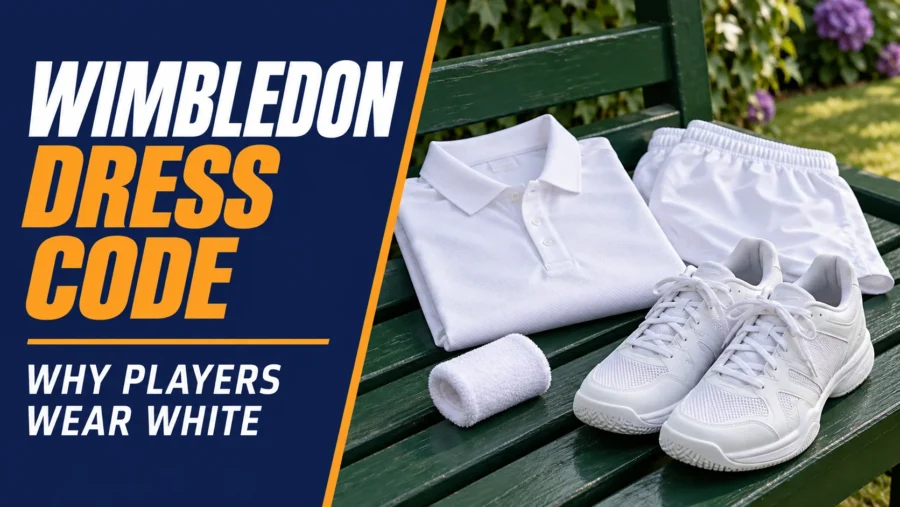
Wimbledon requires competitors to wear suitable tennis clothing that is almost entirely white from the moment they enter the court surround. White does not include cream or off-white, and most colored trim is limited to 1cm.
The rule covers shirts, dresses, shorts, skirts, tracksuits, headwear, wristbands, socks, shoes and visible undergarments. Female players have been allowed to wear solid mid- or dark-colored undershorts since 2023, provided they are no longer than the outer shorts or skirt.
What Is the Wimbledon Dress Code?
Wimbledon’s current clothing regulations are much more precise than simply asking players to “wear white.” They control the color, location and width of visible details.
The main requirements are:
- Clothing must be suitable tennis attire and almost entirely white.
- Cream and off-white do not count as white.
- There can be no large solid panel or mass of color.
- A colored trim around the neckline or sleeve cuff can be no wider than 1cm.
- Colored trim down the outside seam of shorts, skirts or tracksuit bottoms can be no wider than 1cm.
- The back of a shirt, dress, tracksuit top or sweater must be completely white.
- Caps, including the underbill, headbands, bandanas, wristbands and socks must be white except for permitted narrow trim.
- Shoes must be almost entirely white, with completely white soles and laces.
- Medical supports should be white where possible but can be colored when absolutely necessary.
Patterns are not a loophole. Wimbledon measures color contained within a pattern as if it formed one solid area, and material variations cannot be used to create an oversized logo.
Why Do Wimbledon Players Wear White?
The white tradition developed from the clothing culture of Victorian lawn tennis. Visible perspiration was considered improper in the social settings where the sport grew, and white clothing was thought to make sweat less noticeable.
White also became associated with clean, formal summer sportswear. As competitive tennis changed into a global professional sport, Wimbledon retained that visual identity.
The tournament now treats white clothing as part of its heritage alongside grass courts, formal ceremonies and traditional green-and-purple branding. The effect of the playing surface itself is explained in what makes Wimbledon grass special.
It would be too simple to say modern players wear white because the color keeps them cool. Light clothing can reflect more solar radiation than dark clothing, but Wimbledon’s rule is primarily a tournament tradition and regulation, not a sports-science requirement.
When Did the All-White Rule Begin?
Players wore white long before the tournament produced today’s detailed wording. The formal requirement evolved in stages.
1963: Predominantly White
Wimbledon introduced a formal clothing rule requiring competitors to be dressed predominantly in white. That wording allowed more interpretation than the present standard.
1995: Almost Entirely White
The club tightened the language from “predominantly” to “almost entirely” white. The change signaled that white should dominate every visible part of the outfit rather than merely account for more than half of it.
2014: Detailed Color Limits
More exact guidance established the familiar 1cm limit and extended control across accessories, shoe details and undergarments. This reduced arguments over whether large brand-colored panels still counted as mainly white.
2023: Dark Undershorts Allowed
Wimbledon changed the rule for female competitors after players and campaigners raised anxiety about visible menstrual leaks. Women and girls may wear solid mid- or dark-colored undershorts as long as they do not extend below the outer shorts or skirt.
The rest of the outfit remains subject to the white regulations. This was a targeted welfare adjustment, not the removal of the dress code.
How White Must a Wimbledon Outfit Be?
There is no published percentage that says an outfit must be 90%, 95% or 99% white. Compliance depends on the specific placement rules rather than a single mathematical total.
| Clothing area | Main rule |
|---|---|
| Shirt or dress front | Almost entirely white, no large color panel |
| Shirt or dress back | Completely white |
| Neckline and sleeve cuff | One colored trim up to 1cm |
| Shorts or skirt | White, with one outside-seam trim up to 1cm |
| Hat, headband or wristband | White, with narrow permitted trim |
| Socks | White, with narrow permitted trim |
| Shoes | Almost entirely white; soles and laces completely white |
Manufacturers work with the tournament before play to avoid last-minute problems. A product sold as “Wimbledon style” is not automatically court-compliant if it contains cream fabric, a wide colored logo or a non-white sole.
Does the Rule Apply to Underwear?
Visible undergarments generally need to be white, including fabric that can become visible through perspiration. The rule prevents a brightly colored base layer from showing through an otherwise compliant shirt or shorts.
The female undershorts exception is specific. The shorts must be solid and mid- or dark-colored, and they cannot be longer than the player’s outer shorts or skirt.
A sports bra or other visible undergarment is not automatically covered by that exception. Players and clothing teams need to check each garment against the current tournament wording.
Are Logos Allowed at Wimbledon?
Yes, within the Grand Slam rules governing manufacturer and commercial identification. Wimbledon does not require players to remove every brand mark.
However, a logo cannot be enlarged or recreated through colored panels, patterns or changes in fabric that conflict with the white rules. Large manufacturer logos on shoes are specifically discouraged.
This forces brands to produce special white versions of normal tour outfits. A player may wear a highly colorful kit during the French Open and then use a Wimbledon-specific version weeks later.
Must Tennis Shoes Be Completely White?
Shoes must be almost entirely white, while the soles and laces must be completely white. Grass-court shoes also need to satisfy the technical sole rules that protect the playing surface.
In 2013, Roger Federer was told not to continue wearing shoes with orange soles after his opening match. The upper was white, but the bright outsole detail conflicted with Wimbledon’s interpretation.
Choosing a white shoe is not enough for ordinary players either. Court movement requires lateral support and suitable traction, which the best men’s tennis shoes and best women’s tennis shoes address separately.
What About Medical Supports and Tape?
Wimbledon asks for medical supports and equipment to be white where possible. Colored support is allowed when white is not available or a medical need makes it necessary.
Novak Djokovic, for example, received approval to use a gray knee support after surgery when an appropriate white version was not available. The exception showed that medical necessity can override the preferred appearance.
Players should obtain approval rather than assume any brace or tape will be accepted. A genuine support need does not give unrestricted permission to display commercial branding.
What Happens if a Player Breaks the Dress Code?
Officials can require a player to change an item before or during a match. Clothing approval is therefore often handled in advance with the manufacturer and tournament staff.
Refusing an instruction can lead to more serious consequences under the Grand Slam Code of Conduct. A clothing issue is not automatically the same as an ordinary warning for racket abuse or audible obscenity.
Tennis code violations, fines and defaults explains why clothing rules, point penalties and financial sanctions need to be separated.
Famous Wimbledon Clothing Controversies
Anne White’s Bodysuit in 1985
Anne White wore a full-length white bodysuit during a first-round match. The color complied, but tournament officials asked her not to wear it again when play resumed the next day.
The episode showed that “all white” does not automatically mean acceptable tennis attire. Style and customary sporting standards also matter.
Andre Agassi’s Early Absences
Andre Agassi skipped Wimbledon from 1988 through 1990 during the period associated with his colorful image and resistance to the tournament’s conventions. He returned in 1991 wearing white and won the title in 1992.
His decision involved more than one factor, but it became closely connected to public discussion of Wimbledon’s clothing rules.
Roger Federer’s Orange Soles in 2013
Federer’s white shoes had bright orange soles. He was required to use a different pair after the first round, helping prompt wider attention to how strictly small color details could be controlled.
Colored Undergarments
Players have been asked to change when colored underwear became visible beneath white clothing. The 2023 undershorts change addressed a specific concern for female competitors, but it did not create a general permission for all colored underwear.
These incidents belong to the event’s offbeat history alongside the strangest records at Wimbledon.
Do Spectators Have to Wear White?
No. The player rule does not apply to ordinary ticket holders. Spectators can wear color and are not expected to arrive in tennis clothing.
Comfortable shoes, layers, sun protection and rain preparation matter more for a long day. A smart standard applies in the Royal Box, where men are generally expected to wear a suit or jacket and tie and women are asked not to wear view-blocking hats.
The beginner tennis equipment checklist also explains why practical tennis clothing for normal play does not need to imitate professional tournament regulations.
Do Ball Crews and Officials Wear White?
No. The all-white player code is not the uniform for every person on court. Officials and ball crew members wear the tournament’s designated uniforms, which have used navy and cream in the modern era.
Their distinct clothing helps spectators and players identify operational roles. It also allows Wimbledon to maintain a consistent visual presentation without applying the competitor rule to staff.
Why Wimbledon Keeps the Rule
The all-white image is immediately recognizable on television and in photographs. It distinguishes Wimbledon from tournaments where players wear their normal seasonal kits.
The club has shown that the tradition can be adjusted without being abandoned. The dark-undershorts exception responded to a practical player concern while keeping the visible outer outfit white.
Critics argue that the rule limits expression and creates avoidable scrutiny. Supporters view it as a rare shared visual standard in an increasingly commercial sport.
Whatever the preference, competitors enter under published event conditions. Wimbledon, rather than the general differences between tennis court surfaces, is what makes white clothing mandatory at this event.
Wimbledon Dress Code FAQ
Can Players Wear Cream at Wimbledon?
No. The rules state that white does not include off-white or cream.
Can Players Wear a Colored Headband?
Headbands must be white except for a single permitted trim no wider than 1cm.
Can Women Wear Black Shorts Under a White Skirt?
Yes, under the female undershorts exception, provided they are solid, mid- or dark-colored and no longer than the outer skirt or shorts.
Do Players Practice in White?
The strict requirement applies when a competitor enters the court surround for a match. Official practice areas can have their own clothing expectations, but the match rule should not be extended to every private training session without checking the current policy.
Can a Player Be Defaulted for Refusing to Change?
Potentially. Officials can direct a player to correct non-compliant clothing, and refusing to comply can escalate under the event’s conduct rules.