
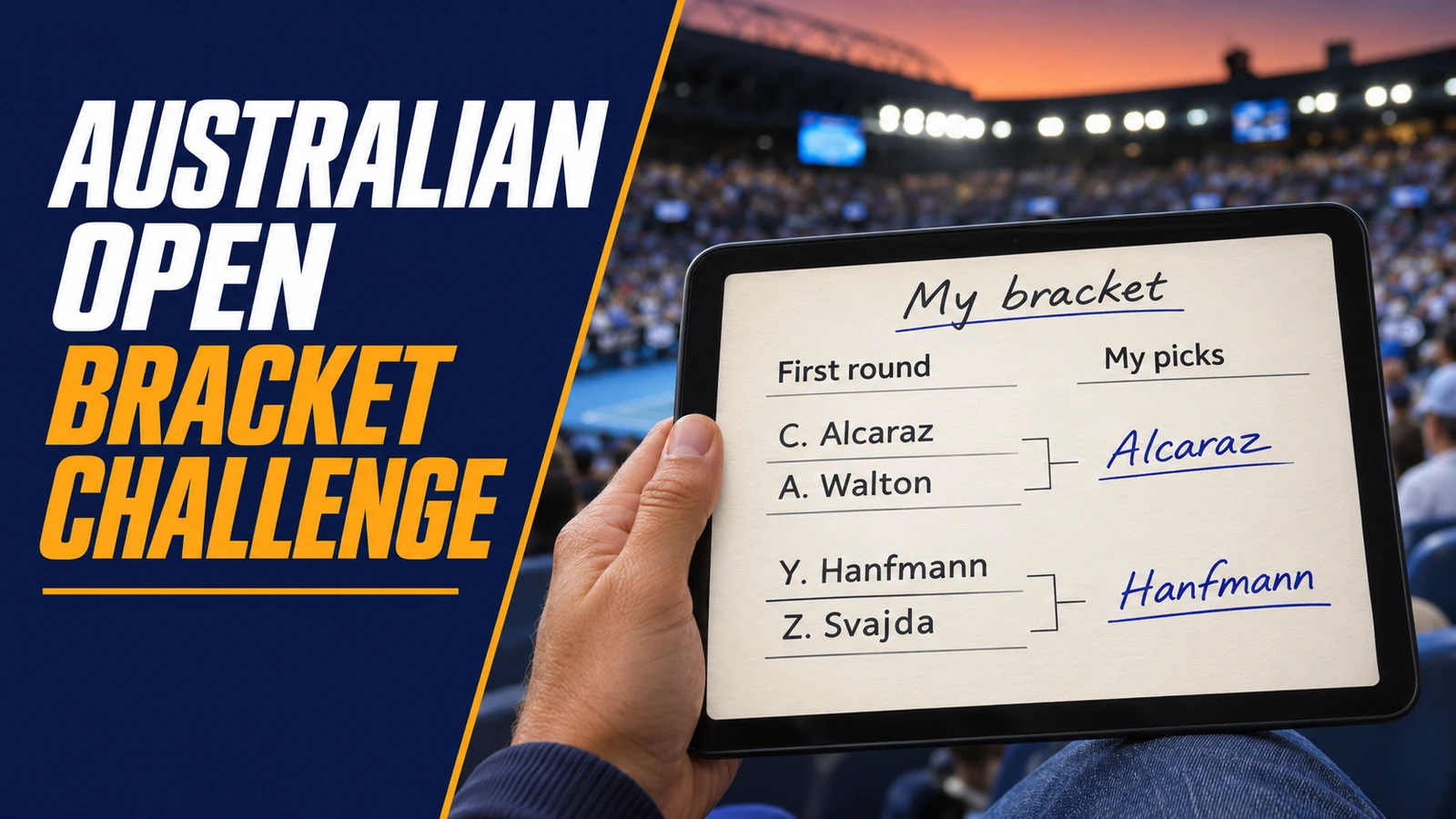
An Australian Open bracket challenge asks you to predict how the singles draw will unfold, choosing a winner in each first-round match and continuing those selections until you have a champion. A complete 128-player draw contains 127 matches, so picking the eventual winner alone is only a small part of the task.
The official AO 2026 competition offered a prize of A$10 million for a perfect bracket. That competition has closed. Its eligibility rules, entry limit and prizes should not be assumed to apply to a future edition, including 2027.
What a Tennis Bracket Prediction Contains
Each choice determines the next hypothetical match in your bracket. If you pick Player A to beat Player B, Player A becomes the player you can advance from that section in the next round.
| Round | Matches to predict |
|---|---|
| First round | 64 |
| Second round | 32 |
| Third round | 16 |
| Fourth round | 8 |
| Quarterfinals | 4 |
| Semifinals | 2 |
| Final | 1 |
| Total | 127 |
The bracket is a forecast of the whole tournament, not a sequence of fresh predictions made after each result. Our explanation of rounds, sets and draw sizes helps separate those terms.
How the Official 2026 Australian Open Challenge Worked
The 2026 competition was free to enter and restricted to Australian residents aged 18 or older, with exclusions set out in its terms. Entrants used an Australian Open account on the official website or app.
The final terms allowed one entry per person, in either the men’s or women’s singles draw, not both. An entrant therefore had to choose one competition before submitting.
The entry period ran from 4pm AEDT on January 15 to 10am AEDT on January 18, 2026. Participants selected every main-draw winner and answered an attendance-estimate tie-break question. Qualifying matches were not part of the bracket.
The headline prize required all 127 predictions to be correct. The announcement also provided for A$10,000 consolation prizes for the leading men’s and women’s entries if no perfect bracket was achieved. These were contest prizes for fans, separate from Australian Open player prize money.
A Practical Way to Build Your Bracket
Start With the Actual Draw
A ranking list is not a bracket. First establish which players can meet and in which round. Two favorites drawn into the same quarter cannot both reach the semifinals.
Identify any qualifier placeholders and the competition’s rules for updating them. A player coming through Australian Open qualifying has earned a main-draw place, but the bracket may initially show that position without the final name.
Judge the Matchup, Not Only the Seed
Ranking is useful evidence, but it summarizes results across many tournaments. Surface suitability, recent competitive activity, fitness information and the return-versus-serve matchup can matter in a specific contest.
For example, a strong server drawn against an excellent returner may face a different problem from the one suggested by their ranking gap. The tennis ranking guide explains what the published numbers measure and why they are not a prediction of every match.
Trace Your Champion’s Full Route
Before submitting, work backward from your chosen champion. Make sure the opponents you have selected in earlier rounds create a plausible path and that you have not accidentally eliminated a player you intended to advance.
Avoid choosing an upset simply to make the bracket look original. An unusual selection is only useful if you have a reason for it and understand how an early error affects later rounds.
Perfect Brackets and Points-Based Competitions
A perfect-bracket prize and a points leaderboard reward different outcomes. One incorrect result ends a perfect prediction, while a points contest may still reward accurate picks elsewhere.
Some competitions give later rounds more weight. Others use different tie-break questions, withdrawal procedures or entry limits. Read those mechanics before deciding how much risk to take on an uncertain early-round pick.
The same principle applies to US Open, Wimbledon and independent tennis draw challenges. The sport’s knockout structure is similar, but the organizer controls the competition rules. Never carry an Australian Open entry allowance, prize or residency requirement into another event without checking that event’s terms.
Before You Submit
Confirm that every match has a selection, the bracket is submitted rather than saved as a draft, and the closing time is converted into your local time zone. If edits are permitted before the deadline, use them to correct an error or respond to a confirmed withdrawal.
A bracket can make the Australian Open’s singles competition more engaging even when it is only shared with friends. The useful exercise is explaining your choices and seeing where your understanding of the draw held up.