
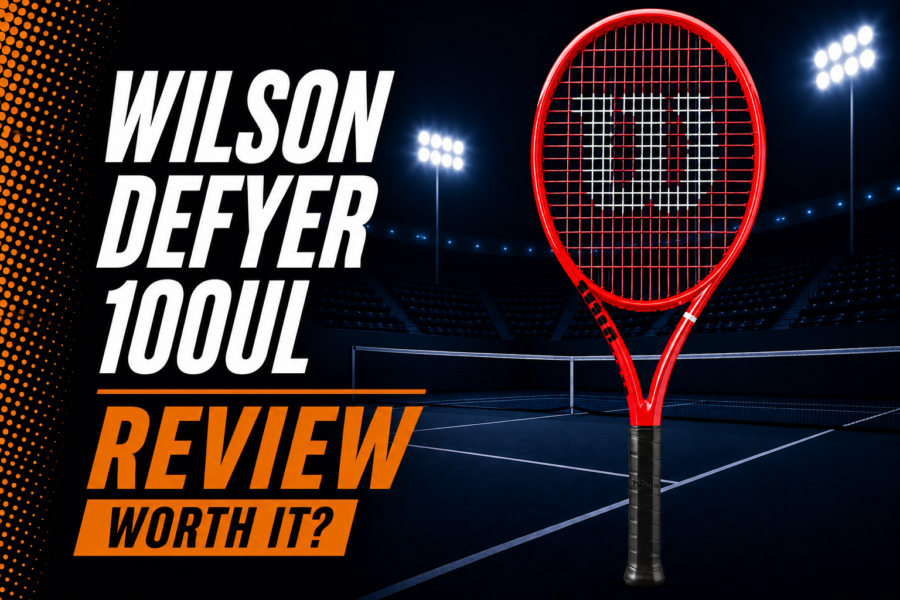
The Wilson Defyer 100UL V1 is the lightest 100 in² model in Wilson’s first-generation Defyer line, announced for 2026 with an August 21 release listed by Wilson Japan. It uses a 16×19 string pattern, a 265 g (9.3 oz) unstrung weight and an officially stated 33 cm (13 in) balance to create a fast-handling, spin-oriented option for developing players and adults who need a low-mass full-length racket.
The 100UL shares the Defyer family’s modern frame systems and general emphasis on acceleration, launch and shape, but it should not be confused with the 285 g 100L, the 300 g 100 or the smaller 98 Pro. Some Wilson regional stores label early 100UL stock Concept Edition, while Wilson Japan lists it simply as V1, so that regional first-run wording should not be mistaken for another generation.
Wilson Defyer 100UL V1 Score
| Category | Score |
|---|---|
| Power | 7.5/10 |
| Spin | 8.5/10 |
| Control | 7/10 |
| Comfort | 7.5/10 |
These are editorial estimates based on the verified official specification, construction, intended player profile and independently measured retail data. They position the stock 100UL within the wider racket market and do not imply an identical outcome for every swing or setup.
Wilson Defyer 100UL V1 Specifications
| Specification | Details |
|---|---|
| Head size | 100 in² / 645 cm² |
| Length | 27 in / 68.6 cm |
| Unstrung weight | 265 g / 9.3 oz, official |
| Strung weight | 280 g / 9.9 oz, official; approximately 278 g / 9.8 oz in a retailer listing |
| Unstrung balance | 33 cm / 13 in, official, about 4 points head light |
| Strung balance | Approximately 33.5 cm / 13.2 in, retailer measured, about 2 points head light |
| Swingweight | Approximately 303 kg·cm² strung, retailer measured; unstrung swingweight not officially stated on the reviewed product page |
| Stiffness | Approximately 65 RA strung, retailer measured; not officially stated on the reviewed product page |
| Beam width | Approximately 23.8 mm / 25 mm / 23 mm, retailer listed; Wilson officially identifies a Dual Taper Beam but does not publish numeric widths on the reviewed product page |
| String pattern | 16×19 |
| Composition | Carbon fiber and graphite |
| Recommended tension | 23–27 kg / 50–60 lb, official stringing range |
| Grip | Pro Performance |
The official Wilson fields and the approximate retailer measurements are deliberately separated because strung and unstrung data are not interchangeable. Finished weight, balance and swingweight can vary with Wilson’s production tolerances, string material and gauge, grip size, overgrips, dampeners and other accessories.
Design, Materials and Technologies
Head Size, Beam and Frame Geometry
The 100 in² (645 cm²) head gives the 100UL a familiar adult-performance contact area. It offers more forgiveness than the Defyer 98 Pro without moving into an oversized recreational format, so the model can support development beyond the first stages of learning.
Wilson officially calls the profile a Dual Taper Beam, while an authorized retailer lists approximate widths of 23.8 mm / 25 mm / 23 mm. That moderate-to-wide structure is intended to blend energy return in the hoop with enough definition through the throat, making the frame more power supportive than a uniformly thin player’s racket.
Weight, Balance and Swingweight
At 265 g (9.3 oz) unstrung, the 100UL is designed around low starting inertia and quick preparation. Its 33 cm (13 in) unstrung balance places a meaningful share of the modest mass toward the hoop, helping the ball-facing portion of the racket avoid feeling entirely insubstantial.
The approximately 303 kg·cm² measured strung swingweight is higher than the static weight alone might suggest. It remains accessible but gives the frame more presence through contact than an extremely low-swingweight beginner racket, illustrating why maneuverability and stability cannot be inferred from grams alone.
Materials and Construction
Wilson officially lists carbon fiber and graphite for this version. The frame combines that composite structure with a molded handle connection, a tapered beam and replaceable protection around the hoop.
Those elements define how the racket is intended to bend and transfer energy, but manufacturer technology terms are not independent proof of improved performance. Sample variation, strings and the player-frame interaction remain important, especially in a low-mass model.
String Pattern
The 16×19 string pattern supports launch, string movement and access to spin. In a 100 in² head, the pattern gives developing players useful clearance over the net while the low static weight makes it easier to create the head speed needed for topspin and slice.
Pattern labels do not reveal exact spacing, and two 16×19 rackets can produce different trajectories. More string movement can also increase notching or breakage, so frequent hitters should evaluate durability alongside spin potential.
Technologies
Torq Shaft is Wilson’s name for the Defyer’s shaft geometry. Wilson presents it as a way to support stability and rotational acceleration, which reasonably describes the design goal without establishing that it will add spin independently of stroke mechanics.
SI3D is intended to control three-dimensional frame bending for a chosen combination of power, spin and control. On the 100UL, it works within a very light platform, so its layup cannot remove the normal stability tradeoffs associated with low total mass.
The Airfoil Bumper uses a streamlined external profile intended to reduce drag around the top of the hoop. Click-and-Go describes Wilson’s removable bumper-and-grommet system, making replacement more straightforward when compatible parts are available.
Parallel Drilling aligns selected grommet holes to promote a more consistent stringbed response and useful movement. DirectConnect extends the carbon-fiber handle structure into the butt-cap area instead of relying on a conventional foam-filled handle arrangement, with the manufacturer claiming improved torsional stability and connection.
Elite Spec Control is Wilson’s tighter production-control program for this family. Wilson publishes tolerances of ±5 g for static weight, ±0.5 cm for balance and ±5 kg·cm² for swingweight, which still means two compliant frames can differ enough for sensitive players to notice.
Wilson Defyer 100UL V1 Performance
Comfort and Feel
An independently measured stiffness of approximately 65 RA suggests a moderately firm response rather than an extremely rigid one. The tapered beam and low mass can make off-center contact more apparent, while DirectConnect is intended to give a clearer connection through the handle.
Comfort remains personal and depends on technique, timing, impact location, grip size, strings, tension and individual sensitivity. A soft multifilament at a moderate tension may produce a more forgiving setup than a stiff monofilament pulled near the top of the range.
Comfort score: 7.5/10
Power
The 100 in² head, open pattern and beam width provide accessible rebound, but the 100UL has limited mass to drive through the ball. Its power is therefore best understood as easy launch and acceleration rather than the heavy, penetrating response of a high-swingweight performance frame.
Compact and developing swings can use the lively geometry to reach depth. Stronger hitters may find that the ball lacks weight when contact is late or the frame is pushed around, particularly against fast incoming pace.
Power score: 7.5/10
Control
Low mass makes it easier to position the face, and the approximately 303 kg·cm² swingweight remains manageable for repeatable preparation. However, the open 16×19 bed and spin-oriented launch offer less built-in trajectory restraint than a dense, thin-beamed control racket.
The best directional consistency should come from centered contact and a technically stable swing. Players who over-accelerate with the wrist or contact outside the center may see greater variation in depth and face angle.
Control score: 7/10
Spin
Spin potential is one of the 100UL’s clearer strengths. Its low static weight supports rapid acceleration, while the 16×19 pattern, Parallel Drilling and aerodynamic bumper are all intended to facilitate head speed or string movement.
The player must still produce an appropriate low-to-high or carving swing path. A worn, locked stringbed can reduce snapback, and extremely light mass does not guarantee a heavier spinning ball if the racket slows or deflects at contact.
Spin score: 8.5/10
Maneuverability
The 265 g unstrung specification is particularly useful for quick preparation, defensive reactions and doubles exchanges. Players transitioning from a junior frame may find the full 27 in length manageable without immediately accepting the mass of an adult competition racket.
Its head-oriented distribution and measured swingweight mean it has more inertia than the gram figure might imply. That can be beneficial through contact, but a player choosing it because of limited strength should assess the complete strung frame rather than the unstrung number alone.
Stability
Torq Shaft, DirectConnect, SI3D and the Dual Taper Beam are designed to reinforce the frame in different regions. Even with those systems, the stock 100UL cannot match the mass-based resistance to twisting of the 100L or 100.
Clean center contact should give the most reliable result, while hard balls struck near the sides of the hoop can produce deflection or a shorter reply. Customization can add stability, but substantial additions may defeat the purpose of selecting the ultra-light version.
Performance by Shot
Groundstrokes
On groundstrokes, the 100UL favors early learners, developing juniors and adults using compact to medium swings. It is easy to bring around on a forehand, and the 16×19 bed encourages topspin height when the player brushes effectively.
Two-handed backhands can benefit from the forgiving head and quick setup, while a one-handed player may appreciate the acceleration on slice. Flat drives need careful face control, and blocks against heavy pace may land short because the frame brings limited stock mass to contact.
Serves
The low weight makes the 100UL easy to accelerate overhead and can help a developing server learn a fluid motion without fighting the racket. The open pattern supports slice and kick, provided the player supplies the upward and lateral racket-head path.
Flat pace depends heavily on timing because the frame has less mass to carry through the ball. Players who already serve powerfully may receive a heavier delivery from the 100L or 100, while players still building mechanics may value the 100UL’s repeatability more.
Volleys and Net Play
Quick handling is a natural asset during rapid net exchanges. The 100UL can be positioned easily for reaction volleys, and its responsive beam helps compact punches produce usable depth.
Against a hard passing shot, centered contact becomes essential because the frame offers less torsional resistance. It suits active volleying and doubles reflexes better than passive blocking against sustained pace.
Returns
The racket’s low mass helps shorten preparation and attack a slower second serve with spin. Its 100 in² head also provides a reasonable margin when the returner has little time.
Heavy first serves expose the stability compromise more clearly. A simple, centered block with the body supporting the shot is preferable to a loose swing that asks the light frame to absorb and redirect pace on its own.
String and Setup Considerations
A multifilament is a logical starting point for developing players because it can supply elasticity, depth and a softer subjective response. Natural gut offers excellent resilience at a higher cost, while a hybrid can add control or durability without making the entire bed a firm monofilament.
Full polyester is most relevant to players with enough swing speed and string wear to benefit from its lower launch and snapback properties. In this light frame, an overly stiff or dead polyester setup may reduce depth and make off-center contact feel more severe.
The Tennis String Finder can help compare materials by comfort, control and durability. The Tennis String Tension Calculator can provide a general reference within Wilson’s official 23–27 kg (50–60 lb) range, though the lower portion of a range is not automatically correct for every string or player.
Strings add roughly 15 g to many adult frames and shift mass toward the hoop, explaining the difference between official unstrung and finished measurements. An overgrip or protective tape changes balance again, so setup changes should be recorded instead of judged only by the final static weight.
Build Quality and Durability
The carbon-fiber and graphite frame uses an Airfoil Bumper and Click-and-Go bumper-and-grommet components. These protect the upper hoop and string entry points, and the replaceable design allows worn protection to be renewed when exact compatible parts are available.
Court scrapes and paint chips are often cosmetic, particularly around the bumper. A widening crack, separated fibers, unusual softness or distortion is different and should be inspected before the racket is played or restrung.
No frame has a guaranteed service life. Stringing frequency, installation technique, court contact, impacts, storage temperature and transport all affect wear, so routine checks are more useful than an age-based promise.
Who Should Use It?
The Defyer 100UL V1 best suits juniors moving to a full-length racket, adult beginners, improving recreational players and doubles players who need very quick handling. It favors compact to medium swings and a preference for spin access, maneuverability and forgiveness over maximum plow-through.
It can also serve players who cannot maintain timing with a 285 g frame, provided the approximately 303 kg·cm² measured swingweight remains manageable. Selection should consider the complete strung setup and physical capacity rather than treating 265 g as the only relevant number.
Who Should Avoid It?
Strong intermediates and advanced players who face heavy pace are likely to find the stock frame too light or unstable. The Wilson Defyer 100L Racket Review model adds 20 g unstrung, while the Wilson Defyer 100 Racket Review version adds 35 g and supplies a substantially higher measured swingweight.
Players seeking low launch and dense-pattern precision may prefer a control family or the smaller Defyer 98 Pro. Anyone planning to add large amounts of mass should first consider whether a heavier factory version offers a more coherent starting balance and swingweight.
Pros and Cons
| Pros | Cons |
|---|---|
| Very low static weight supports quick preparation | Limited mass-based stability against heavy pace |
| 100 in² head and 16×19 pattern aid forgiveness and spin access | Open launch provides less inherent trajectory restraint |
| Approximately 303 kg·cm² strung swingweight gives more substance than grams imply | Head-oriented distribution may be more demanding than the 265 g label suggests |
| Replaceable Click-and-Go bumper-and-grommet system | Stronger hitters may outgrow its stock weight quickly |
Wilson Defyer 100UL V1 Compared With Similar Rackets
The Wilson Defyer 100L Racket Review model has the same head size, length and 16×19 pattern but weighs 285 g unstrung and balances at 32 cm. Its approximately 312 kg·cm² measured strung swingweight improves stability and ball weight, while the 100UL is faster to start and easier for less developed swings.
The Wilson Defyer 100 Racket Review version reaches 300 g unstrung with a 31.5 cm official balance and an approximately 326 kg·cm² measured strung swingweight. It is intended for stronger, faster swings and handles pace more convincingly, but it demands earlier preparation and greater physical capacity.
The Wilson Defyer 98 Pro Racket Review model uses a smaller head and a more performance-focused specification. It offers advanced hitters greater definition and mass, whereas the 100UL provides more forgiveness, easier launch and much lower static weight for a developing audience.
These are functional differences, not cosmetic steps. The 100UL is the specialist low-mass option in the adult Defyer family, while the 100L is the more broadly balanced bridge toward full performance weight.
Final Verdict
The Wilson Defyer 100UL V1 combines a full-length 100 in² head and spin-friendly 16×19 pattern with an unusually accessible 265 g unstrung specification. Its primary strengths are preparation speed, forgiveness and acceleration, while its central limitation is the stability and ball weight surrendered to reach that low mass.
It is best for full-length transition players, beginners and adults whose timing improves with a very light frame. The most important check is whether its relatively head-oriented balance and approximately 303 kg·cm² measured swingweight are genuinely easier for the player, and whether the pace normally faced requires the added substance of the 100L.
Frequently Asked Questions
Is the Wilson Defyer 100UL V1 suitable for beginners?
Yes, its low static weight, 100 in² head and accessible launch can suit adult beginners and juniors moving to a full-length racket. Grip size, strength and the complete strung swingweight should still be matched to the individual.
Is the Defyer 100UL designed for power or control?
It emphasizes acceleration, spin access and easy launch more than precision-oriented control. Its beam supplies useful rebound, although low mass limits the penetrating power available against heavy balls.
Is the Defyer 100UL comfortable?
Its measured stiffness is moderate, but low mass can make off-center impact more noticeable. Comfort depends on strings, tension, technique, grip fit, contact quality and individual sensitivity.
What is the difference between the Defyer 100UL and 100L?
The 100UL is 265 g unstrung with a 33 cm balance, while the 100L is 285 g with a 32 cm balance. The 100UL is easier to accelerate, and the 100L provides greater stock stability and momentum.
Is the Concept Edition a different Defyer 100UL generation?
No. Some Wilson regional listings use Concept Edition for early 100UL stock, while the official Japanese listing calls the same 2026 model V1. The naming does not establish a V2 or an older generation.
Can the Defyer 100UL generate spin?
Its manageable weight, 16×19 pattern and aerodynamic features create useful conditions for spin. The player must still supply racket-head speed, an appropriate swing path and a functioning stringbed.
What strings suit the Defyer 100UL?
Multifilament or natural gut can complement its low mass with elasticity and a softer subjective response. A hybrid or polyester may suit faster string breakers, but the material and tension should not make the setup unnecessarily stiff or low powered.