
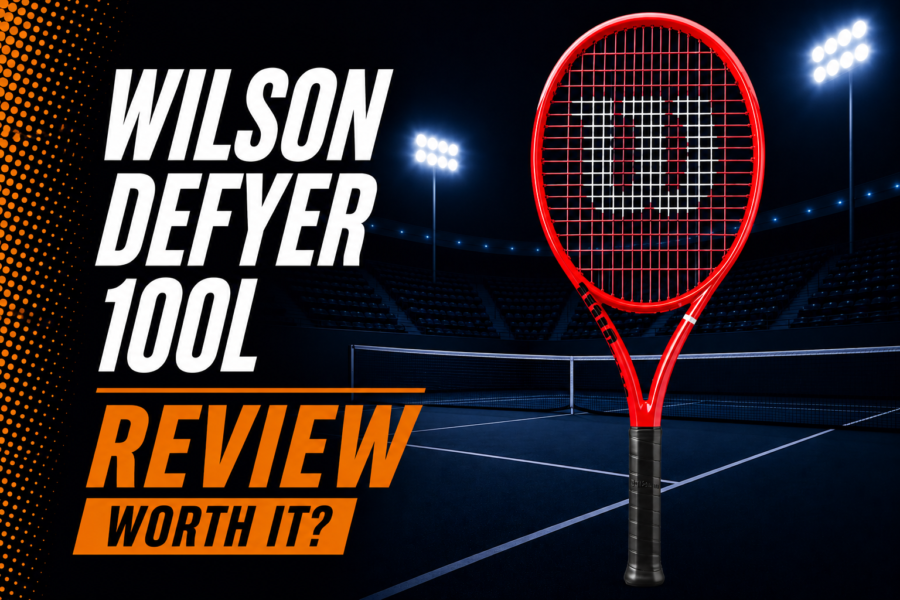
The Wilson Defyer 100L V1 is the 285 g (10.1 oz) unstrung middleweight in Wilson’s first Defyer generation, announced for 2026 with an August 21 release listed by Wilson Japan. A 100 in² (645 cm²) head, 16×19 pattern and officially stated 32 cm (12.6 in) balance give it a modern spin-and-acceleration profile with more stock substance than the 100UL.
This is the bridge between the ultra-light 265 g model and the 300 g Defyer 100. It targets improving intermediates, competitive juniors and adults who want easier handling than a full-weight performance frame without accepting the larger stability compromise of the 100UL; some Wilson regional stores call early stock Concept Edition, while Wilson Japan lists the model simply as V1.
Wilson Defyer 100L V1 Score
| Category | Score |
|---|---|
| Power | 8/10 |
| Spin | 8.5/10 |
| Control | 7.5/10 |
| Comfort | 7.5/10 |
The scores are editorial estimates derived from official specifications, the verified construction, the intended playing profile and approximate retailer measurements. They compare the stock 100L with the broader racket market and cannot account for every player’s technique or string setup.
Wilson Defyer 100L V1 Specifications
| Specification | Details |
|---|---|
| Head size | 100 in² / 645 cm² |
| Length | 27 in / 68.6 cm |
| Unstrung weight | 285 g / 10.1 oz, official |
| Strung weight | 300 g / 10.6 oz, official; approximately 301 g / 10.6 oz in a retailer measurement |
| Unstrung balance | 32 cm / 12.6 in, official, about 7 points head light |
| Strung balance | Approximately 33 cm / 13 in, retailer measured, about 4 points head light |
| Swingweight | Approximately 312 kg·cm² strung, retailer measured; unstrung swingweight not officially stated on the reviewed product page |
| Stiffness | Approximately 65 RA strung, retailer measured; not officially stated on the reviewed product page |
| Beam width | Approximately 23.8 mm / 25 mm / 23 mm, retailer listed; Wilson officially identifies a Dual Taper Beam but does not publish numeric widths on the reviewed product page |
| String pattern | 16×19 |
| Composition | Carbon fiber and graphite |
| Recommended tension | 23–27 kg / 50–60 lb, official stringing range |
| Grip | Pro Performance |
The table keeps official Wilson information separate from approximate strung measurements supplied by an authorized retailer. Individual frames can vary within Wilson’s Elite Spec Control limits, and strings, gauges, grips, overgrips, dampeners and protective tape can further change finished weight, balance and swingweight.
Design, Materials and Technologies
Head Size, Beam and Frame Geometry
The 100 in² (645 cm²) hoop supplies a useful contact margin for baseline exchanges, defensive shots and returns. It is more forgiving than a 98 in² advanced frame but avoids the extra size and often higher power of an oversized game-improvement racket.
Wilson describes a Dual Taper Beam, and retailer specifications place its sections at approximately 23.8 mm / 25 mm / 23 mm. The wider middle region supports energy return and torsional structure, while the taper keeps the entire frame from behaving like a uniformly thick power beam.
Weight, Balance and Swingweight
The official 285 g (10.1 oz) unstrung weight gives the 100L a meaningful advantage in maneuverability over the 300 g Defyer 100. At the same time, it adds 20 g over the 100UL, an important increase for momentum, stability and the authority of a compact stroke.
Its 32 cm (12.6 in) unstrung balance is head light, and the approximate 312 kg·cm² strung swingweight remains accessible for a performance-oriented adult frame. This combination should help the racket change direction readily while keeping enough mass in the hitting system to handle moderate pace more convincingly than the ultra-light version.
Materials and Construction
Wilson identifies carbon fiber and graphite as the frame materials. The layup is shaped through the Defyer shaft and beam geometry, then connected to the grip through the DirectConnect handle construction.
The presence of branded systems describes the engineering approach, not a guaranteed gain for every player. Measured sample variation and the stringbed can change the response, so construction should be considered alongside actual weight, balance and swingweight.
String Pattern
The 16×19 string pattern is central to the 100L’s spin-oriented identity. Its open arrangement permits useful string movement and creates the launch window needed for topspin height, kick serves and defensive shape.
The exact spacing matters as much as the pattern count, and the same 16×19 label can behave differently in another head. Players who strike with considerable spin should monitor notching and tension loss because greater movement can accelerate wear, especially in elastic strings.
Technologies
Torq Shaft refers to the Defyer’s distinctive shaft geometry, which Wilson links to rotational acceleration and stability. It is reasonable to expect geometry to influence bending and torsion, but the player still has to create the head speed and swing path behind any spin outcome.
SI3D is Wilson’s system for tuning frame bending in three dimensions. The stated goal is to balance power, spin and control in the chosen model, with the 100L’s lower mass naturally producing a different result from the otherwise related 300 g frame.
Airfoil Bumper gives the top protection a more streamlined shape in an effort to reduce aerodynamic drag. The bumper forms part of the Click-and-Go system, which allows compatible bumper-and-grommet components to be removed and replaced rather than treated as permanent frame pieces.
Parallel Drilling routes selected grommet holes parallel through the frame, supporting more consistent string movement and a forgiving bed. DirectConnect extends the carbon-fiber handle into the butt cap to create a more rigid connection, which Wilson associates with improved torsional stability and a connected response.
Elite Spec Control is the production program Wilson uses for this series. The published tolerances are ±5 g in weight, ±0.5 cm in balance and ±5 kg·cm² in swingweight, so matching services can still be useful when a player wants two frames to behave as similarly as possible.
Wilson Defyer 100L V1 Performance
Comfort and Feel
The approximately 65 RA measured stiffness suggests moderate firmness rather than an exceptionally rigid platform. Its 285 g mass gives centered impact more substance than the 100UL, while the DirectConnect handle is intended to communicate the frame’s response clearly.
That connected character may be appealing to players who dislike heavily muted feedback, but comfort remains subjective. Technique, contact point, string material, tension, gauge, grip size and personal sensitivity can make the same frame seem comfortable to one player and too direct to another.
Comfort score: 7.5/10
Power
Power comes from a combination of the 100 in² head, moderate-to-wide tapered beam, open stringbed and enough swingweight to carry useful momentum. It should create depth more easily than a thin, low-powered control frame without relying solely on a long, advanced swing.
The 100L does not have the 100’s mass or approximately 326 kg·cm² measured strung swingweight. It therefore offers accessible pace rather than maximum plow-through, and the player must still accelerate cleanly to produce a heavy ball against strong opposition.
Power score: 8/10
Control
The head-light balance and manageable swingweight support timely face positioning, helping the player direct medium and full strokes. At the same time, the open pattern and power-supportive beam create a higher, livelier launch than a compact-head dense-pattern frame.
Control is best when the player shapes the ball and uses repeatable spacing. The 100L offers a more settled platform than the 100UL, but advanced flat hitters who aim close to the lines may prefer the mass and trajectory definition of a heavier control-oriented racket.
Control score: 7.5/10
Spin
The 16×19 bed, Parallel Drilling, Airfoil Bumper and manageable inertia all support the conditions needed for spin. A player can accelerate the 100L rapidly while the extra mass over the 100UL helps the racket continue through contact.
Technique remains decisive, since an open pattern cannot create rotation without appropriate head speed, swing path and face angle. A slick, resilient stringbed may preserve snapback, while deeply notched strings can reduce the intended movement.
Spin score: 8.5/10
Maneuverability
The 285 g unstrung weight, 32 cm balance and approximate 312 kg·cm² swingweight form a maneuverable middleweight package. Preparation should be relatively quick on returns and passing shots, and the frame can be repositioned efficiently during doubles exchanges.
It is less effortless than the 100UL because the additional mass is real and useful. Players should choose the 100L when that extra substance improves contact quality without delaying the swing, not simply because a heavier number appears more advanced.
Stability
The frame’s moderate swingweight, wider beam, Torq Shaft and DirectConnect systems are all intended to support a stable response. Its 20 g advantage over the 100UL materially improves mass-based resistance to deflection, particularly on centered blocks and volleys.
The 100L still yields some stability to the 300 g model, especially when facing high pace or striking near the hoop edge. Static weight does not tell the whole story, but the measured swingweight difference between the versions confirms that their stock hitting substance is not the same.
Performance by Shot
Groundstrokes
The Defyer 100L is configured for modern baseline play with frequent topspin and quick changes between attack and defense. Its open pattern supplies net clearance, while the head-light balance helps accelerate on both forehands and backhands.
Flatter drives can use the frame’s moderate swingweight for depth, although they demand careful control of face angle. Against faster balls, the 100L redirects more convincingly than the 100UL but does not produce the same penetrating response as the full-weight 100.
Serves
The 100L’s blend of manageable inertia and open string spacing supports slice and kick serves. It should be easier to accelerate repeatedly than the 300 g version for players whose timing deteriorates with greater mass.
Flat serves receive accessible beam power and enough stock weight for useful pace. Strong, technically developed servers may still prefer the heavier model’s momentum, while developing servers can benefit more from the 100L if it preserves motion speed and placement.
Volleys and Net Play
At net, head-light balance aids quick positioning and rapid grip changes. The 100 in² hoop offers a practical margin in reflex exchanges, and the beam can send a short punch deep without requiring a large swing.
The additional mass over the 100UL helps against passing-shot pace, but off-center blocks remain less secure than with the 100. Touch players should expect a relatively connected response and may use a softer string to add pocketing.
Returns
An approximate 312 kg·cm² swingweight is light enough for abbreviated preparation but substantial enough to redirect moderate first-serve pace. On second serves, the frame can be accelerated to create an attacking topspin return.
Very heavy deliveries still reward compact, centered contact. A large backswing can make even a maneuverable frame late, and contact near the side of the hoop may reveal the middleweight model’s lower torsional mass.
String and Setup Considerations
Multifilament offers accessible depth and a softer impact character, making it a sensible choice for developing players or those who do not break strings rapidly. Natural gut supplies resilience and tension maintenance, while a hybrid can combine elastic response with a firmer, more controlled string in one axis.
Polyester can suit faster swingers who want lower launch, snapback and durability against notching. It is less helpful when the player lacks the speed to flex it, and a dead or overly tense polyester bed can make the 100L feel less powerful and more severe.
Wilson’s official range is 23–27 kg (50–60 lb), but string material matters when selecting a point within it. The Tennis String Finder helps compare construction types, and the Tennis String Tension Calculator can provide a general reference before adjustments are made in small, documented steps.
Customization should begin with a clear goal. Hoop mass can increase stability and swingweight, while handle mass changes balance differently, and adding enough material to replicate the 100’s static weight will not automatically reproduce the 100’s factory layup or mass distribution.
Build Quality and Durability
The composite frame is protected by Wilson’s Airfoil Bumper and replaceable Click-and-Go components. Grommets isolate strings from drilled graphite edges, while the bumper accepts routine scraping at the top of the hoop.
Surface scratches and small paint chips are usually cosmetic, but damage should not be dismissed without inspection. Cracks that propagate, exposed or separated fibers, distorted sections and unusual softness can be structural and should be assessed before play or stringing.
Bumpers and grommets wear through court contact and repeated string installation. Compatible replacements can extend practical serviceability, though no exact lifespan is responsible because playing frequency, storage, impacts and stringing technique vary.
Who Should Use It?
The Defyer 100L V1 best suits improving intermediates, competitive teenagers moving into an adult frame and recreational adults with medium to full swings. It favors players who build points with topspin, value quick preparation and want more stability than an ultra-light frame without accepting the full demand of a 300 g model.
Doubles players can also benefit from its net handling and forgiving head. The ideal user can comfortably repeat swings with an approximately 301 g strung frame and 312 kg·cm² measured swingweight through an entire session.
Who Should Avoid It?
Beginners or players who struggle to prepare 285 g may find the Wilson Defyer 100UL Racket Review model easier. Strong advanced players who regularly face heavy pace may prefer the Wilson Defyer 100 Racket Review version for its higher mass and swingweight.
Players seeking a dense, low-launch stringbed or a thin flexible beam should consider a control-oriented family. The 100L may also be too lively for fast flat hitters who do not want to use spin as a primary depth-control tool.
Pros and Cons
| Pros | Cons |
|---|---|
| Middleweight specification balances handling and useful substance | Less plow-through and off-center stability than the 300 g version |
| Head-light balance supports preparation and spin-oriented acceleration | Open launch asks flat hitters to manage trajectory actively |
| More stable stock platform than the 100UL | Approximately 312 kg·cm² swingweight may still be too much for players seeking minimum effort |
| Replaceable Click-and-Go bumper and grommet parts | Numeric beam and lab stiffness data are retailer supplied, not official Wilson fields |
Wilson Defyer 100L V1 Compared With Similar Rackets
The Wilson Defyer 100UL Racket Review model uses the same 100 in² head and 16×19 pattern but weighs 265 g unstrung and balances at 33 cm. It is easier to accelerate, while the 100L adds 20 g, moves balance toward the handle and supplies an approximately 9 kg·cm² higher measured strung swingweight.
The Wilson Defyer 100 Racket Review model adds another 15 g and has a 31.5 cm official unstrung balance. Its approximately 326 kg·cm² measured swingweight creates more mass-based power and stability, while the 100L remains faster and more accessible for developing or moderate-strength swings.
The Wilson Defyer 98 Pro Racket Review version uses a smaller head and a more advanced-player specification. It should reward precise, forceful ball striking more directly, whereas the 100L offers a larger margin, easier launch and lower physical demand.
The 100L is therefore the range’s practical middle choice rather than a compromise with no clear audience. It gives up some authority to the 100 and some effortless handling to the 100UL, but its balance of the two should suit the broadest group of developing performance players.
Final Verdict
The Wilson Defyer 100L V1 combines a forgiving 100 in² head, open 16×19 pattern and spin-oriented technologies with a manageable 285 g unstrung weight. It is quick enough for active defense and net play yet carries more stock momentum than the 100UL, while its limitations are lower stability than the 100 and a lively launch that requires technique to control.
It is best for improving intermediates, competitive juniors and adults who want a responsive middleweight frame. Before choosing it, players should compare their timing against both adjacent Defyer versions and confirm that the approximately 312 kg·cm² measured swingweight delivers useful stability without making preparation late.
Frequently Asked Questions
Is the Wilson Defyer 100L V1 suitable for beginners?
It can suit athletic beginners who are ready for a 285 g unstrung adult frame, but it is aimed more directly at improving intermediates. Players who consistently arrive late may be better served by the 100UL.
Is the Defyer 100L designed more for spin or control?
Its 16×19 pattern and acceleration-focused design emphasize spin and lively launch. It provides reasonable directional control, but it is not a dense-pattern precision racket.
Is the Defyer 100L comfortable?
Its retailer-measured stiffness is approximately 65 RA, which suggests moderate firmness. Subjective comfort still depends on strings, tension, technique, contact point, grip fit and the individual player.
What is the difference between the Defyer 100L and 100UL?
The 100L weighs 285 g unstrung and balances at 32 cm, while the 100UL weighs 265 g and balances at 33 cm. The 100L offers more stability and momentum, and the 100UL is easier to start moving.
How does the Defyer 100L differ from the Defyer 100?
The Defyer 100 is 15 g heavier unstrung and has a substantially higher measured strung swingweight. It handles pace more authoritatively, while the 100L requires less preparation effort.
Is the Concept Edition a different 100L generation?
No. Concept Edition appears on some official regional listings for early 100L stock, while another official regional listing uses V1 without that label. Both identify the 2026 first-generation 285 g model rather than a V2 or an older frame.
What strings work well in the Defyer 100L?
Multifilament and natural gut can add elasticity and pocketing, while hybrids offer adjustable control and comfort. Polyester is most appropriate for players with the swing speed and string wear to use its lower launch and snapback behavior.