
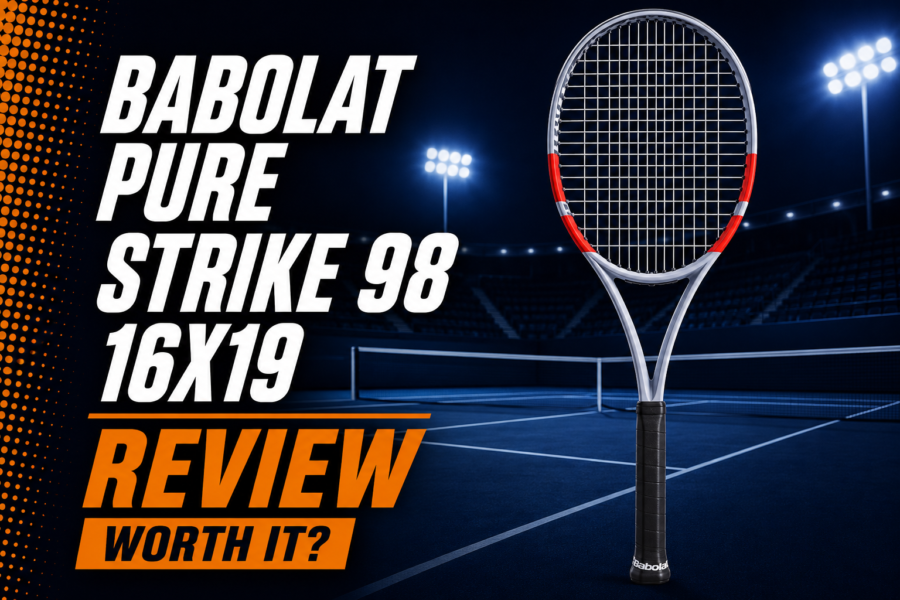
The Babolat Pure Strike 98 16×19 is the fourth-generation control frame officially identified by Babolat as the Pure Strike 98 16×19 Gen4. Its exact specification combines a 632 cm² / 98 in² head, a 16×19 string pattern, a 305 g / 10.8 oz unstrung weight and a standard 685 mm / 27 in length.
This model is designed for aggressive intermediate and advanced players who generate their own acceleration and want precision without moving to the denser launch of an 18×20 pattern. It occupies a distinct position from the smaller Pure Strike 97 and the more forgiving Pure Strike 100 family, each of which has its own dimensions and playing profile.
The Gen4 update combines a variable-width Control Frame, FSI Control string-bed design and NF²-Tech flax in the handle. Its approximately 330 retailer-measured strung swingweight and 64 RA measured stiffness create a demanding but comparatively flexible specification, emphasizing directional authority, connected feedback and stability over easy depth.
Babolat Pure Strike 98 16×19 Score
| Category | Score |
|---|---|
| Power | 7.5/10 |
| Spin | 8/10 |
| Control | 9.5/10 |
| Comfort | 8/10 |
These scores are editorial estimates based on the Pure Strike 98 16×19 Gen4’s verified dimensions, construction, intended player profile and position within the wider racket market. They refer only to the fourth-generation 98 in² 16×19 model, not the Pure Strike 97, 98 18×20 or any 100 in² version.
Babolat Pure Strike 98 16×19 Specifications
| Specification | Details |
|---|---|
| Head size | 632 cm² / 98 in² |
| Length | 685 mm / 27 in |
| Unstrung weight | 305 g / 10.8 oz, official tolerance ± 7 g |
| Strung weight | Approximately 323 g / 11.4 oz, retailer-measured |
| Unstrung balance | 32 cm / 12.6 in, official tolerance ± 7 mm |
| Strung balance | Approximately 330.2 mm / 4 points head light, retailer-measured |
| Swingweight | 305 official listed figure with string state not specified; approximately 330 strung, retailer-measured |
| Stiffness | 68 RA, official tolerance ± 3; approximately 64 RA strung, retailer-measured |
| Beam width | 21 mm / 23 mm / 21 mm |
| String pattern | 16×19 |
| Composition | Graphite with verified natural-flax inserts in the handle |
| Recommended tension | 22-26 kg / 48-57 lb |
| Grip | Babolat Syntec Team |
Babolat publishes the unstrung figures with tolerances, while the finished weight, balance, swingweight and comparative stiffness are approximate measurements from a retailer sample. Frame tolerances, strings, grip size, overgrips, dampeners and protective additions can change the complete setup, so actual examples may not match the reference numbers exactly.
Design, Materials and Technologies
Head Size, Beam and Frame Geometry
The 632 cm² / 98 in² head provides a more compact hitting surface than the 100 in² and oversize categories. That smaller geometry concentrates the string bed, supports directional targeting and rewards central contact, but it offers less margin when spacing or timing breaks down.
The 21 mm / 23 mm / 21 mm beam is narrower than Babolat’s power and spin families. Its moderate central width provides structural support, while the slimmer throat and tip keep the profile closer to the controlled response expected from an advanced frame.
Control Frame Technology combines square and elliptical cross sections. Babolat describes the square portion as stability oriented and the elliptical portion as more dynamic; the cautious inference is a frame designed to resist unwanted movement while retaining useful energy return rather than behaving like a uniformly thin box beam.
The standard 27 in length supports normal reach and maneuverability. There is no extended leverage to manage, so timing differences from a conventional adult frame come primarily from the approximately 330 finished swingweight and compact head.
Weight, Balance and Swingweight
At 305 g / 10.8 oz unstrung, this Pure Strike carries more base mass than the standard 300 g Pure Drive or Pure Aero. A retailer sample measured approximately 323 g / 11.4 oz strung, providing enough substance for advanced pace without entering the very heavy traditional category.
The official 320 mm unstrung balance moved to approximately 330.2 mm, or 4 points head light, in the measured finished setup. That head-light bias helps the player prepare and recover, but the distribution still leaves considerable momentum in the hoop.
Babolat lists 305 as its official swingweight figure without clarifying string state on the product page, while a retailer measured approximately 330 after stringing. The finished number is a better guide to rotational demand in play and explains why the frame can be stable yet less immediately quick than its static weight alone suggests.
Maneuverability and stability must be separated. A 4-point head-light balance supports handling, but a 330 swingweight still requires early preparation and developed mechanics; in return, it can keep the racket moving through a heavy incoming ball more effectively than a lightweight, low-inertia control frame.
Materials and Construction
The frame’s main construction material is graphite. NF²-Tech adds natural flax fibers in the handle, where Babolat says they filter vibration and shape impact sound while allowing the player to receive useful ball information.
The location matters. The Gen4 page identifies flax in the handle rather than presenting it as a blanket softening layer throughout the hoop, so performance descriptions should not invent material placements or equate damping with low frame stiffness.
Babolat officially lists 68 RA with a ± 3 tolerance, while the retailer sample measured approximately 64 RA strung. The latter places the measured frame toward a more flexible range than many modern power rackets, contributing to longer perceived loading and a less rigid response, although measurement conditions and samples vary.
Control Frame geometry, graphite layup and mass distribution all contribute to impact behavior. Marketing names describe design intentions, but the compact head, beam dimensions and measured inertia give the stronger evidence for how demanding and stable the model is likely to be.
String Pattern
The 16×19 layout distinguishes this version from the Pure Strike 98 18×20. It provides more space for string movement, a slightly higher launch and easier spin access than the denser sibling while retaining a controlled arrangement within a 98 in² head.
FSI Control combines a tighter pattern with the Woofer system. Babolat’s stated purpose is to extend effective ball-string interaction and improve control, and the reasonable result is a more disciplined launch than a widely spaced 16×19 pattern in a large head.
The pattern should not be treated as identical to the standard Pure Aero’s 16×19. Head size, drilling positions, grommet function and beam response change how the bed launches and moves, with this Pure Strike placing precision before maximum net clearance.
String durability will depend on material, gauge, spin rate and friction. The controlled spacing may reduce movement relative to a very open bed, but an aggressive topspin player can still notch or break strings and should monitor snapback rather than relying on pattern count alone.
Technologies
NF²-Tech places natural flax fibers in the handle to filter selected vibration and refine sound. This is a vibration-management feature within a graphite performance frame, not a guarantee of comfort or a substitute for appropriate string selection.
FSI Control uses a tighter model-specific string pattern together with Babolat’s Woofer string-frame interaction. The manufacturer links this system to longer contact and control, while actual launch remains sensitive to string gauge, material, tension and wear.
Control Frame Technology blends square and elliptical sections. The design aims to combine the square geometry’s resistance to deformation with the livelier response of an elliptical structure, fitting the Gen4 goal of precision without eliminating all useful power.
These are the verified Gen4 technologies for the Pure Strike 98 16×19. The Pure Strike 97, older Pure Strike generations, Pure Drive and Pure Aero families use their own combinations of geometry and technology despite sharing the Babolat brand.
Babolat Pure Strike 98 16×19 Performance
Comfort and Feel
The approximate 64 RA retailer measurement, 21 mm / 23 mm / 21 mm beam and flax-equipped handle suggest a more flexible and connected response than Babolat’s stiffer power frames. Its 323 g approximate finished mass can also absorb more impact than a very light frame when contact is centered.
The response remains direct. The compact head and control-oriented bed transmit clear information about contact quality, and off-center impacts can be less forgiving than on a larger, thicker frame.
NF²-Tech is intended to filter selected vibration, but comfort is subjective and depends on technique, strings, tension, grip size, contact location and the individual player. A firm polyester installed at excessive tension can dominate the frame’s comparatively flexible measured response.
Comfort score: 8/10
Power
The Pure Strike 98 16×19 provides controlled power rather than automatic depth. Its approximately 330 swingweight and 23 mm central beam can deliver substantial pace when the player accelerates cleanly, but the compact head and tighter FSI Control bed do not launch the ball as freely as a Pure Drive.
Strong hitters can use the frame’s mass to convert a full swing into a penetrating ball. Short or hesitant strokes receive less assistance, especially when contact falls outside the concentrated central zone.
The 16×19 pattern adds more elasticity and launch than the 18×20 sibling, preventing the frame from becoming entirely low powered. Even so, most of its pace depends on timing, kinetic-chain efficiency and confident acceleration.
Power score: 7.5/10
Control
Control is the defining strength. The 98 in² head, compact FSI spacing, head-light finished balance and approximately 330 swingweight create a platform intended to keep face angle stable and reward precise contact.
Directional accuracy still belongs to the player. The racket offers a predictable response and enough mass to resist small disruptions, but late preparation against the swingweight can reduce control more than a nominally easier frame would.
The 16×19 version balances precision with a usable launch window. It offers more shape and margin than the 18×20 without becoming as lively as a 100 in² power frame, making it especially suitable for an attacker who alternates between drive and spin.
Control score: 9.5/10
Spin
The 16×19 pattern gives this Pure Strike meaningful spin access. A player with fast racket-head speed can use string movement and the compact head to create a shaped attacking ball while preserving a clear sense of face direction.
Spin is less automatic than with an aerodynamically specialized Pure Aero. The approximately 330 swingweight can produce a heavy ball once moving, but it also asks the player to prepare early enough to generate vertical acceleration.
The pattern alone cannot create rotation. Technique, string snapback, contact height and face control remain decisive, and worn strings can reduce the response even when the drilling remains unchanged.
Spin score: 8/10
Maneuverability
The 4-point head-light measured balance and standard length help the frame move predictably through preparation and at net. Its compact head also presents less frontal area than an oversize model.
The approximately 330 swingweight prevents it from qualifying as exceptionally quick. Established players may value the momentum, while developing players can find it slow during rushed returns, running forehands or repeated serving.
Stability
The 323 g approximate finished mass, 330 swingweight and Control Frame geometry are designed to keep the response composed against pace. Centered blocks and driven exchanges can use the frame’s inertia without requiring an exaggerated swing.
The 98 in² head gives less off-center margin, and no verified twistweight was available for this review. Resistance to twisting should therefore be described as useful rather than absolute, with contact quality and mass distribution remaining important.
Performance by Shot
Groundstrokes
On groundstrokes, the Pure Strike 98 16×19 rewards full preparation and clean acceleration. A flatter forehand can use the controlled launch and compact head to drive through targets, while a topspin forehand gets more clearance and string movement than the 18×20 alternative.
The two-handed backhand benefits from the approximately 330 swingweight when redirecting pace. A one-handed player can appreciate the head-light balance and precise face response, but must get the frame moving early because the rotational demand is not low.
Defensive groundstrokes are less assisted than on a 100 in² power model. The frame can produce a heavy neutral ball when the player has space, but late contact or a shortened flick may land short unless the string setup supplies additional elasticity.
The compact string bed also makes spacing visible. That feedback can help an advanced player refine contact, while a developing intermediate who regularly hits near the edge may benefit more from the Pure Strike 100.
Serves
The standard length, head-light balance and 16×19 pattern allow varied serving. Flat deliveries can use the mass and controlled face for placement, while slice and kick serves gain more pattern movement than the denser 18×20 version.
Power is earned through acceleration. The frame does not provide the immediate free pace of a wide, stiff Pure Drive beam, but its approximate 330 swingweight can transfer substantial momentum when the service motion is complete.
Repeated serving is an important fit test because the head-light label can obscure the real rotational load. A player who begins to decelerate late in a match may lose both pace and placement.
Volleys and Net Play
The Pure Strike’s compact head and controlled response suit decisive volleying. The finished mass helps a short punch remain stable, while the measured flexibility and flax-equipped handle can preserve more touch information than a very stiff, highly damped frame.
Quick exchanges still expose the swingweight. Early racket positioning is important, and contact outside the smaller central zone offers less forgiveness than a 100 in² model.
Touch volleys and drop shots benefit from a string that retains elasticity and feedback. A dead, firm bed can reduce both comfort and subtle response, regardless of the frame’s control credentials.
Returns
Against a first serve, the approximate 330 swingweight and finished mass make compact blocks effective when the face meets the ball centrally. The head-light balance helps position the frame, but late contact can be difficult to rescue because of the smaller head.
On second-serve returns, a developed player can take a full cut and trust the controlled 16×19 launch. Topspin offers margin, while flatter attacking returns can use the compact bed for line changes.
Players who rely on last-second improvisation may prefer a lighter 100 in² alternative. This Pure Strike rewards anticipation and footwork more than it rewards hurried wrist correction.
String and Setup Considerations
Babolat does not state a specific recommended string for this Gen4 model, so no single material should be presented as mandatory. The official frame range is 22-26 kg / 48-57 lb, which defines a broad permitted range rather than an individualized target.
Polyester can complement the 16×19 bed for advanced players who create enough speed to need launch control, snapback and durability. A shaped or smooth option changes friction and response, and a full firm bed should be selected with attention to comfort and restringing frequency.
Multifilament, natural gut or synthetic gut can increase elasticity and accessible depth. They may suit players who want the frame’s directional geometry without a very firm impact, while a hybrid can combine a softer response with some polyester control.
The compact head and controlled spacing make tension changes noticeable. The Tennis String Finder can help narrow material and construction, and the Tennis String Tension Calculator can provide an organized starting range based on the chosen string and desired launch.
Strings add meaningful mass to the hoop, which helps explain the difference between the official listed 305 swingweight and the approximate 330 retailer-measured strung figure. Gauge, overgrip, dampener and protective tape can move the final balance and inertia further.
Comfort depends on the complete system rather than the approximate 64 RA measurement alone. Technique, tension, string condition, grip size and individual sensitivity all matter, so setup should be evaluated over normal match duration rather than only during a brief warm-up.
Build Quality and Durability
The graphite hoop uses a replaceable bumper and grommet system to protect the frame and string path. Normal court contact can abrade the bumper and paint, particularly at the top of the compact hoop, without automatically damaging the underlying structure.
Replacement parts must match the Pure Strike 98 16×19 Gen4 drilling. Grommets for the 18×20, Pure Strike 97 or 100 in² versions should not be assumed compatible because string count, hole position and head geometry differ.
Cosmetic chips and surface scuffs should be separated from cracks, exposed graphite fibers, hoop distortion or a soft area under light pressure. Split grommets and sharp edges also require attention because they can shorten string life or expose the frame.
No reliable fixed lifespan applies to every racket. Court impacts, storage conditions, restringing technique and frequency, and customization all affect durability, so a qualified technician should inspect suspected structural damage before the frame returns to play.
Who Should Use It?
The Pure Strike 98 16×19 Gen4 best suits advanced players and strong intermediates with medium-to-long, fast swings. It rewards early preparation, central contact and the ability to generate depth without relying on a highly powerful frame.
Aggressive baseliners can use the controlled launch to redirect or attack, while all-court players receive enough head-light balance and touch for net transitions. The 16×19 version is especially logical for someone who wants Pure Strike precision with easier spin and trajectory height than the 18×20.
The player must be able to sustain an approximate 330 swingweight across returns, defensive shots and serves. Static weight alone is an incomplete fit test, so repeated swings and late-session timing are more informative than simply lifting the frame.
Who Should Avoid It?
Beginners and developing intermediates with inconsistent contact may find the 98 in² head and 330 swingweight too demanding. A Pure Strike 100 or another lighter 100 in² frame provides more margin and easier defensive depth.
Players seeking maximum free power should consider the standard Pure Drive, while those whose game is built primarily around high topspin may find the Pure Aero easier to accelerate vertically. The Pure Strike can generate both pace and spin, but it makes the player contribute more.
Someone who wants the lowest possible launch and densest response may prefer the Pure Strike 98 18×20 or the smaller Pure Strike 97. Conversely, a player sensitive to direct impact should not assume NF²-Tech guarantees comfort and may need a softer frame or string system.
Pros and Cons
| Pros | Cons |
|---|---|
| Compact 98 in² head and FSI Control bed support precise targeting | Smaller hitting area is unforgiving of recurring off-center contact |
| 16×19 pattern adds useful spin and launch to the control platform | Less naturally restrained than the 18×20 version for very flat hitters |
| Approximate 330 strung swingweight supplies stability and ball weight | Rotational demand requires early preparation and sustained strength |
| Approximate 64 RA measured flex and flax handle refine the response | Controlled power gives limited help to short or hesitant swings |
Babolat Pure Strike 98 16×19 Compared With Similar Rackets
The Babolat Pure Strike 98 18×20 Gen4 shares the 98 in² head and 305 g unstrung mass but uses a denser string bed. The 18×20 provides a lower launch and greater restraint for flat hitters, while the 16×19 reviewed here offers easier height, spin and defensive shape.
The Babolat Pure Strike 97 Racket Review covers a separate Gen4 smaller-headed, thinner-beamed model intended for highly advanced control. It should not be treated as another name for this 98 in² frame; the 98 16×19 is more forgiving and lively while retaining a demanding precision profile.
The Babolat Pure Strike 100 16×20 Racket Review covers a Gen4 model that expands the head to 100 in² and uses a different pattern and specification. It provides more usable area and easier all-court margin, whereas the 98 16×19 concentrates response and carries a more advanced swingweight profile.
The Babolat Pure Drive 98 2025 Review covers another 98 in² racket, but it pairs that head with a 16×20 bed, stiffer official construction and more power-oriented Gen11 geometry. The Pure Drive 98 supplies easier pace and a firmer response, while the Pure Strike provides greater flex and a more control-first identity.
Final Verdict
Babolat identifies the Pure Strike 98 16×19 reviewed here as the Gen4 model. Its exact 98 in² head, 16×19 FSI Control bed, variable Control Frame beam and flax-equipped handle form a precise, relatively flexible platform for developed strokes.
Its approximately 330 strung swingweight is both an advantage and the central demand. It supports stability, pace redirection and a heavy ball, but it asks for early preparation and enough endurance to maintain acceleration through a full match.
For an aggressive intermediate or advanced player who wants more spin access than an 18×20 without leaving the control category, the Pure Strike 98 16×19 Gen4 is a focused choice. Players needing larger margins or free depth should move toward a 100 in² option rather than expecting this compact frame to hide contact and timing errors.
Frequently Asked Questions
Which generation is the Babolat Pure Strike 98 16×19?
Babolat officially identifies this exact frame as the Pure Strike 98 16×19 Gen4. The fourth-generation designation is part of the exact model identity.
Is it the same as the Pure Strike 97?
No. The Pure Strike 97 is a separate smaller-headed control model, while this racket has a 98 in² head, 16×19 pattern and its own beam and weight specification.
How does it differ from the Pure Strike 98 18×20?
The 16×19 bed offers more string movement, launch and spin access. The 18×20 version is denser and better suited to players seeking maximum restraint on flat, forceful swings.
What are its approximate finished measurements?
A retailer sample measured approximately 323 g / 11.4 oz strung, 330.2 mm or 4 points head light, 330 swingweight and 64 RA. Manufacturing tolerances and setup can produce different results.
Is the Pure Strike 98 16×19 powerful?
It produces substantial pace when a developed player accelerates its mass, but it does not provide the easy depth of the Pure Drive. The frame is control oriented and rewards players who generate their own power.
Is this racket suitable for intermediate players?
It can suit a strong intermediate with reliable central contact, early preparation and the ability to handle an approximate 330 swingweight. Players still developing those traits may progress more easily with a lighter 100 in² frame.
What strings work well in the Pure Strike 98 16×19?
Polyester can supply control and durability for fast hitters, while multifilament, synthetic gut or natural gut can add elasticity and comfort. A hybrid offers a middle path, and the best option depends on swing speed, breakage and preferred launch.