
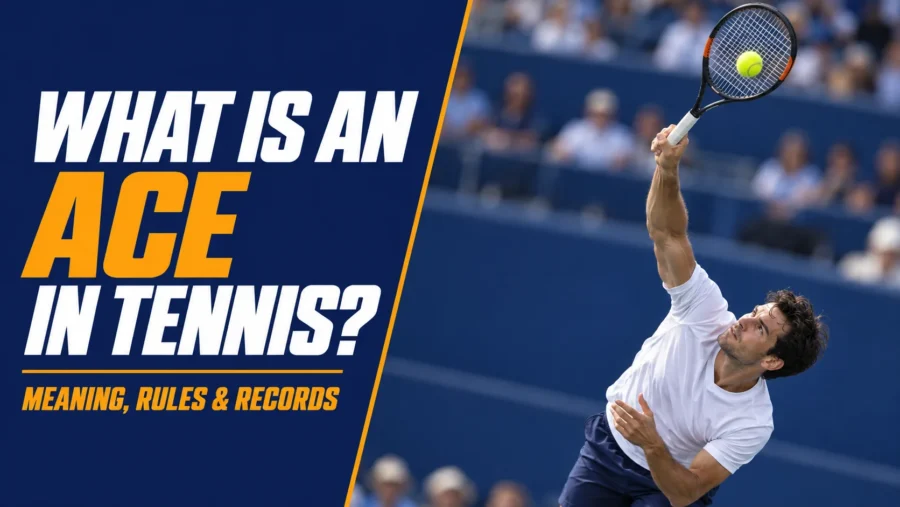
An ace in tennis is a legal serve that lands in the correct service box and is not touched by the receiver. The server wins the point immediately. If the receiver gets a racket on the ball but cannot return it, the serve is normally recorded as an unreturned serve rather than an ace.
That definition sounds simple, but lets, line calls and statistical conventions create a few useful exceptions. Understanding them makes it easier to follow match commentary and read serving statistics correctly.
What Counts as an Ace?
A serve counts as an ace when all three conditions are met:
- The server delivers a legal serve.
- The ball lands in the diagonally opposite service box, including a ball that touches a boundary line.
- The receiver does not touch the ball before its second bounce or before the point otherwise ends.
An ace can be hit down the center, out wide or into the receiver’s body. Speed helps, but placement, spin and disguise can also produce an untouched serve. A well-placed slice serve may be an ace even when it is slower than the server’s hardest delivery.
For the underlying court positions and service sequence, see the complete guide to tennis serving rules.
Is a Touched Serve Still an Ace?
Usually, no. If the receiver’s racket touches the serve, professional statisticians generally record the point as a service winner or unreturned serve, depending on the data provider and quality of the contact.
The distinction is statistical rather than a change to the score. Whether the serve is an ace or a service winner, the server still wins one point. An ace does not have a special scoring value, so it moves the score from love to 15, 15 to 30 or through the next normal step explained in how tennis scoring works.
Does a Serve on the Line Count as an Ace?
Yes. Tennis lines are part of the areas they define, so a serve that touches the correct service line is in. If the receiver does not touch it, the serve can be an ace.
Electronic line-calling systems and officials decide whether a ball clipped the line in organized competition. In an unofficiated match, the receiver makes calls on their side under the applicable code of conduct.
Can a Let Serve Be an Ace?
Under the standard Rules of Tennis, a serve that touches the net, strap or band and then lands in the correct service box is a service let. The serve is replayed, so it is not an ace and does not change the score.
Some recreational or alternative formats use a no-let rule, meaning a serve that clips the net and lands in can remain live. In that specific format, an untouched legal serve could win the point. Check the competition rules rather than assuming every event handles service lets in the same way.
Is an Ace the Same as a Service Winner?
Every ace is a service winner in the broad sense that the serve wins the point, but not every service winner is an ace. The receiver may touch a serve without making a viable return.
| Outcome | Receiver touches ball? | Point result |
|---|---|---|
| Ace | No | Server wins immediately |
| Unreturned serve or service winner | Yes, but no successful return | Server wins immediately |
| Return error | Yes, return is attempted and missed | Server wins the rally |
| Double fault | Not applicable | Receiver wins the point |
| Service let | No or not relevant | Serve is replayed under standard rules |
Terms can vary slightly among statistical providers. When comparing ace totals, use the same source and competition level. The site’s complete tennis terms glossary explains related language such as fault, let, break point and service winner.
Why Do Players Hit Aces?
An ace usually comes from a combination of four factors rather than raw speed alone.
Placement
A serve near the center line shortens the ball’s travel and can jam a receiver who is protecting the wide angle. A wide serve pulls the receiver away from the court and can exploit the natural angle of slice.
Disguise
If the toss, preparation and early swing look similar for several targets, the receiver has less time to move. A predictable server may hit hard without producing many aces.
Spin and Trajectory
Slice moves sideways after the bounce, while topspin and kick can jump above a comfortable contact height. Spin changes the returner’s contact point and can make a moderate-speed serve difficult to touch cleanly.
Score and Return Position
Receivers change position according to the server, surface and score. Standing farther back creates more reaction time but can expose a sharper wide angle. Standing close can reduce the angle but leaves less time against pace.
Serve speed varies substantially by level, age and sex. The figures in average tennis serve speed by playing level provide more context than comparing a recreational player with tour measurements.
Famous Ace Records
Ace records need a defined data set. Tour-level databases do not cover every match in tennis history, and exhibitions, qualifying rounds and lower-level events may be treated differently.
Most Career Aces on the ATP Tour
John Isner’s ATP statistics list 14,470 career aces. ATP reporting describes that as the tour record, based on its recorded match statistics. His height, delivery and ability to hold serve made the ace a central part of his career.
Most Aces by One Player in a Wimbledon Match
Isner served 113 aces against Nicolas Mahut in their 2010 Wimbledon first-round match. Mahut hit 103. The match lasted 11 hours and 5 minutes across three days and finished 70-68 in the fifth set under the rules used at the time.
That match is an extreme case, not a sensible target for normal serving. It combined two exceptional servers with a fifth set that had no deciding tiebreak.
WTA Single-Match Record
The WTA’s April 2026 statistical roundup lists Kristyna Pliskova’s tour record as 29 aces against Monica Puig in the second round of the 2016 Australian Open. Older WTA articles and profile text reported 31 for the same match, so historical totals differ within the tour’s own published material. Puig won 4-6, 7-6, 9-7 after saving five match points, a reminder that aces are only one part of performance.
Databases can revise historical totals or apply different inclusion rules. A record should therefore name the tour, event and source period rather than being presented as universal across all tennis.
Fast serves and ace totals are related but not interchangeable. The guide to the fastest tennis serves ever recorded explains why equipment and measurement conditions also matter.
Do Aces Matter More Than Double Faults?
An ace wins one point, while a double fault loses one point. A simple ace-to-double-fault ratio can describe part of a serving performance, but it misses first-serve percentage, placement, return quality and what happens after the return.
A player can serve few aces and still dominate by starting points with a weak reply. Another can hit many aces but give back too many points with double faults or lose most neutral rallies. Service points won and service games held are usually more complete measures.
How to Hit More Aces Without Chasing Maximum Speed
Trying to hit every serve as hard as possible often reduces accuracy and first-serve percentage. Use a more repeatable process:
- Develop a consistent toss for your intended serve.
- Learn two reliable targets before adding more variation.
- Use the same preparation for serves down the T and out wide.
- Build a dependable spin second serve so first-serve aggression has a safety net.
- Track target percentage, not just aces, during practice.
- Serve to patterns that fit the score and the receiver’s position.
Players who want more pace should improve the whole motion progressively rather than forcing the arm. This guide to serving faster in tennis covers leg drive, sequencing and practice structure.
How Should a Receiver Defend Against Aces?
The receiver cannot eliminate aces, but better preparation can reduce them. Watch the server’s patterns, use a split step near contact and choose a return position that gives enough time without surrendering every angle.
Against a powerful first serve, shorten the backswing and prioritize a neutral return. Against a predictable second serve, step in when appropriate and make the server defend. The full guide to returning a tennis serve explains those adjustments in detail.
Final Takeaway
An ace is an untouched legal serve that lands in the correct service box and wins the point immediately. It is not worth extra on the scoreboard, and a touched serve is generally recorded separately. Great serving combines pace with placement, spin and disguise, which is why the fastest server is not always the player who produces the most useful first strike.