
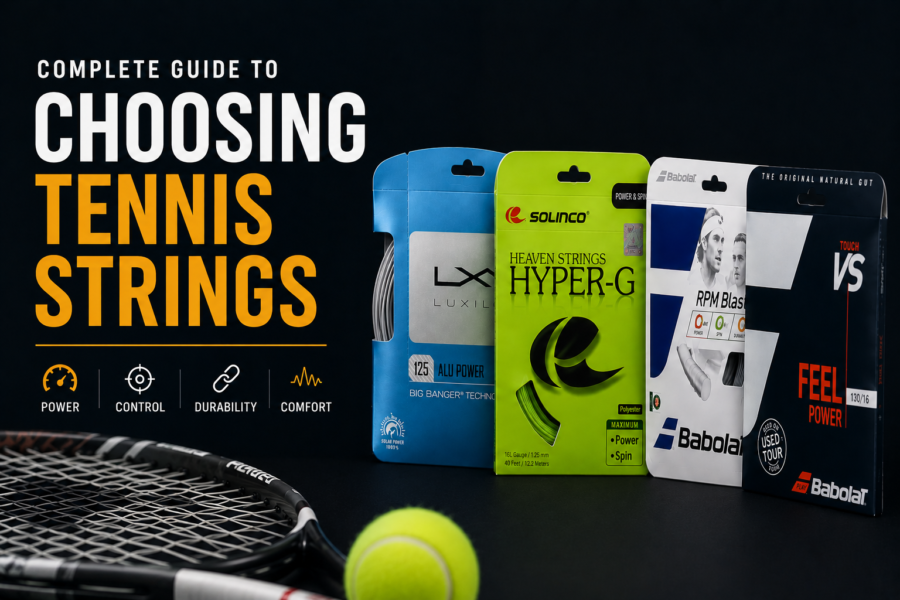
Most tennis players spend hours researching rackets, but very few pay enough attention to the strings inside them. In reality, tennis strings have a massive impact on how a racket performs. They influence almost everything you feel during a match, from the amount of spin you generate to the level of comfort in your arm after long rallies.
Two players can use the exact same racket and have completely different experiences simply because they use different strings or tensions. A racket that feels powerful and comfortable with one setup can suddenly feel stiff, uncontrollable, or even painful with another. That is why professional players obsess over their string setups and restring their rackets constantly throughout tournaments.
Strings directly affect power, spin, control, comfort, feel, launch angle, durability, and even confidence. Softer strings can make the game easier and more forgiving, while stiffer strings can provide more precision and spin potential for advanced players. The wrong combination, however, can completely ruin the performance of an otherwise great racket.
This is also why expensive rackets do not automatically guarantee good performance. Many players buy premium rackets expecting instant improvement, only to struggle because the strings are poorly suited to their game. A high-end racket with dead polyester strings can feel harsh and unforgiving, while a more affordable racket with the right string setup can feel incredible.
Choosing tennis strings can seem confusing at first because there are so many variables involved. Polyester, multifilament, natural gut, synthetic gut, hybrid setups, gauges, tensions, shaped strings, round strings, soft strings, control strings, spin strings, comfort strings. The options are endless, and every brand claims to have the perfect solution. The good news is that understanding tennis strings is much simpler once you learn what each type is designed to do and how it matches your playing style.
If you already know what type of setup you want, you can also explore our guides on the Best Tennis Strings for Spin, Best Tennis Strings for Comfort, and Best Tennis Strings for Power.
This guide is designed for every type of player, from complete beginners buying their first restring to advanced players looking to maximize spin, control, or feel. Whether you are trying to improve comfort, hit heavier topspin, avoid tennis elbow, or simply understand what setup works best for your game, this guide will walk you through everything you need to know.
Tennis Strings Explained
What Do Tennis Strings Actually Do?
Most players think the racket frame does most of the work, but the strings are actually the part of the racket that directly interacts with the ball. Every shot you hit is affected by how the string bed responds at contact. You can think of the strings as the engine of the racket. The frame provides the structure and overall characteristics, but the strings determine how the ball launches off the racket face, how much spin you generate, how much control you have, and how comfortable the racket feels during play. When the ball hits the strings, the string bed stretches and absorbs energy before snapping back into place. This process happens incredibly fast, but it plays a huge role in performance.
One of the most important concepts in tennis strings is ball pocketing. This refers to how deeply the ball sinks into the string bed during contact. Softer strings usually create more pocketing, which often gives players a more comfortable and connected feel. Many players describe this sensation as the ball “staying on the strings longer.” Pocketing can improve feel, comfort, and confidence, especially for players who like touch shots, topspin, or controlled rallies from the baseline.
Another major concept is snapback. This is especially important with polyester strings. During impact, the main strings slide sideways and then quickly snap back into position. That snapping motion helps generate extra spin by grabbing and rotating the ball more aggressively. This is one reason why modern polyester strings became so popular during the topspin-heavy era of tennis. Players with fast swings can create massive spin because of how these strings move and recover during contact.
Strings also have a huge impact on comfort and arm health. A soft multifilament or natural gut setup can feel smooth, powerful, and forgiving. On the other hand, stiff polyester strings at high tension can feel harsh and demanding, especially for recreational players or anyone dealing with arm pain.
This is why two rackets with identical frames can feel completely different depending on the strings installed.
Even factors like:
- String material
- Gauge (thickness)
- Shape
- Tension
- Durability
- Tension maintenance
all change the way a racket performs.
That is why choosing the right strings is one of the most important decisions a tennis player can make.
Why Strings Matter More Than the Racket
Many players spend weeks researching rackets while barely thinking about strings. In reality, changing your strings often has a bigger impact on performance than changing your racket.
A new string setup can completely transform how a racket feels.
The same racket can become:
- More powerful
- More spin-friendly
- More controlled
- Softer on the arm
- More forgiving
- More precise
simply by changing the strings or tension.
For example, a stiff control racket with soft multifilament strings may suddenly feel comfortable and easy to use. Meanwhile, a powerful racket with dead polyester strings can feel harsh, inconsistent, and difficult to control.
Professional players understand this better than anyone.
Many pros are extremely picky about their string setups and constantly fine-tune tensions depending on:
- Court surface
- Weather conditions
- Altitude
- Opponent
- Ball type
At the professional level, even a one or two pound tension adjustment can noticeably change performance. Pros also restring their rackets far more often than recreational players. Some players restring multiple rackets before every single match because fresh strings perform more consistently and maintain better feel. Meanwhile, one of the most common mistakes recreational players make is leaving the same strings in their racket for months or even years.
Even if the strings do not break, they still lose tension and performance over time. Dead strings often feel:
- Less comfortable
- Less responsive
- Harder to control
- More unstable
- Worse for the arm
This is especially true with polyester strings, which lose elasticity relatively quickly. A lot of players blame their racket when the real issue is actually their strings.
In many cases, restringing with the right setup can improve a racket more than buying a completely new frame.
The 5 Main Tennis String Types
Choosing the right type of tennis string is one of the biggest factors in how your racket will perform. Every string category has its own feel, strengths, weaknesses, and ideal player type. Some strings are built for spin and control, while others focus on comfort, power, or durability.
Understanding the differences between these string types makes it much easier to choose a setup that actually fits your game instead of blindly copying professional players or buying whatever is popular.
Polyester Strings
Polyester strings, often called “poly” strings, are the most popular choice among advanced and professional players. They are designed primarily for control, spin, and durability, which is why they dominate modern aggressive baseline tennis. Most polyester strings have a firmer and stiffer feel compared to other string types, allowing players to swing faster and hit harder without losing control.
One of the biggest advantages of polyester is spin potential. Poly strings are typically very slippery, allowing the main strings to slide and snap back aggressively during contact. This snapback effect helps create the heavy topspin that modern players rely on. Shaped polyester strings can increase this effect even further by adding more bite on the ball.
Polyester strings are also very durable. Hard hitters and frequent string breakers usually prefer poly because it resists notching and breaking much better than softer strings. However, this durability comes with trade-offs. Polyester loses elasticity over time and can become harsh or “dead” if left in the racket too long. Dead polyester often feels stiff, uncomfortable, and less responsive, which can increase the risk of arm pain or tennis elbow. Some of the most popular polyester strings include Babolat RPM Blast, Solinco Hyper-G, and Luxilon ALU Power, all known for their spin and control-oriented performance.
Because of their stiffness, polyester strings are generally best suited for intermediate to advanced players with fast swing speeds who can generate their own power. Beginners often struggle with full polyester setups because they can feel underpowered and unforgiving at slower swing speeds.
Pros of Polyester Strings
- Excellent spin potential
- Great control on full swings
- Very durable
- Popular among advanced players
- Works well for aggressive baseline tennis
Cons of Polyester Strings
- Stiffer and less comfortable
- Can cause arm discomfort if used incorrectly
- Loses playability over time
- Lower power compared to softer strings
- Not ideal for most beginners
If you want more aggressive spin-focused setups, check out our full guide to the Best Tennis Strings for Spin.
Multifilament Strings
Multifilament strings are designed to prioritize comfort, power, and feel. They are made using thousands of tiny fibers woven together to imitate the softness and playability of natural gut. Because of this construction, multifilament strings are among the most arm-friendly options available.
Compared to polyester, multifilaments feel much softer and more forgiving. They provide easier depth, better shock absorption, and a more comfortable response on off-center shots. Many players immediately notice how much easier it is to generate power with multifilament strings, especially at slower swing speeds.
These strings are especially popular among beginners, intermediate players, seniors, doubles players, and anyone dealing with arm pain or tennis elbow. Softer multifilaments like Head Velocity MLT are especially popular among players looking for extra comfort and easy power. Players who value comfort and feel over maximum spin or durability often prefer multifilament setups because they create a smooth, lively response that is easy to play with.
The downside is durability. Multifilament strings fray and break much faster than polyester, especially for players who hit with heavy topspin. They also tend to move around more during play and usually offer less spin and control compared to poly strings.
Still, for many recreational players, the added comfort and easy power make multifilaments one of the best overall choices.
Pros of Multifilament Strings
- Extremely comfortable
- Easy access to power
- Soft, arm-friendly feel
- Great for beginners and intermediates
- Excellent touch and feel
Cons of Multifilament Strings
- Less durable than polyester
- Lower spin potential
- Strings move more during play
- Can feel too powerful for advanced hitters
- Usually more expensive than synthetic gut
Players dealing with arm discomfort should also read our guide to the Best Tennis Strings for Comfort.
Natural Gut Strings
Natural gut is considered the gold standard of tennis strings and is still viewed by many players as the best-performing string type ever made. Despite all the modern polyester technology available today, natural gut remains unmatched in comfort, feel, power, and tension maintenance.
Natural gut is made from natural fibers and offers an incredibly elastic and responsive feel. It pockets the ball exceptionally well, creating a plush sensation that many players describe as unmatched by synthetic materials. It also maintains tension better than any other string type, meaning it stays playable and consistent for much longer.
One reason many professional players still use natural gut, especially in hybrid setups, is because it combines power and comfort without sacrificing feel. Players can pair natural gut with polyester to create a setup that offers spin and control while keeping the racket comfortable and lively.
The biggest drawbacks are price and durability. Natural gut is by far the most expensive string type, and it is also sensitive to moisture and humidity. Heavy topspin players may break it quickly, especially in full-bed setups. For casual players or anyone on a tighter budget, the cost can be difficult to justify.
Even so, many players who try natural gut for the first time immediately understand why it has remained popular for decades.
Pros of Natural Gut Strings
- Best comfort available
- Outstanding feel and pocketing
- Excellent power
- Best tension maintenance
- Extremely arm-friendly
Cons of Natural Gut Strings
- Very expensive
- Less durable for heavy hitters
- Sensitive to moisture
- Not ideal for frequent string breakers
- Premium option not necessary for every player
Synthetic Gut Strings
Synthetic gut is one of the most popular choices for recreational tennis players because it offers a balanced mix of performance, durability, and affordability. It is often recommended as a safe starting point for players who are unsure what type of string they should use.
Compared to polyester, synthetic gut is softer and more comfortable. Compared to multifilament, it is usually cheaper and slightly more durable. This balance makes it one of the best value options in tennis.
Synthetic gut provides a fairly neutral response. It does not specialize heavily in spin, control, or comfort, but instead offers solid all-around performance in every category. Many casual players enjoy synthetic gut because it feels predictable, easy to use, and affordable to restring regularly.
While advanced players often move toward polyester or hybrid setups for more specialized performance, synthetic gut remains a reliable option for beginners, club players, juniors, and recreational hitters who want balanced playability without spending too much money.
Pros of Synthetic Gut Strings
- Affordable and widely available
- Balanced all-around performance
- More comfortable than polyester
- Good option for beginners
- Decent durability for the price
Cons of Synthetic Gut Strings
- Less spin than polyester
- Less comfort than multifilament or natural gut
- Average tension maintenance
- Not as specialized for advanced performance
- Strings can move during play
Hybrid String Setups
Hybrid setups combine two different types of strings in the same racket. Usually, one string is installed in the mains and another in the crosses. This allows players to blend the strengths of multiple string types while reducing some of their weaknesses.
The most common hybrid setup uses polyester mains with softer crosses, such as multifilament or natural gut. This combination gives players access to polyester spin and control while improving comfort and feel. Many advanced players use hybrids because they provide a more balanced response than a full polyester setup.
Another popular option is natural gut mains with polyester crosses. This setup is widely used at the professional level because it combines the power, feel, and tension maintenance of gut with the control and spin of polyester. Players who want premium performance often view this as one of the best overall setups in tennis.
Hybrids can also help players customize durability, launch angle, comfort, and feel more precisely. Instead of committing fully to one string type, hybrids allow players to fine-tune their racket to fit their personal preferences.
The downside is complexity and cost. Hybrid setups require more experimentation, and some combinations can wear unevenly or lose consistency over time. Still, for players looking to maximize performance, hybrids offer some of the best customization options available.
Pros of Hybrid Setups
- Combines strengths of different strings
- Better balance of spin and comfort
- More customization options
- Popular among advanced players
- Can improve overall playability
Cons of Hybrid Setups
- More expensive
- Requires experimentation
- Some hybrids lose consistency unevenly
- Can be confusing for beginners
- Durability depends on the combination used
How Tennis Strings Affect Performance
Tennis strings change far more than just how a racket feels. They directly affect power, spin, control, comfort, durability, and even confidence during matches. Small adjustments in string type, tension, or gauge can completely change the way a racket performs on court.
This is why experienced players pay so much attention to their setups. The right strings can help you swing faster, generate easier depth, improve consistency, reduce arm pain, or create heavier topspin. The wrong setup can do the exact opposite.
Power
Power in tennis strings comes mainly from elasticity. Softer and more elastic strings return more energy to the ball, helping players generate easier pace and depth without swinging harder. This is why multifilament strings and natural gut are considered some of the most powerful string types available.
Stiffer strings, especially polyester, absorb more energy during impact instead of returning it to the ball. This creates a more controlled response but usually requires players to generate their own pace through faster swings and better technique. One important concept behind power is the trampoline effect. When the ball hits the strings, the string bed stretches and then rebounds. Softer strings stretch more and launch the ball with greater energy, which makes shots feel livelier and easier to hit deep. This is especially helpful for beginners, older players, doubles players, or anyone with slower swing speeds.
Natural gut is widely considered the most powerful string because of its exceptional elasticity and energy return. Multifilament strings are also excellent for easy depth and effortless pace. Polyester strings, by comparison, are usually much lower powered and designed for players who prioritize control over free power. Players who struggle to hit deep shots consistently often benefit from softer strings or lower tensions. Meanwhile, players who naturally generate a lot of pace usually prefer lower-powered setups to avoid overhitting.
If you want easier depth and effortless pace, check out our guide to the Best Tennis Strings for Power.
Spin
Spin has become one of the most important aspects of modern tennis, and strings play a massive role in how much topspin a player can generate. Polyester strings dominate spin-oriented setups because of how they move during contact. The biggest factor behind spin generation is the snapback effect. During impact, the main strings slide sideways and then quickly snap back into place. That snapping motion helps the strings grab and rotate the ball more aggressively, creating heavier topspin.
Polyester strings are especially effective at snapback because they are smooth and slippery. Their stiffness also allows players to swing harder and faster without losing control, which further increases spin potential. String shape also affects spin. Round strings provide a smoother and more predictable response, while shaped strings are designed with sharp edges or textured surfaces to increase bite on the ball. Common shapes include hexagonal, octagonal, twisted, or rough-textured designs. Popular spin strings like RPM Blast and Solinco Hyper-G are designed specifically for players who want heavier topspin and aggressive baseline performance.
However, shaped strings alone do not magically create spin. Swing speed still matters most. A player with slow swings will not suddenly generate massive topspin just because they switch to an aggressive shaped polyester string. Material matters too. Polyester is by far the most spin-friendly string material because it promotes string movement and snapback. Multifilaments and synthetic gut usually generate less spin because their fibers create more friction and reduce string movement over time.
For more recommendations, check out our complete guide to the Best Tennis Strings for Spin.
Control
Control is the ability to hit shots accurately and predictably without the ball launching unpredictably off the string bed. Players looking for maximum precision usually prefer stiffer strings, firmer string beds, or higher tensions because these setups reduce excess power and create a more controlled response.
Polyester strings are strongly associated with control because they produce a lower launch angle and less trampoline effect. The ball leaves the strings in a more direct and predictable way, allowing advanced players to swing aggressively without worrying about overhitting.
This is one reason why so many high-level players use polyester setups. Modern tennis rewards aggressive baseline hitting, and control-oriented strings allow players to attack the ball with full swings while still keeping shots inside the court.
Control also depends heavily on consistency. Some strings feel lively at first but become inconsistent as tension drops. More stable strings maintain a predictable response longer, which helps players trust their shots during pressure moments. Advanced players often sacrifice comfort and power in exchange for better control because they already generate enough pace through technique and racket speed. Recreational players, however, sometimes choose overly control-oriented setups that make the game unnecessarily difficult.
If precision and consistency are your priorities, take a look at our guide to the Best Tennis Strings for Control.
Comfort
Comfort is one of the most overlooked parts of choosing tennis strings, yet it can completely change the playing experience. The stiffness of the string bed directly affects how much shock travels into the arm during impact. Softer strings absorb more shock and vibration, making them feel smoother and easier on the arm. Multifilament strings and natural gut are considered the most comfortable options because they provide excellent shock absorption and elasticity.
Stiffer strings like polyester transfer more impact force into the arm, especially at high tensions. While many advanced players tolerate this for the added control and spin, recreational players often experience discomfort when using stiff polyester setups incorrectly.
This becomes especially important for players dealing with tennis elbow or chronic arm pain. Dead polyester strings are one of the most common causes of arm discomfort because they lose elasticity over time and become increasingly harsh during impact. Natural gut remains the gold standard for comfort, while multifilaments are often the best value arm-friendly option. Strings like Head Velocity MLT and Tecnifibre X-One Biphase are especially popular among players prioritizing comfort and feel. Softer hybrid setups can also provide a good balance between comfort and performance for players who still want some polyester characteristics without excessive stiffness.
Players dealing with arm pain should also read our full guide to the Best Tennis Strings for Tennis Elbow.
Feel & Touch
Feel is harder to define than power or spin, but experienced players notice it immediately. It refers to how connected and responsive the racket feels during contact. Some strings provide a crisp, direct response, while others feel softer and more muted.
One major factor behind feel is pocketing. Strings that allow the ball to sink deeper into the string bed usually create a more connected sensation. Many players describe this as better “touch” because they can sense the ball more clearly during contact.
Natural gut is often considered the best string for feel because of its elasticity and pocketing ability. Multifilaments also provide excellent touch and softness, especially for players who enjoy doubles, volleys, slices, and drop shots.
Touch becomes especially important around the net. Players who rely on volleys, angles, or finesse shots often prefer softer strings because they provide more feedback and control on delicate shots.
Polyester strings usually feel firmer and less lively, though some softer polys offer improved feel compared to traditional stiff control strings. Preferences vary heavily from player to player, which is why feel is one of the most personal aspects of string selection.
Durability
Durability refers to how long strings last before breaking or becoming unplayable. Some players break strings frequently because of heavy topspin and racket speed, while others can use the same strings for months.
Polyester strings are the most durable overall because they resist notching and friction better than softer strings. This is why heavy hitters and competitive players often choose poly setups. Multifilaments and natural gut are much softer and tend to fray or break faster under aggressive play.
String movement is often a sign of reduced durability. Softer strings tend to shift around after impact because they create more friction between fibers. Polyester strings usually snap back into place more effectively, which helps them maintain spin and durability longer.
Over time, strings develop notches where the mains and crosses rub against each other. As these notches deepen, strings become more likely to break. Thin gauges generally break faster than thicker gauges, while shaped strings can sometimes wear out quicker because of their sharp edges.
Durability is not only about breakage. A string may technically remain intact while already losing its performance characteristics. This is especially important with polyester strings, which can become “dead” before they actually snap.
Tension Maintenance
Tension maintenance refers to how well a string holds its original tension over time. This is one of the biggest differences between string materials and one of the most important factors in long-term playability.
Some strings lose tension very quickly after installation. Polyester is notorious for this. Even though polyester is durable physically, it often loses elasticity and playability relatively fast. This is why fresh poly feels much better than old poly. As polyester loses tension, it can start feeling inconsistent, harsh, and less responsive. Control often drops, comfort decreases, and the string bed may feel unstable during aggressive hitting. Many players continue using dead polyester for far too long simply because the strings have not broken yet.
Natural gut is the complete opposite. It has the best tension maintenance of any string type and stays playable much longer than polyester. This is one reason why natural gut remains so respected even in the modern game. Multifilaments usually hold tension better than polyester but worse than natural gut. Synthetic gut tends to fall somewhere in the middle depending on construction and quality.
Good tension maintenance helps keep a racket feeling predictable over time. Poor tension maintenance can make the exact same racket feel completely different after only a few sessions.
Understanding Tennis String Gauge
String gauge refers to the thickness of a tennis string, and it plays a surprisingly important role in how a racket performs. Even when using the exact same string model, changing the gauge can noticeably affect spin, feel, durability, comfort, and control.
Many players focus heavily on string type while completely ignoring gauge, but thickness alone can change the response of a racket more than expected. Choosing the right gauge often comes down to balancing performance and durability based on your playing style.
What Is String Gauge?
In tennis, gauge simply means string thickness. The lower the gauge number, the thicker the string. The higher the gauge number, the thinner the string. This can feel confusing at first because the numbering system works opposite to what many players expect.
Most tennis strings fall somewhere between 15 gauge and 18 gauge, with common thicknesses ranging from around 1.15 mm to 1.40 mm. Thin strings are usually labeled as 17 or 18 gauge, while thicker strings are often 15 or 16 gauge.
Here are some of the most common string gauges:
- 15 gauge: Very thick and durable
- 16 gauge: Standard balance of durability and playability
- 17 gauge: Thinner with more feel and spin
- 18 gauge: Very thin with maximum feel and bite
Some brands also use measurements in millimeters instead of traditional gauge numbers. For example:
- 1.30 mm is usually considered 16 gauge
- 1.25 mm is typically 17 gauge
- 1.20 mm or lower is considered thin gauge territory
Even small thickness differences can noticeably affect performance, especially for experienced players.
Thin vs Thick Strings
Thin strings are popular among players looking for more feel, spin, and responsiveness. Because thinner strings dig into the ball more easily, they often create better bite and improved ball pocketing. Many players feel that thinner gauges provide a livelier and more connected response during rallies.
Spin-friendly players also tend to prefer thinner strings because they can enhance snapback and help the strings grip the ball more aggressively. Thin polyester strings, in particular, are widely used by advanced topspin players who want maximum rotation and precision. The downside is durability. Thin strings break faster because there is simply less material resisting friction and notching during play. Heavy hitters who use a lot of topspin can destroy thin gauges very quickly, especially in softer string types like multifilament or natural gut.
Thicker strings focus more on durability and control. Because they are firmer and more resistant to movement, they usually last longer and feel slightly more stable during aggressive hitting. Players who break strings frequently often move toward thicker gauges to avoid constant restringing. However, thicker strings can feel less lively and slightly less spin-friendly. They usually provide a firmer response with less pocketing and a slightly lower level of touch or feel compared to thinner gauges. The difference is not massive, but experienced players often notice it immediately. Thin strings generally feel more responsive and lively, while thicker strings feel more solid and durable.
Which Gauge Should You Choose?
For most beginners, a standard 16 gauge setup is usually the safest starting point. It provides a balanced combination of durability, comfort, and playability without breaking too quickly. Beginners generally do not need extremely thin gauges because they are less likely to generate enough racket speed to fully benefit from the added spin potential. Intermediate players often start experimenting more with gauge depending on their style. Players looking for additional spin, feel, or touch may prefer thinner 17 gauge strings, while players who break strings often may stay with thicker 16 gauge options.
Advanced players typically choose gauge very carefully based on their priorities. Heavy topspin players often prefer thinner polyester strings because of the added bite and snapback, even if durability suffers slightly. Big hitters who constantly break strings may move toward thicker gauges for better longevity and control. There is no universally perfect gauge because the best option depends on swing speed, playing style, string type, and personal preference.
In general:
- Thin gauges prioritize spin, feel, and responsiveness
- Thick gauges prioritize durability and stability
For most recreational players, 16 or 17 gauge strings offer the best balance overall.
String Shapes Explained
Not all tennis strings are shaped the same way. Some strings have a completely smooth and round surface, while others are designed with sharp edges, textured coatings, or twisted constructions to increase spin potential. String shape mainly matters with polyester strings because polyester is stiff enough to maintain those edges during play. The goal of shaped strings is simple: create more bite on the ball and improve spin generation during fast swings.
For many players, especially aggressive baseliners, string shape can noticeably change how a racket feels and performs.
Round Strings
Round strings have a smooth and consistent surface without any sharp edges or textures. They are often associated with a cleaner and more predictable response because the strings slide more freely across each other during impact.
Many players prefer round polyester strings because they feel smoother and more controlled. Since there are no sharp edges digging into the ball, the response usually feels more consistent and less erratic, especially on flatter shots or touch shots around the net.
Round strings also tend to maintain their playability longer. Shaped strings gradually lose their edges as they wear down, but round strings start smooth and stay relatively consistent throughout their lifespan. They also usually slide and snap back more efficiently over time, which helps maintain spin generation even after several hours of play.
Another advantage is durability. Because there are no sharp corners rubbing aggressively against other strings, round strings often notch more slowly and last longer than heavily shaped designs.
Players who prioritize control, predictability, durability, or a cleaner feel often prefer round strings over aggressive shaped polys.
Shaped Strings
Shaped strings are designed with edges or textured surfaces that help the strings grip the ball more aggressively during contact. The idea is that these edges increase friction between the string and the ball, creating extra bite and helping players generate heavier topspin.
Most shaped strings are polyester because polyester is firm enough to hold these aggressive designs. Common shapes include:
- Hexagonal
- Octagonal
- Pentagonal
- Twisted
- Rough-textured designs
Some strings have subtle edges, while others feel extremely sharp and aggressive. Certain shaped polys are specifically built for heavy topspin players who swing fast and attack the ball aggressively from the baseline.
Shaped strings often feel slightly firmer and more aggressive compared to smooth round polys. Many players notice higher net clearance, heavier topspin, and more explosive ball rotation when using them correctly.
However, shaped strings usually wear down faster because the edges gradually flatten during play. They can also feel harsher or less predictable than round strings for players who prefer a smoother response.
For spin-focused players with modern fast swings, though, shaped strings remain one of the most popular setups in tennis.
Do Shaped Strings Really Increase Spin?
The short answer is yes, but not as dramatically as many players think.
Shaped strings can absolutely help increase spin potential by creating more bite on the ball and improving snapback behavior. However, they are not magic. Swing speed and technique still matter far more than string shape alone.
A player with slow or compact swings will not suddenly produce massive topspin simply by switching to an aggressive shaped polyester string. The biggest spin gains come from racket head speed, brushing up on the ball, and modern stroke mechanics.
What shaped strings really do is help maximize spin for players who already swing aggressively. When combined with fast racket head speed, shaped polys can create heavier ball rotation, higher net clearance, and more aggressive shot trajectories.
The difference between shaped and round strings is also smaller than many marketing campaigns suggest. Some round polyester strings generate incredible spin because of excellent snapback and low friction between strings, even without sharp edges.
In real-world play:
- Shaped strings usually provide more bite and a more aggressive response
- Round strings usually feel smoother, more predictable, and often more durable
Neither option is automatically better. It depends entirely on the player’s style, swing speed, and preferences.
Choosing Strings Based on Your Playing Style
There is no single “best” tennis string for everyone. The right setup depends heavily on your skill level, swing speed, physical condition, and playing style. A string that feels incredible for an advanced topspin player may feel terrible for a beginner, while a soft comfort setup that works perfectly for a casual player may feel uncontrollable for a high-level competitor.
This is one of the biggest mistakes recreational players make. Many copy professional setups without realizing those strings are designed for completely different swing speeds and physical demands. Choosing strings based on how you actually play is far more important than simply buying the most popular option.
Best Strings for Beginners
Beginners should usually prioritize comfort, power, and forgiveness over maximum spin or control. At this stage, the goal is to make tennis easier and more enjoyable while developing proper technique and consistency.
Softer strings help beginners generate easier depth without needing perfect timing or huge swings. Multifilament strings and synthetic gut are usually the best starting points because they provide a comfortable feel, good power, and a forgiving response on off-center shots.
Many new players make the mistake of using stiff polyester strings too early because they see professionals using them. In reality, full polyester setups often feel underpowered and harsh for beginners, especially at slower swing speeds. They can also increase the risk of arm discomfort if technique is still developing.
A beginner-friendly setup should make the racket feel lively, comfortable, and easy to control without forcing the player to swing extremely hard just to create depth.
Best Strings for Intermediate Players
Intermediate players usually benefit from balanced setups that combine comfort, control, spin, and durability without becoming too extreme in any one category. At this level, players often start developing clearer preferences and understanding what they want from their equipment.
Many intermediates begin experimenting with softer polyester strings or hybrid setups to gain more spin and control while still maintaining enough comfort. Others continue using multifilaments if they prioritize easy power or arm-friendliness.
Consistency becomes more important at this stage. Intermediate players are often working on improving rally tolerance, directional control, and shot reliability, so strings that feel predictable and stable usually work best.
This is also the stage where players may start adjusting tensions more carefully depending on whether they want extra control, comfort, or spin. Finding the right balance matters much more than simply chasing the most aggressive setup possible.
Best Strings for Advanced Players
Advanced players usually prefer control-oriented setups that allow them to swing aggressively while keeping the ball under control. Because high-level players already generate their own pace, they often prioritize precision, spin, and consistency over free power.
Polyester strings dominate at this level because they provide the low-powered and spin-friendly response that advanced players need during fast rallies. Many advanced players also use hybrid setups to soften the feel slightly while maintaining control and spin potential.
Precision becomes extremely important at higher levels. Advanced players rely on confidence during full swings, aggressive baseline exchanges, and pressure moments, so they often prefer strings with predictable launch angles and stable tension maintenance.
Spin also becomes a major factor. Heavy topspin allows advanced players to hit harder while still controlling depth, which is why shaped polyester strings are so popular among competitive players.
However, even advanced players need to be careful with stiffness and restringing frequency. Dead polyester can negatively affect both performance and arm health, especially during heavy training schedules.
Best Strings for Baseliners
Baseliners usually benefit most from strings that prioritize spin, control, and durability. Since modern baseline tennis involves heavy topspin and long rallies, many baseliners prefer polyester strings that can handle aggressive swings without losing control.
Spin-friendly polyester strings help create higher net clearance and heavier ball rotation, making it easier to attack from the baseline while still keeping shots inside the court. Durability also matters because frequent topspin hitting creates significant string wear and notching.
Many baseliners prefer shaped polyester strings because of the extra bite and aggressive response they provide. Others prefer round polys for a smoother and more predictable feel.
Players who spend most of their time rallying from the baseline generally need setups that remain stable under heavy hitting and maintain control during long exchanges.
Best Strings for Aggressive Hitters
Aggressive hitters often generate plenty of pace naturally, so their biggest priority is usually control. Strings that are too powerful can quickly become difficult to manage for players who swing fast and attack constantly.
Polyester strings are usually the preferred option because they reduce trampoline effect and create a firmer, more controlled response. This allows aggressive players to swing fully without worrying as much about overhitting.
Tension stability also becomes important for this style of player. As strings lose tension, launch angle and control can change noticeably, which is why many aggressive hitters restring frequently to maintain consistency.
Some advanced hitters use hybrids to slightly soften the feel while still keeping enough control for high-intensity play. The goal is usually to find a setup that feels stable, predictable, and spin-friendly during aggressive shotmaking.
Best Strings for Serve-and-Volley Players
Serve-and-volley players often prioritize feel, touch, and responsiveness more than extreme topspin. Since this style involves frequent volleys, slices, and transition play, many players prefer softer strings that provide better feedback and pocketing.
Natural gut and multifilament strings are especially popular for touch-oriented players because they create a connected and comfortable response around the net. These strings make it easier to control delicate volleys, half-volleys, drop shots, and angled touch shots.
Some serve-and-volley players still use polyester hybrids for added control on serves and groundstrokes, but extremely stiff full polyester setups can sometimes reduce feel during net play.
A good setup for this style should feel lively, precise, and responsive during quick exchanges at the net.
Best Strings for Junior Players
Junior players should usually focus on comfort and proper development instead of jumping immediately into stiff professional-level setups. One of the biggest mistakes young players make is switching to full polyester too early simply because advanced players use it.
Unless a junior has developed strong technique and fast swing speeds, stiff polyester often creates unnecessary stress on the arm while offering limited benefits. Softer multifilament or synthetic gut setups are usually much safer and more forgiving during development.
Comfort matters even more for younger players because their bodies are still growing. A softer setup encourages better feel, easier depth, and a more natural learning process without excessive strain.
As juniors improve and begin generating more racket head speed, they may gradually experiment with softer polyester hybrids or lower-tension poly setups if additional spin and control become necessary.
Best Strings for Seniors
Senior players usually benefit most from comfortable and arm-friendly string setups. As players age, protecting the arm, shoulder, and wrist becomes increasingly important, especially for anyone dealing with past injuries or chronic discomfort.
Natural gut and multifilament strings are often the best choices because they absorb shock extremely well and provide easy power without requiring huge swings. Softer strings also help reduce vibration and minimize stress during longer hitting sessions.
Many seniors benefit from avoiding stiff polyester altogether, especially at high tensions. Even if polyester provides more control and spin, the added stiffness is often not worth the increased risk of discomfort or injury.
A softer setup can make tennis feel easier, more enjoyable, and significantly more comfortable while still providing plenty of performance for recreational and competitive senior players alike.
Choosing Strings Based on Arm Comfort
Arm comfort is one of the most important factors when choosing tennis strings, yet many players ignore it until pain starts appearing. The wrong string setup can put excessive stress on the wrist, forearm, elbow, and shoulder, especially during frequent play or long hitting sessions.
While technique, racket choice, and physical conditioning also play a role, strings have a massive impact on how much shock and vibration travel into the arm during contact. A comfortable setup can make tennis feel smooth and effortless, while a harsh setup can quickly lead to soreness or even long-term injuries like tennis elbow.
What Causes Tennis Elbow?
Tennis elbow is usually caused by repetitive stress and overuse of the forearm muscles and tendons, but string choice can significantly increase or reduce that stress. One of the biggest causes of arm discomfort is string stiffness.
Stiff strings absorb less impact and transfer more shock directly into the arm. Polyester strings, especially firm control-oriented polys, are the main example. While advanced players often tolerate them because of the added spin and control, recreational players frequently experience discomfort when using stiff setups that do not match their swing speed or technique.
Dead polyester is another major issue. Even though polyester strings are durable physically, they lose elasticity relatively quickly. Once they go dead, they stop absorbing impact properly and begin feeling harsher during contact. Many players continue using dead polyester because the strings have not broken yet, without realizing the string bed has already become uncomfortable and unstable.
High tensions can also contribute to arm pain. Tight string beds create a firmer response with less shock absorption, which increases stress during impact. Combining stiff polyester with high tension is often one of the worst combinations for comfort, especially for casual players or anyone with previous arm issues.
Poor technique and overtraining matter too, but using an arm-friendly string setup can dramatically reduce the amount of stress placed on the body.
Worst Strings for Arm Pain
The worst setups for arm comfort are usually full polyester string beds installed at high tensions. Polyester is naturally stiffer than other string materials, and when pulled too tightly it can create a very harsh and unforgiving response.
Extremely stiff control polys are especially demanding. These strings are designed for advanced players with fast swings who generate heavy pace and spin consistently. Recreational players often struggle with them because they do not produce enough racket head speed to fully benefit from the control advantages.
Old or dead polyester is arguably even worse. Fresh polyester may still feel manageable for some players, but once the strings lose elasticity they can become noticeably harsher and less comfortable. The racket may start feeling board-like, unstable, or jarring during impact.
Thin, stiff polys at very high tensions can also increase vibration significantly, especially in lighter rackets or stiff frames. Players dealing with tennis elbow or chronic soreness should generally avoid these setups unless they have a very specific reason to use them.
Many players assume pain comes from the racket alone, when in reality the strings are often the biggest problem.
Best Strings for Tennis Elbow
Players dealing with tennis elbow or arm discomfort should prioritize softer and more elastic strings that absorb shock effectively. Multifilament strings are one of the best overall options because they provide excellent comfort, easy power, and strong vibration dampening.
Natural gut is widely considered the best string available for arm comfort. Its elasticity and shock absorption are unmatched, which is why many players recovering from elbow pain switch to gut setups immediately. Natural gut also maintains tension extremely well, helping the racket feel comfortable and consistent for longer periods.
Soft hybrid setups can also work very well. Many players combine softer polyester mains with multifilament or natural gut crosses to create a balance between comfort and control. Others reverse the setup and use natural gut mains with polyester crosses for added feel and arm-friendliness.
Lower tensions can help too because they allow the string bed to absorb impact more effectively. Softer rackets combined with comfortable strings usually create the safest overall setup for players trying to protect their arm.
For most recreational players dealing with discomfort, multifilament strings are often the best balance between comfort, affordability, and performance.
How Often You Should Restring to Protect Your Arm
One of the biggest misconceptions in tennis is that strings only need replacing after they break. In reality, strings can become uncomfortable and lose performance long before snapping.
Dead strings are strings that have lost their elasticity and responsiveness. They no longer absorb shock properly, which causes more vibration and impact stress during contact. Polyester strings are especially prone to this because they lose tension and playability faster than most players realize.
A dead poly setup may still look perfectly fine visually while already feeling harsh and unstable on court. Many recreational players use the same polyester strings for several months, unknowingly increasing stress on their elbow every time they play.
Regular restringing helps maintain both performance and comfort. Players who use polyester should generally restring far more often than casual players expect, especially if they play multiple times per week. Multifilament and natural gut usually remain playable longer because they maintain elasticity better.
If your racket suddenly starts feeling stiff, uncomfortable, powerless, or inconsistent, the strings may already be dead even if they have not broken yet. In many cases, restringing with a fresh and softer setup can immediately improve both comfort and confidence on court.
Tennis String Tension Explained
String tension is one of the easiest ways to customize how a tennis racket performs. Even small tension changes can noticeably affect power, spin, comfort, control, and feel. Two players using the exact same racket and strings can still have completely different experiences simply because their tensions are different.
Many players underestimate how important tension is, but it can dramatically change the response of a racket. Lower tensions usually make the string bed feel softer and more powerful, while higher tensions create a firmer and more controlled response.
Finding the right tension is often about balancing comfort, power, and precision based on your skill level and playing style.
If you want a more detailed breakdown, read our guide on What Tension Should My Racket Strings Have?
What Is String Tension?
String tension refers to how tightly the strings are pulled during the stringing process. It is usually measured in pounds (lbs) or kilograms (kg), depending on the country and stringing machine.
Most tennis rackets have a recommended tension range printed somewhere on the frame, often around:
- 45–65 lbs
- 20–30 kg
This range is designed to give players flexibility depending on their preferences and string type.
A lower tension means the strings are pulled less tightly, creating a softer and more elastic string bed. A higher tension means the strings are pulled tighter, creating a firmer and stiffer response. The difference may seem small on paper, but even a change of 2–3 pounds can noticeably affect how the racket launches the ball and feels during contact.
String type matters too. Polyester strings are usually strung at lower tensions than multifilament or natural gut because polyester is naturally stiffer. A tension that feels comfortable with multifilament may feel extremely harsh with a firm polyester setup.
Low Tension vs High Tension
Low tension setups are popular because they provide more power, comfort, and forgiveness. Since the strings can stretch and rebound more easily, they create a stronger trampoline effect that helps launch the ball with greater energy.
Players often notice easier depth and a larger sweet spot at lower tensions. The racket feels more forgiving on off-center hits and usually absorbs shock better during impact, which improves comfort significantly.
Lower tensions can also improve spin for many players because the strings move more freely and pocket the ball deeper. This is one reason why many modern players use polyester strings at surprisingly low tensions compared to older generations.
High tensions create the opposite effect. The string bed feels firmer, more controlled, and less powerful because the strings do not stretch as much during impact. This reduces trampoline effect and creates a lower launch angle, which many advanced players prefer during aggressive hitting.
A tighter string bed can make shots feel more precise and predictable, especially for players who swing fast and generate their own pace. However, higher tensions also reduce comfort and sweet spot size, making the racket feel less forgiving overall. Neither option is universally better. Lower tensions generally favor comfort, power, and forgiveness, while higher tensions prioritize control and precision.
Recommended Tension Ranges
There is no perfect tension for every player, but certain ranges tend to work well depending on skill level and playing style.
Beginners usually benefit from lower to mid-range tensions because they provide easier power, more comfort, and a larger sweet spot. A softer and more forgiving response helps make the game easier while developing technique. Many beginners perform well somewhere around:
- 48–54 lbs
- 22–24.5 kg
Intermediate players often start experimenting more based on their preferences. Players looking for additional control may move slightly higher, while players prioritizing comfort or easy depth may stay lower. Many intermediates fall somewhere around:
- 50–56 lbs
- 22.5–25.5 kg
Advanced players often customize tension very carefully depending on string type, weather conditions, and playing style. Many advanced players using polyester strings actually string surprisingly low, often:
- 44–52 lbs
- 20–23.5 kg
This helps maintain comfort and spin while still keeping enough control because polyester itself is already low powered. Players using multifilament or natural gut usually string slightly higher because those strings are softer and more powerful naturally.
How Weather Affects String Tension
Weather conditions can noticeably change how strings perform, especially during outdoor play. Temperature has one of the biggest effects on string bed feel.
In hot weather, strings become softer and more elastic. The ball also travels faster through warm air, making the racket feel more powerful overall. Many players notice that their shots launch higher and fly deeper during summer conditions.
In cold weather, the opposite happens. Strings stiffen up and feel firmer because lower temperatures reduce elasticity. The ball becomes heavier and slower as well, which can make the racket feel less lively and more demanding. Many players experience reduced comfort and power during colder conditions.
Humidity also affects performance, particularly with natural gut. Moisture can weaken gut strings and reduce durability if the strings are exposed to wet conditions repeatedly. Modern coatings help protect natural gut more than in the past, but humidity still affects it more than synthetic materials.
Competitive players sometimes adjust tension depending on climate and conditions. For example:
- Higher tensions may be used in hot weather for extra control
- Lower tensions may be used in cold weather for added comfort and power
While recreational players usually do not need constant adjustments, understanding how weather changes string performance can help explain why a racket sometimes feels completely different from one day to the next.
Full Bed vs Hybrid String Setups
One of the biggest decisions players make when choosing strings is whether to use a full bed setup or a hybrid setup. This choice can completely change how a racket feels and performs on court.
Some players prefer the simplicity and consistency of using one string throughout the racket, while others mix different string types together to combine specific performance benefits. Understanding how these setups work makes it much easier to customize a racket for your playing style.
What Is a Full Bed?
A full bed setup means using the same string throughout the entire racket, both in the mains and crosses. This is the simplest and most common stringing method because it creates a uniform feel across the string bed.
Many players use full polyester setups for maximum control, spin, and durability. Others prefer full multifilament or full natural gut setups for comfort, power, and feel. Full synthetic gut is also very common among recreational players because it offers balanced all-around performance at a lower price.
The biggest advantage of a full bed is consistency. Since every string in the racket behaves the same way, the response usually feels very predictable during rallies. Players who know exactly what type of performance they want often stick with full bed setups because they provide a cleaner and more straightforward feel.
However, full beds also mean accepting the strengths and weaknesses of a single string type. A full polyester setup may provide excellent spin and control, but comfort can suffer. A full multifilament setup may feel extremely comfortable and powerful, but durability and spin potential may decrease.
For players who want more balance between different characteristics, hybrid setups become very appealing.
What Is a Hybrid Setup?
A hybrid setup combines two different types of strings in the same racket. Usually, one string is installed in the mains and another in the crosses. This allows players to blend the strengths of multiple string types while reducing some of their weaknesses.
Hybrid setups became especially popular during the modern topspin era because they offer more customization than full bed setups. Players can adjust comfort, spin, power, feel, and durability more precisely depending on the combination they choose.
For example, a player may want the spin and control of polyester but dislike the stiffness of a full poly setup. By pairing polyester with a softer string in the crosses, the racket becomes more comfortable while still maintaining much of the control-oriented performance.
Some hybrids are designed mainly for comfort, while others focus on maximizing spin, feel, or durability. The possibilities are nearly endless, which is why many advanced players experiment heavily with hybrid combinations.
The downside is that hybrids can become more expensive and complicated. Different strings wear out at different rates, and finding the perfect combination often requires trial and error.
Most Popular Hybrid Combinations
The most common hybrid setup is polyester mains combined with multifilament crosses. This setup is popular because it provides the spin and control benefits of polyester while softening the feel slightly with the multifilament crosses. Many intermediate and advanced players use this combination because it offers a more comfortable alternative to full polyester without sacrificing too much spin potential. The polyester mains still dominate the overall response, but the softer crosses help reduce harshness and improve feel.
Another extremely popular option is polyester combined with natural gut. This is one of the most famous setups in professional tennis because it blends the best characteristics of both string types. Natural gut provides incredible comfort, feel, power, and tension maintenance, while polyester adds spin and control. Many professional players use natural gut mains with polyester crosses because the gut mains preserve comfort and responsiveness while the poly crosses help control power and increase spin potential. This setup is often considered one of the best overall combinations in tennis, though it is also expensive.
Synthetic gut hybrids are another common choice for recreational players. Synthetic gut can be paired with polyester to create a more affordable hybrid setup that still improves comfort compared to full polyester. Some players also combine synthetic gut with multifilament for a softer and more forgiving response. Hybrid setups are ultimately about balance. Players use them to target specific weaknesses in their setup without completely sacrificing other performance characteristics.
Popular combinations include RPM Blast hybrids, Wilson Champions Choice, and softer multifilament/polyester combinations.
Which String Goes in the Mains?
The mains are the vertical strings in the racket, and they have the biggest influence on how the racket feels and performs. Most of the string movement happens in the mains, which means they dominate characteristics like spin, feel, and overall response.
If polyester is placed in the mains, the racket will usually feel more control-oriented and spin-friendly even if the crosses are softer. If natural gut or multifilament is placed in the mains, the racket will generally feel more comfortable, powerful, and lively. The crosses still matter, but their role is usually more supportive. Cross strings influence comfort, smoothness, durability, and overall balance. They can soften or firm up the response depending on the combination used.
This is why many players build hybrids around the mains first. The mains largely determine the identity of the setup, while the crosses fine-tune the feel and overall behavior of the string bed.
In general:
- Polyester mains prioritize spin and control
- Multifilament or gut mains prioritize comfort and feel
- Crosses help balance the setup overall
Understanding this makes hybrid setups much less confusing and helps players experiment more intelligently with different combinations.
How Often Should You Restring Your Tennis Racket?
Many recreational players wait until their strings break before restringing, but that is usually far too late. Tennis strings lose tension, elasticity, and performance long before they actually snap. Even if the strings still look fine visually, the racket can already feel completely different on court.
Fresh strings feel more responsive, more comfortable, and more predictable. Old strings often feel inconsistent, unstable, and harsh, especially with polyester setups. Regular restringing is one of the easiest ways to improve both performance and arm comfort without buying new equipment.
The frequency depends on the type of string, how often you play, and how aggressively you hit, but learning the warning signs of dead strings is extremely important.
Signs Your Strings Need Replacing
One of the biggest signs that strings need replacing is loss of control. Shots may suddenly start launching long for no obvious reason, even when your technique feels the same. This usually happens because the strings have lost tension and no longer respond consistently during contact.
Excessive string movement is another common warning sign, especially with softer strings like multifilament or synthetic gut. If the strings constantly move out of place and do not snap back naturally after shots, the string bed may already be losing stability and playability.
Many players also notice a mushy or dull feel when strings become old. The racket may feel less crisp, less responsive, or disconnected during impact. Instead of feeling clean and controlled, the response becomes inconsistent and unpredictable.
Arm discomfort is one of the most important warning signs, especially with polyester strings. Dead poly loses elasticity and absorbs less shock, which increases vibration and stress on the arm. If a racket suddenly starts feeling harsh or uncomfortable, the strings may already be overdue for replacement even if they have not broken.
The problem is that tension loss happens gradually, so many players do not realize how bad their strings have become until they try a freshly restrung racket again.
General Restringing Rules
One of the most common guidelines in tennis is the “times per week” rule. A simple recommendation is to restring your racket at least as many times per year as you play per week.
For example:
- Playing once per week = restring at least once per year
- Playing three times per week = restring at least three times per year
However, this is a very general guideline and often not enough for polyester users. Competitive players usually restring much more frequently because performance changes become noticeable quickly at higher levels. Many tournament players restring every few matches or even before every match to maintain maximum consistency and feel.
Recreational players can typically wait longer, especially when using multifilament, natural gut, or synthetic gut strings. These strings generally maintain comfort and playability better than polyester over time. Polyester users, however, should pay closer attention to playability rather than waiting for breakage. Even durable polyester strings can lose performance relatively quickly, particularly for players who hit hard or play several times per week.
Ultimately, the right restringing schedule depends on:
- String type
- Playing frequency
- Swing speed
- Skill level
- Sensitivity to tension loss
Players who value consistency and comfort usually restring more often than casual players expect.
If you are unsure when to replace your strings, read our complete guide on How Often Should I Change Strings on My Tennis Racket?
Why Dead Polyester Is Dangerous
Dead polyester is one of the biggest hidden problems in recreational tennis. Because polyester strings are physically durable, many players continue using them for months after they have already lost their elasticity and performance. The issue is that dead poly becomes increasingly stiff and unforgiving over time. Instead of absorbing impact smoothly, the string bed starts transferring more shock directly into the arm. This can significantly increase the risk of tennis elbow, wrist pain, shoulder discomfort, and general arm fatigue.
Performance also drops noticeably. Dead polyester often feels:
- Less comfortable
- Less responsive
- Less controlled
- More unstable
- Harder to generate spin with
The launch angle can become inconsistent, touch shots may feel disconnected, and overall confidence usually decreases. Many players blame themselves or their racket without realizing the strings are actually the problem. Fresh polyester can perform extremely well when used correctly, but leaving it in the racket too long is one of the most common mistakes in tennis equipment. For many players, simply restringing with fresh strings immediately improves both comfort and performance more than changing rackets entirely.
Final Thoughts
Choosing tennis strings is far more personal than many players realize. There is no universally perfect setup because every player swings differently, hits with different levels of spin and power, and values different aspects of performance. Some players want maximum control and spin, while others care more about comfort, feel, or easy depth. This is why experimenting matters so much. Even small changes in string type, gauge, or tension can completely change how a racket performs. A setup that feels harsh and difficult for one player may feel perfect for another. Finding the right combination often takes a bit of testing, but once players discover a setup that truly fits their game, the difference can be massive.
One thing players should never ignore is comfort. Too many recreational players use stiff setups that simply do not match their level or swing speed because they want to copy professional players. In reality, a comfortable setup usually leads to better confidence, cleaner ball striking, and more enjoyable tennis overall. Protecting the arm is just as important as maximizing spin or control, especially for players who play frequently or deal with any type of elbow or shoulder discomfort. Restringing regularly is also extremely important. Fresh strings maintain better control, comfort, and consistency, while old strings gradually lose playability even if they never break. Many players would see immediate improvements in both performance and feel simply by restringing more often instead of waiting until the strings snap.
The biggest takeaway is that the right string setup can completely transform a racket. A frame that feels uncomfortable, inconsistent, or underwhelming with one setup can suddenly feel powerful, controlled, spin-friendly, and comfortable with another. In many cases, changing strings has a bigger impact than changing rackets entirely. As you continue improving your game, your string preferences will likely evolve too. The best thing you can do is learn what each setup offers, experiment intelligently, and choose the combination that helps your own game feel the most confident and natural on court.