
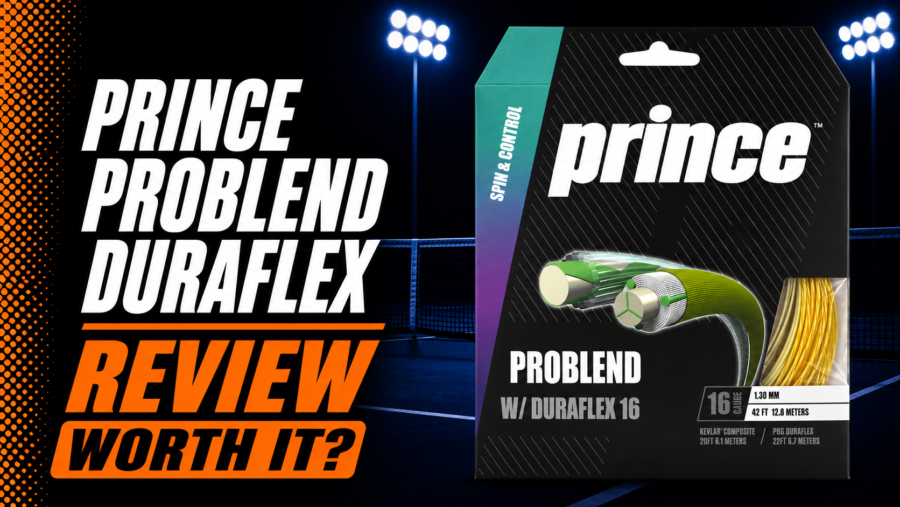
Prince ProBlend Duraflex is an extreme-durability hybrid tennis-string set that pairs aramid mains, commonly described as Kevlar, with Prince Synthetic Gut Duraflex crosses. Both components are 16 / 1.30mm, but their materials and playing roles are very different.
The aramid mains provide exceptional resistance, very low power and a rigid response. The nylon crosses add some elasticity and feel while protecting the frame from the impractical harshness of an all-aramid stringbed.
ProBlend targets chronic string breakers with fast swings who prioritize lifespan and control above comfort or free depth. It is a specialist product, not a general recommendation for beginners or players with arm discomfort. The Tennis String Finder can help identify less demanding alternatives.
Prince ProBlend Duraflex Rating
| Category | Rating |
|---|---|
| Power | 3.5/10 |
| Spin | 7.5/10 |
| Comfort | 2.5/10 |
| Control | 9/10 |
These ratings reflect the packaged aramid-main configuration. Control and physical resistance are exceptional, while power and comfort are extremely limited.
Prince ProBlend Duraflex Specifications
| Specification | Details |
|---|---|
| String type | Aramid/synthetic-gut hybrid |
| Main material | Aramid fiber, commonly called Kevlar |
| Main gauge | 16 / 1.30mm |
| Main length | Approximately 6.7m |
| Cross material | Prince Synthetic Gut with Duraflex reinforcement |
| Cross gauge | 16 / 1.30mm |
| Cross length | Approximately 6.1m |
| Colors | Tan mains with Gold or Black crosses |
The packaged lengths are intended for one hybrid installation. They are not two complete full sets.
Material and Construction
The mains use braided or bundled aramid fibers. Kevlar is a well-known aramid trade name, while aramid is the more general material category. The fibers have extremely low elongation and resist cutting better than ordinary nylon.
The crosses use Prince Synthetic Gut Duraflex. This is a solid-core nylon with outer wraps and Duraflex reinforcement intended to improve wear resistance.
The synthetic-gut cross adds elasticity, power and feel to the rigid main string. It also becomes a sacrificial component at the intersections and may fray or break before the aramid mains.
An all-aramid installation would be substantially firmer and is not the packaged design. ProBlend should be evaluated as an integrated hybrid rather than treating either material alone as the complete product.
Prince ProBlend Duraflex Performance
Power
ProBlend is one of the lowest-powered setups available. Aramid mains stretch very little, returning less easy depth than polyester, nylon, multifilament or natural gut.
The synthetic-gut crosses add some rebound, but they cannot overcome the dominant response of the mains. Players must supply pace through swing speed and clean contact.
The low power can be useful to very strong hitters who routinely launch softer strings. It is demanding for defensive shots, compact strokes and late contact.
Lower reference tension can improve pocketing, but it will not turn ProBlend into a lively setup. Players seeking accessible pace should choose another construction.
Power rating: 3.5/10
Spin
ProBlend can support strong spin for fast swingers. Its low power allows aggressive acceleration, and the aramid mains resist breaking under repeated topspin friction.
The system does not provide modern co-polyester snapback. Aramid and synthetic gut can notch, and the mains may remain displaced rather than returning efficiently.
Spin therefore comes more from swing path and the player’s ability to accelerate than from low-friction string movement. The setup can suit chronic breakers who shred softer strings with topspin.
Players seeking the easiest spin production should prefer a suitable shaped or low-friction co-polyester. ProBlend’s advantage is survival under spin-heavy wear.
Spin rating: 7.5/10
Control
Control is exceptional for players who can generate their own pace. The low elongation of the aramid mains creates a restrained, direct launch.
Hard hitters can swing fully without the trampoline response of softer strings. Directional targeting remains predictable while the cross retains useful tension and elasticity.
The response can become too dead for players without sufficient strength or timing. A stringbed that produces short balls is not meaningfully controlled for that player.
As the nylon cross loses tension or wears, the relationship between components changes. Control should be judged by current trajectory, not by the mains remaining unbroken.
Control rating: 9/10
Comfort and Feel
Comfort is ProBlend’s main weakness. Aramid is exceptionally stiff and transfers a direct response through the stringbed, especially on off-center contact.
The Synthetic Gut Duraflex cross adds some cushioning, but the mains remain the dominant component. A vibration dampener changes sound and some high-frequency vibration, not the fundamental stiffness of the setup.
Players with previous or current arm discomfort should generally avoid this construction and seek qualified advice where appropriate. ProBlend should never be marketed as arm friendly.
Even players who tolerate firm strings should avoid excessive tension and assess the full racket setup. A stiff frame combined with aramid mains can be particularly demanding.
Comfort rating: 2.5/10
Durability and Tension Maintenance
Physical durability is the reason ProBlend exists. The aramid mains resist sawing and breakage far better than typical nylon or multifilament.
The Synthetic Gut Duraflex crosses are less resistant and often become the limiting component. They can notch, fray and eventually snap while the aramid mains remain intact.
Physical resistance is separate from useful playability duration. Aramid has low elongation and holds its character, but the nylon cross loses tension and elasticity over time, changing feel and trajectory.
Do not leave ProBlend installed indefinitely simply because the mains are unbroken. Replace it when the cross is deeply worn, tension relationship changes, trajectory becomes inconsistent or the bed feels excessively dead.
Choosing the Right Gauge
The packaged system uses one fixed gauge for both components.
| Component | Gauge | General role |
|---|---|---|
| Aramid mains | 16 / 1.30mm | Maximum physical resistance, low power and control |
| Synthetic Gut Duraflex crosses | 16 / 1.30mm | Added elasticity, feel and sacrificial wear layer |
Players wanting a thinner or softer blend need to build a custom hybrid. The standard ProBlend pack does not offer a gauge choice.
Full Bed or Hybrid Setup
Packaged Aramid/Synthetic-Gut Configuration
Install the tan aramid in the mains and Synthetic Gut Duraflex in the crosses. This is the intended and most sensible orientation because the mains dominate breakage and performance.
An all-aramid bed is not the packaged setup and would be even less forgiving.
Aramid Mains With Softer Crosses
Replacing Duraflex with multifilament or natural gut can add power and comfort. The aramid mains may cut through the softer cross quickly, reducing the economic value of the upgrade.
This custom setup remains very firm because the aramid mains dominate the stringbed.
Softer Mains With Aramid in the Crosses
Putting natural gut or multifilament in the mains and aramid in the crosses is generally less logical. The rigid cross can restrict movement and saw into expensive soft mains.
Players seeking soft mains with control crosses should normally use a smooth, round co-polyester rather than aramid.
General Tension Guidance
ProBlend should generally be installed below the reference used for a full bed of nylon or synthetic gut. The aramid mains stretch very little and feel substantially firmer.
Many stringers reduce the main reference relative to ordinary nylon while keeping the cross relationship sensible. Exact numbers depend on the frame, pattern and player, so one universal prescription would be inappropriate.
Avoid using high tension simply because the player wants control. ProBlend already supplies extreme restraint through material stiffness.
The Tennis String Tension Calculator can provide only a broad starting point for this unusual construction. Experienced stringer guidance is particularly valuable.
Who Should Use Prince ProBlend Duraflex?
ProBlend is best suited to:
- Chronic string breakers with long, fast swings
- Players who prioritize physical lifespan over comfort
- Strong hitters seeking an extremely restrained launch
- Users familiar with aramid hybrids
- Players whose nylon mains break very quickly
- Buyers who understand the cross may fail first
Who Should Avoid Prince ProBlend Duraflex?
ProBlend is less suitable for:
- Beginners and compact swingers
- Players with current or previous arm discomfort
- Users seeking easy power or pocketing
- Players who prefer soft impact and touch
- Anyone planning to keep the setup indefinitely
- Players seeking modern polyester snapback
Pros and Cons
| Pros | Cons |
|---|---|
| Exceptional resistance to main-string breakage | Extremely firm response |
| Outstanding control for very fast swings | Very low free power |
| Complete packaged hybrid | Unsuitable for many players |
| Duraflex cross adds some playability | Cross can wear before the aramid main |
| Useful for chronic string breakers | Limited modern snapback |
| Long history as a specialist setup | Fixed 16 / 1.30mm gauges |
Prince ProBlend Duraflex Compared With Other Strings
ProBlend vs Prince Synthetic Gut Duraflex
Prince Synthetic Gut Duraflex in a full bed is far more powerful and comfortable but much easier to break. ProBlend uses it only in the crosses beneath aramid mains.
ProBlend vs Prince Tour XC
Prince Tour XC is a durable low-powered co-polyester. It provides modern snapback and more comfort, while ProBlend offers even greater break resistance and stiffness.
ProBlend vs Luxilon 4G
Luxilon 4G is a firm polyester known for tension stability. It is more responsive and spin efficient than aramid, while ProBlend is aimed at the most severe string breakers.
ProBlend vs Wilson NXT DuraMax
Wilson NXT DuraMax approaches durability from the opposite direction by reinforcing a comfortable multifilament. It is far softer and livelier, but cannot match aramid resistance.
Final Verdict
Prince ProBlend Duraflex is a specialist durability system, not a broadly balanced hybrid. Its 16 / 1.30mm aramid mains provide extreme resistance and control, while matching Synthetic Gut Duraflex crosses add enough elasticity to make the package more playable than all aramid.
The tradeoffs are substantial. Power and comfort are extremely low, modern snapback is limited, and the nylon cross can lose useful performance while the aramid remains intact.
For chronic string breakers with strong, fast swings, ProBlend can solve a specific physical-lifespan problem. Most beginners, comfort seekers and players with arm concerns should choose a less demanding material.
Frequently Asked Questions
What strings are included in Prince ProBlend Duraflex?
The pack contains 16 / 1.30mm aramid mains and 16 / 1.30mm Prince Synthetic Gut Duraflex crosses.
Is the main string Kevlar?
It is an aramid fiber commonly described as Kevlar. Kevlar is a widely recognized trade name within the aramid category.
Is ProBlend comfortable?
No. It is one of the firmest common string setups and should not be presented as arm friendly.
Is ProBlend powerful?
No. Its aramid mains provide very little free depth.
Why use synthetic gut in the crosses?
The nylon cross adds elasticity, feel and playability to the extremely rigid aramid mains.
Does ProBlend last until the mains break?
Not necessarily. The cross can wear or lose performance first, and the bed may require replacement before either component snaps.
Should ProBlend be strung at normal nylon tension?
Usually not. Aramid is much firmer, so the setup generally requires a lower and carefully considered reference.