
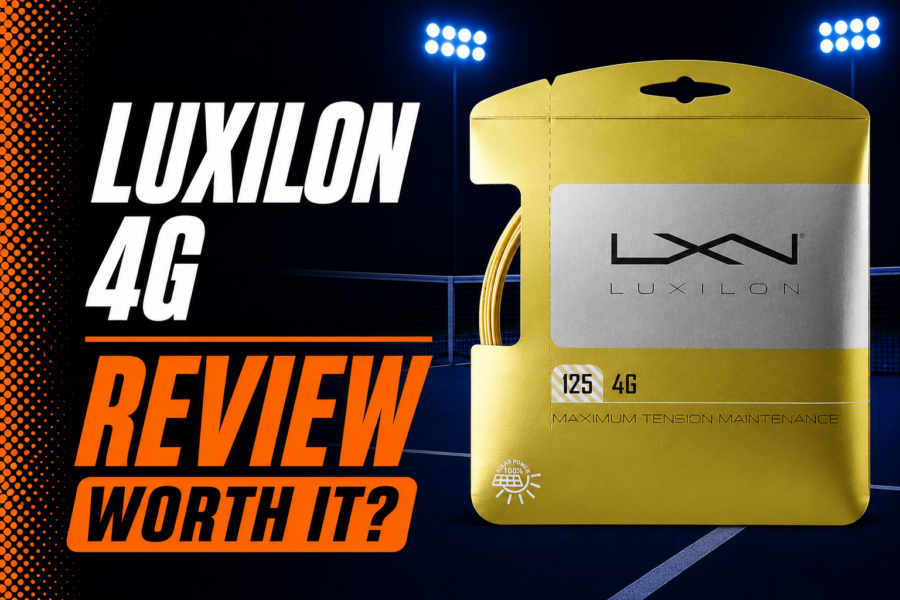
Luxilon 4G is a round polyester tennis string designed for advanced players who prioritize control, tension stability and a predictable response. It is one of Luxilon’s most control-focused strings and provides the foundation for variations such as 4G Soft and 4G Rough.
The string is firm and relatively low powered, but its performance is more nuanced than those labels suggest. Independent evaluations have found strong spin, useful pocketing for an experienced polyester user and a response that remains consistent longer than many traditional co-polyesters.
4G works best when paired with developed technique and fast acceleration. It allows a player who already generates pace to take committed swings without excessive launch. Players unsure whether that profile fits their game can use the Tennis String Finder to compare it with softer and more powerful materials.
Luxilon 4G Rating
| Category | Rating |
|---|---|
| Power | 6/10 |
| Spin | 8.5/10 |
| Comfort | 7/10 |
| Control | 9/10 |
These ratings compare 4G with the complete tennis-string market. Comfort remains relative for a firm polyester, and power remains lower than natural gut, multifilament and most synthetic gut.
Luxilon 4G Specifications
| Specification | Details |
| String type | Polyester monofilament |
| Composition | Poly-ether-ether formulation with performance-enhancing nucleates |
| Profile | Round |
| Surface | Smooth |
| Common gauges | 1.25mm and 1.30mm |
| Colors | Gold and Black, depending on gauge and market |
| Set length | Approximately 12.2m |
| Reel length | Approximately 200m |
| Made in | Belgium |
Gauge, color and package availability can differ between regions and retailers.
Material and Construction
Luxilon 4G uses a poly-ether-ether-based monofilament. The manufacturer describes aligned molecular chains and added nucleates as important parts of the construction, with the goal of combining strength, controlled flexibility and tension stability.
The string has a round, smooth profile. It does not depend on sharp edges, dents or a separately advertised rough coating. Its spin potential comes from string movement, snapback, a predictable launch and the player’s ability to accelerate.
The construction is designed to reduce the rapid change in response that can occur as a polyester string loses tension. This does not mean that 4G maintains its original performance indefinitely, but tension stability is a central and well-supported advantage.
The material remains firm and less elastic than nylon or natural gut. 4G’s useful pocketing becomes most apparent when an advanced swing supplies enough force to activate the stringbed. Players with compact strokes are more likely to experience only the rigidity and low free power.
The 1.25mm and 1.30mm versions preserve the same basic construction but shift the balance between response and resistance to wear. The racket, pattern and tension remain equally important parts of the final result.
Luxilon 4G Performance
Power
4G is low powered across the broader tennis-string market, but independent playtesting suggests that a simple minimum score would understate its response. Fast-swinging players can obtain useful depth and pocketing without the string becoming unpredictable.
Its power is controlled rather than effortless. A developed stroke can compress the stringbed and drive through the court, while a short or hesitant swing receives limited assistance.
Compared with natural gut, multifilament or synthetic gut, 4G requires substantially more player-generated pace. Compared with very stiff durability polyesters, it can feel moderately responsive once properly activated.
Power rating: 6/10
Spin
4G provides stronger spin than its round profile might suggest. Independent evaluations have found very good spin potential, supported by string movement and the confidence its controlled launch gives the player.
The string does not need sharp edges to create a heavy ball. A fast upward swing can use snapback to generate topspin, while the firm response helps aggressive players maintain trajectory control.
Players seeking a visibly shaped or textured response may prefer 4G Rough or a dedicated spin string. Regular 4G better suits those who want a clean, consistent release with spin generated mainly through movement and technique.
Spin rating: 8.5/10
Control
Control is one of 4G’s defining strengths. Its restrained power and predictable launch allow accomplished players to accelerate through groundstrokes, returns and serves with confidence.
The string performs well under incoming pace. It supports directional changes and flatter attacks without creating excessive rebound, while its spin potential provides margin during aggressive baseline patterns.
Tension stability also supports control because the response tends to change less abruptly than it does with some performance polyesters. Useful control can still decline as elasticity and snapback fade, even if the string has not broken.
Control rating: 9/10
Comfort and Feel
4G has a firm and connected feel, but independent playtesting has found more comfort and pocketing than its reputation sometimes suggests. It is reasonably forgiving for a control polyester when installed in a suitable racket and used by a player with clean technique.
That context is essential. 4G remains much less elastic than natural gut or multifilament. A player moving from a soft nylon will probably experience it as demanding, particularly at an unnecessarily high tension.
Players who like a stable, substantial response may appreciate its feel. Those who want a more forgiving version of the concept should consider Luxilon 4G Soft. Anyone with recurring arm discomfort should seek an appropriate softer setup and professional medical advice when needed.
Comfort rating: 7/10
Durability and Tension Maintenance
4G has excellent physical resistance to breakage. Its monofilament construction and robust gauges tolerate repeated high-speed impact and friction better than most natural-gut or multifilament strings.
Physical durability is not the same as useful playability duration. The string can remain intact after losing some elasticity, snapback and responsiveness. An unbroken stringbed should not automatically remain in a racket if control and comfort have materially declined.
Tension maintenance is a genuine strength. Manufacturer positioning and independent evaluations both support 4G’s ability to maintain a stable, predictable response for longer than many performance polyesters.
That strength is not permanent immunity to aging. Heavy topspin, open patterns, frequent play and high impact speed can still accelerate notching and performance loss. Reduced snapback, weaker trajectory control or a harsher impact are useful replacement signals.
Choosing the Right Gauge
4G is commonly documented in 1.25mm and 1.30mm. The thinner version offers a more active response, while the thicker version adds material for durability and stability.
| Gauge | General characteristics | Best suited to |
| 1.25mm | More responsive, slightly livelier and easier to move | Players prioritizing spin, feel and a balanced full-bed response |
| 1.30mm | Firmer, more stable and more resistant to wear | Frequent string breakers, open patterns and players prioritizing maximum control |
The difference should not be isolated from the rest of the setup. A dense pattern can make 1.25mm feel controlled, while a powerful open-pattern racket can make 1.30mm the more logical choice.
Full Bed or Hybrid Setup
Full Bed
A full bed produces the strongest version of 4G’s control, tension stability and consistent response. It suits intermediate and advanced players with long, fast swings who already know that polyester works for their arm.
The setup can feel firm and underpowered in a low-powered racket or dense pattern. Players moving from nylon should expect less free depth and may prefer 4G Soft or a hybrid as a transitional option.
4G in the Mains With Softer Crosses
Using 4G in the mains preserves its control and durability character. Natural gut, multifilament or synthetic gut in the crosses can add pocketing, power and comfort.
This orientation works well when 4G should dominate the performance. Its smooth round profile is less abrasive than an aggressively shaped polyester, although firm mains will still notch a softer cross over time.
Luxilon Natural Gut offers a premium partner, while multifilament and synthetic gut provide more economical options.
Softer Mains With 4G in the Crosses
Natural gut or multifilament mains create a more powerful, elastic and comfortable hybrid. 4G crosses reduce launch and add a stable control frame around the softer main strings.
This orientation is particularly relevant to players who want the main string to provide most of the feel while 4G contributes predictability. The smooth round profile also allows soft mains to move more freely than a rough or sharply shaped cross.
General Tension Guidance
4G normally performs best at a lower tension than the same player would choose for synthetic gut or multifilament. Its controlled polyester construction already limits launch, and excessive tension can remove useful pocketing.
Players seeking more depth, comfort and string movement can begin toward the lower part of the racket manufacturer’s recommended range. Players seeking a firmer trajectory can adjust upward gradually while monitoring impact feel.
Gauge, head size, pattern density, racket stiffness and hybrid direction must be considered together. The Tennis String Tension Calculator offers a useful starting framework, while a qualified stringer can refine it from the player’s present setup.
Who Should Use Luxilon 4G?
4G is best suited to:
- Intermediate and advanced players with long, fast swings
- Players who prioritize control and tension stability
- Aggressive baseliners who generate their own power
- Players who want strong spin from a smooth round polyester
- Frequent string breakers seeking substantial wear resistance
- Hybrid users seeking a predictable control-oriented component
Who Should Avoid Luxilon 4G?
4G is less suitable for:
- Beginners who need easy depth and forgiveness
- Players with short or slow swings
- Players seeking plush natural-gut or multifilament comfort
- Anyone with recurring arm discomfort who has not been advised that polyester is appropriate
- Players who leave polyester installed after its playing response declines
- Players who prefer a highly textured or sharply shaped spin string
Pros and Cons
| Pros | Cons |
| Excellent control on committed swings | Low powered compared with nylon and natural gut |
| Very good tension stability for a polyester | Firm response can be demanding |
| Strong spin despite the round profile | Not designed for beginners or slow swings |
| High resistance to physical breakage | Peak response can end before physical breakage |
| Two gauges cover response and durability priorities | Premium price for a polyester string |
| Smooth profile works well in hybrids | Softer alternatives provide easier depth and comfort |
Luxilon 4G Compared With Other Strings
Luxilon 4G vs Luxilon 4G Soft
Luxilon 4G Soft offers more pocketing and forgiveness while retaining excellent control. Regular 4G is the firmer and more direct option. Soft suits players who want easier comfort, while standard 4G suits those who prioritize maximum stability.
Luxilon 4G vs Luxilon 4G Rough
Luxilon 4G Rough adds dents along a round base to create texture and greater flex. Rough may provide a more responsive, surface-oriented experience, while regular 4G offers the cleaner and more uniform release.
Luxilon 4G vs Luxilon ALU Power
Luxilon ALU Power is livelier and has a more explosive, recognizable impact response. 4G emphasizes tension stability and restrained control. ALU Power suits players prioritizing feel and response, while 4G better suits those who want consistency over time.
Luxilon 4G vs Luxilon Big Banger Original
Luxilon Big Banger Original is thicker, firmer and lower powered. It offers extreme break resistance and control but requires even more player-generated pace. 4G is the more responsive and versatile choice for most advanced players.
Luxilon 4G vs Luxilon Adrenaline
Luxilon Adrenaline provides a crisp control response at a lower typical price. 4G offers better tension stability and a more substantial feel, while Adrenaline may appeal to players seeking value within the Luxilon range.
Final Verdict
Luxilon 4G is a firm control polyester with an unusually stable response. Its round construction delivers stronger spin and more useful pocketing than its severe reputation may suggest, provided the player has enough swing speed to activate it.
It remains demanding. Players who need easy pace, maximum comfort or beginner-friendly forgiveness will find better options in nylon, natural gut or softer polyester constructions.
For an experienced player who creates power and wants predictable control over a longer useful period, 4G remains a well-defined choice. The 1.25mm gauge provides the more responsive setup, while 1.30mm emphasizes stability and resistance to wear.
Frequently Asked Questions
Is Luxilon 4G a low-powered string?
Yes, when compared with the complete string market. Fast-swinging players can still obtain useful depth and pocketing, but the string does not supply effortless pace.
Does Luxilon 4G produce good spin even though it is round?
Yes. Independent evaluations support strong spin through movement, snapback and the confidence its controlled launch gives aggressive players.
Is Luxilon 4G comfortable?
It is reasonably comfortable for a firm performance polyester in a suitable setup, but it remains much less elastic than natural gut or multifilament.
What is the difference between 1.25mm and 1.30mm 4G?
The 1.25mm version is more responsive and easier to move. The 1.30mm version offers greater stability and resistance to wear.
Is 4G better than 4G Soft?
Neither is universally better. Regular 4G provides the firmer and more direct response, while 4G Soft offers more pocketing and comfort.
Is 4G suitable for beginners?
It is generally not the best starting string. Synthetic gut or multifilament provides easier depth, more forgiveness and better comfort for most beginners.
How long does Luxilon 4G remain playable?
There is no fixed number of hours. Racket pattern, swing speed, tension and playing frequency all matter. Reduced snapback, weaker control and harsher feel indicate that useful playability may have ended.