
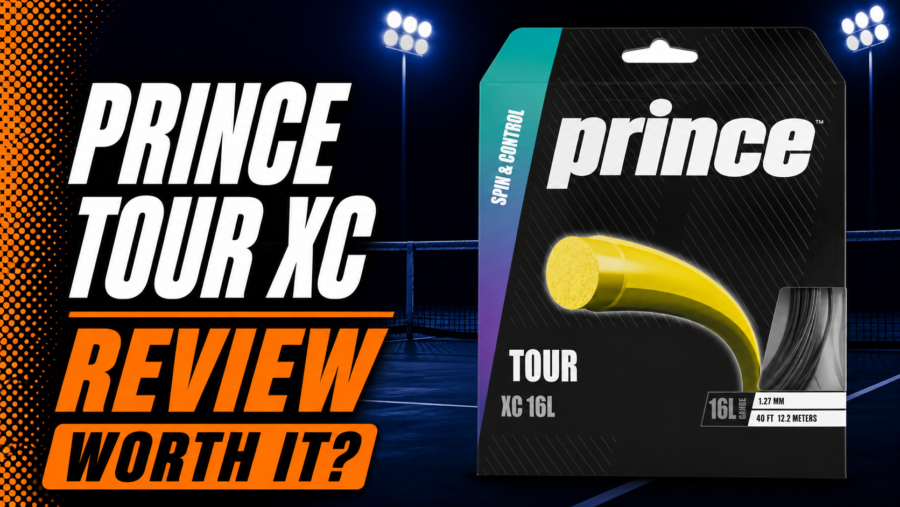
Prince Tour XC is a round co-polyester tennis string developed for maximum control, physical resistance and low-friction snapback. The initials refer to its extra-control positioning within Prince’s Tour polyester family.
Tour XC is firmer and lower powered than Tour XP. Prince adds a high-molecular-weight outer coating that reduces friction at string intersections, supports sliding and protects the surface from wear.
The string targets advanced players with long, fast swings, particularly those using open patterns or powerful rackets. It is too demanding for most beginners and players who need easy depth. The Tennis String Finder can help compare it with more accessible materials.
Prince Tour XC Rating
| Category | Rating |
|---|---|
| Power | 4.5/10 |
| Spin | 8/10 |
| Comfort | 5.5/10 |
| Control | 8.5/10 |
These ratings align with independent playtesting. Tour XC is exceptionally controlled and physically durable, while power and comfort are deliberately limited.
Prince Tour XC Specifications
| Specification | Details |
|---|---|
| String type | Control-oriented co-polyester monofilament |
| Composition | Co-polyester |
| Profile | Round and smooth |
| Surface technology | High-molecular-weight low-friction outer coating |
| Documented gauges | 15 / 1.40mm, 15L / 1.35mm, 16L / 1.27mm and 17L / 1.22mm |
| Common colors | Black and Yellow |
| Set length | Approximately 12.0m to 12.2m |
| Reel length | Approximately 200m, depending on market |
Current availability is strongest for 16L / 1.27mm. Thicker and thinner versions may be regional, legacy or difficult to find.
Material and Construction
Tour XC is a single round co-polyester monofilament. It does not use shaped edges for ball bite, and its low power comes from the firm material and controlled elasticity.
Prince applies a high-molecular-weight outer coating. The coating creates a low-friction surface intended to let the mains slide across the crosses and return after impact.
Reduced friction can also limit wear at string intersections. This is particularly relevant in Prince’s very open ESP patterns, for which the thicker Tour XC gauges were originally practical companions.
The coating should not be described as making the string soft. Independent playtesting found a firm, sometimes board-like response despite laboratory stiffness that was not the highest in its category.
Prince Tour XC Performance
Power
Tour XC is one of the lowest-powered strings in Prince’s polyester range. Independent playtesting gave it a very low power score and found little assistance on compact swings.
This response is intentional. Advanced players who generate substantial pace can take full cuts without the stringbed adding unpredictable depth.
The thinner 17L / 1.22mm gauge is the liveliest option, while the 15 and 15L versions produce maximum restraint and stability. Current 16L provides a balanced control setup within the family.
Lowering tension can add pocketing, but it will not transform Tour XC into a power string. Players who need easy depth should choose Tour XP, multifilament or synthetic gut.
Power rating: 4.5/10
Spin
Tour XC produces good spin through low friction and swing freedom rather than geometric edges. The smooth coating lets the mains slide and snap back when the bed is fresh.
Independent testers found predictable spin and strong string return. The thinner gauge supplied more bite, while the thicker version remained effective in an extremely open pattern.
Its low power also lets advanced players accelerate aggressively, which is essential for rotation. This explains why a round string can be spin friendly without a shaped profile.
Tour XC does not grip the ball as sharply as Prince Vortex Triad. Players choosing between them should decide whether they value smooth snapback and resistance or direct edge bite.
Spin rating: 8/10
Control
Control is Tour XC’s defining strength. The firm, restrained response creates a predictable launch when fast hitters attack the ball.
Independent evaluation found it particularly effective in powerful rackets and very open string patterns. Those setups benefit from a string that limits excess depth.
Directional confidence remains high as long as the player consistently finds the sweet spot. Off-center contact can feel unforgiving and may reduce both depth and comfort.
The low-friction coating helps preserve main movement, but no polyester retains its original response indefinitely. Control should be reassessed when tension and elasticity decline.
Control rating: 8.5/10
Comfort and Feel
Comfort is below average in the wider market. Independent testers disagreed somewhat, with one finding the string firm and board-like and another finding it manageable in a suitable setup.
That difference shows how strongly racket, pattern, tension and contact quality influence polyester feel. Tour XC should not be labeled a soft string solely from laboratory stiffness.
The response is direct, firm and controlled. Sweet-spot contact can feel stable, while off-center shots are less forgiving.
Players with persistent arm discomfort should generally avoid a full bed or consult an appropriate professional. Lower tension can help pocketing but does not remove the material’s firm identity.
Comfort rating: 5.5/10
Durability and Tension Maintenance
Tour XC provides excellent physical durability. Its monofilament structure, thick gauge options and protective low-friction coating resist notching and surface wear.
Independent testers rated durability extremely highly and found the strings continued sliding after several sessions. The thicker versions are especially suitable for open patterns.
Physical durability is not the same as useful playability duration. Tour XC may remain unbroken after tension loss, reduced elasticity or a dead response begin affecting performance.
Independent playability-duration results were above average for co-polyester, but no fixed lifespan applies to every player. Replace the string when it stops returning, trajectory changes or impact becomes unusually unresponsive.
Choosing the Right Gauge
Tour XC’s unusually broad gauge range was designed in part for different pattern densities.
| Gauge | General characteristics |
|---|---|
| 15 / 1.40mm | Maximum resistance for extremely open patterns, with the firmest response |
| 15L / 1.35mm | Very high resistance and stability with slightly more response |
| 16L / 1.27mm | Best current all-around balance of control, spin and lifespan |
| 17L / 1.22mm | Greater feel, bite and launch, with lower resistance |
Availability should guide the decision. The 16L / 1.27mm version is the most realistic starting point for many current buyers.
Full Bed or Hybrid Setup
Full Bed
A full bed maximizes Tour XC’s control, low-friction interaction and durability. This setup is intended for experienced polyester users with powerful swings.
The thicker gauges are specialized for very open patterns. They can feel unnecessarily demanding in a conventional dense pattern.
Prince Tour XC in the Mains With Softer Crosses
Tour XC mains retain its controlled response while natural gut or multifilament crosses add depth and comfort. The round surface is less abrasive than a sharply shaped polyester.
The co-poly main can still notch the soft cross. This hybrid remains firmer than a full soft-string bed and should be evaluated accordingly.
Softer Mains With Prince Tour XC in the Crosses
Natural gut or multifilament mains emphasize power and feel. Tour XC crosses supply a smooth, low-friction support string that can improve snapback relative to a shaped cross.
This is a logical custom hybrid, particularly with natural gut, but the thick Tour XC gauges may overpower delicate mains. The 16L or thinner version is more appropriate than 15 gauge for most standard patterns.
General Tension Guidance
Tour XC should generally be installed below a typical nylon or multifilament reference. Its firm, low-powered character does not require high tension to produce control.
Players seeking pocketing can make a modest reduction. Independent testing found that lower references did not eliminate its restrained identity.
Gauge and pattern matter. Thick Tour XC in an open pattern behaves differently from 17L in a dense pattern, so one universal number would be misleading.
Use the Tennis String Tension Calculator for a broad starting point and adjust in small steps within the racket manufacturer’s approved range.
Who Should Use Prince Tour XC?
Tour XC is best suited to:
- Advanced players with long, fast swings
- Big hitters seeking maximum control
- Users of powerful rackets or open string patterns
- Frequent string breakers
- Players who prefer round low-friction polyester
- Users willing to replace polyester before it breaks
Who Should Avoid Prince Tour XC?
Tour XC is less suitable for:
- Beginners and compact swingers
- Players seeking easy power and depth
- Users who prioritize soft impact
- Players who frequently miss the sweet spot
- Anyone who keeps a durable polyester indefinitely
- Players who want aggressive shaped-string bite
Pros and Cons
| Pros | Cons |
|---|---|
| Exceptional control | Very low free power |
| High-molecular-weight low-friction coating | Firm and unforgiving outside the sweet spot |
| Excellent physical durability | Too demanding for most beginners |
| Good spin from sliding and snapback | No shaped edges for direct bite |
| Broad gauge range | Several gauges are difficult to find |
| Strong fit for open patterns | Physical life can exceed useful playability |
Prince Tour XC Compared With Other Strings
Tour XC vs Prince Tour XP
Prince Tour XP is softer, livelier and more accessible. Tour XC provides less power, a firmer response and greater resistance for big hitters.
Tour XC vs Prince Vortex Triad
Prince Vortex Triad uses three sharp sides for aggressive bite. Tour XC is round and relies more on its low-friction coating and swing freedom.
Tour XC vs Luxilon 4G
Luxilon 4G is also a round control polyester known for tension stability. Tour XC offers strong value and specialized thick gauges, while 4G has a crisper premium response.
Tour XC vs Tecnifibre Razor Code
Tecnifibre Razor Code is a firm round co-polyester with strong precision and a more responsive feel. Tour XC is more deliberately low powered and available in thicker open-pattern gauges.
Final Verdict
Prince Tour XC is a specialized control polyester built for big swings and demanding string patterns. Its round monofilament uses a high-molecular-weight low-friction coating to support snapback and protect against wear.
Independent evaluation confirms excellent control and physical durability, good spin and very limited free power. Comfort depends heavily on setup and should not be overstated.
For advanced hitters who find ordinary co-polyesters too lively or wear them quickly, Tour XC remains a strong-value option. Current buyers will usually find 16L / 1.27mm the most practical gauge.
Frequently Asked Questions
What type of string is Prince Tour XC?
It is a round, control-oriented co-polyester monofilament with a low-friction outer coating.
Is Tour XC shaped?
No. It has a round profile and produces spin through sliding, snapback and swing speed.
Is Tour XC powerful?
No. It is one of Prince’s lowest-powered polyester strings.
What does the outer coating do?
The high-molecular-weight coating reduces friction, supports string movement and helps limit wear.
Which gauge should most players choose?
The currently available 16L / 1.27mm version provides the most balanced starting point.
Is Tour XC suitable for beginners?
Generally no. Its firm feel and low power require reliable contact and fast swings.
Can Tour XC be used as a hybrid cross?
Yes. Its round, low-friction surface makes it more appropriate beneath soft mains than a sharply shaped polyester.