
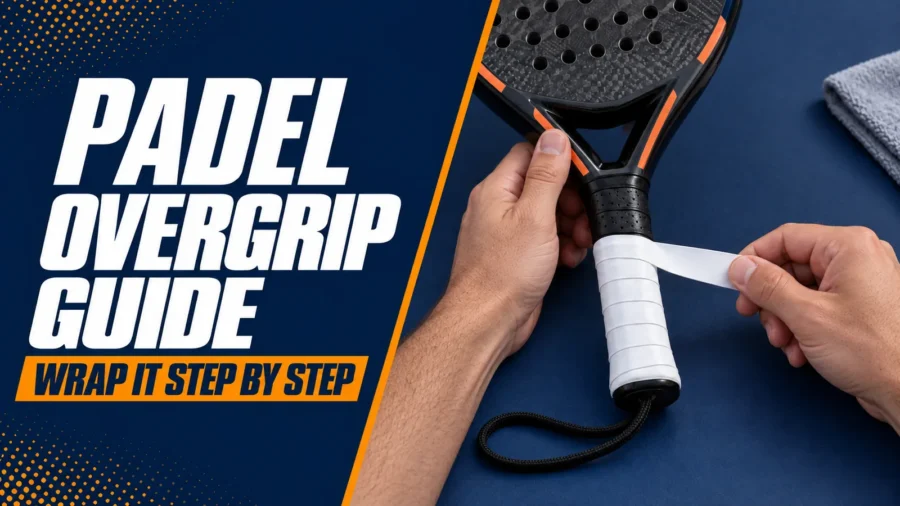
A padel overgrip is wrapped over the racket’s existing base grip to renew traction, manage moisture and make a small change to handle thickness. Installation begins at the butt cap, spirals toward the throat and finishes with tape above the gripping area.
The padel-specific priority is the safety cord. It must remain securely attached, unobstructed and easy to place around the wrist after the new wrap is installed. Do not bury the cord attachment under a bulky start, cut the cord or use the overgrip to hide damage.
Padel Overgrip vs Replacement Grip
The replacement grip is the thicker base layer fitted directly to the handle. It provides the main cushioning, shape and bevel definition. An overgrip is a thinner consumable layer placed over it.
Changing an overgrip normally does not require removing the replacement grip. If the base layer is crumbling, sliding, badly compressed or lifting from the handle, adding another overgrip will only cover the problem temporarily.
| Feature | Overgrip | Replacement grip |
|---|---|---|
| Position | Over the existing grip | Directly on the handle |
| Typical role | Renewable traction, moisture management and a small thickness change | Base cushioning, handle shape and structure |
| Replacement frequency | Condition-dependent and usually more frequent | Less frequent, based on structural wear |
| Installation | Simple spiral wrap | More involved removal and refitting |
Players building a complete first kit can use the beginner padel equipment checklist to separate essential equipment from optional accessories.
What Makes a Padel Overgrip Installation Different?
The basic spiral method is shared with other racket sports, but a padel handle is compact and includes a mandatory safety cord. The wrap needs to cover the gripping area without trapping the cord or climbing onto the throat.
Padel players also commonly use overgrip layers to fine-tune handle thickness. Every added layer changes circumference, softens the bevels and adds some mass near the hand. Those changes may be small, but stacking wraps indefinitely is not a reliable way to correct a badly fitting handle.
Under the current International Padel Federation rules, a padel racket must have a non-elastic safety cord fixed into the handle, no longer than 35cm, and its use around the wrist is obligatory. Inspect that cord before wrapping and again before play.
When Should a Padel Overgrip Be Changed?
There is no universal schedule. Sweat level, climate, surface texture, playing frequency, storage and personal preference all affect how quickly the outer layer changes.
Replace the overgrip when one or more of these signs appears:
- The handle slips during normal swings
- A tacky grip has become smooth
- A dry grip stays damp or no longer manages moisture effectively
- The surface is polished, frayed, torn or dirty
- The wrap shifts under the hand
- The finishing tape loosens
- An edge curls and creates a ridge
- The handle no longer feels secure with a relaxed hold
A manufacturer may publish a playing-hour suggestion, but condition is the better final test. Replace the wrap before it becomes unstable rather than waiting for it to separate completely.
What You Need
Prepare the following before removing the old layer:
- One suitable padel overgrip
- The supplied finishing tape or compatible grip tape
- Clean scissors
- A clean, dry cloth
- A stable table or seated working position
- The racket’s product instructions, when available
Many overgrips have a tapered starting end, a small adhesive tab and a protective film on the surface. Others are reversible or use a different starting construction. Check the package rather than assuming every strip has the same face.
Before You Start
Inspect the Safety Cord
Check where the cord exits the handle and how it moves around the butt cap. It should be firmly attached and free from fraying, cuts or damage.
If the cord is compromised, stop using the racket until it has been assessed or repaired appropriately. A new overgrip is not a safety-cord repair.
Check the Base Grip
Remove only the old overgrip and finishing tape. The base replacement grip should remain attached, evenly wrapped and reasonably clean.
If the base layer has shifted, correct it before continuing. Wrapping tightly over a loose foundation does not create a stable handle.
Identify the Starting End and Outer Face
Look for a tapered end or small adhesive tab. Remove any backing from that tab, but leave a surface-protection film in place until the product instructions say to remove it.
If there is no obvious start, compare both ends and follow the manufacturer’s diagram. Do not guess based only on color or texture.
How to Change a Padel Overgrip Step by Step
1. Remove the Old Overgrip
Peel away the finishing tape, then unwind the old overgrip from the top of the handle toward the butt cap. Work carefully around the safety-cord exit.
Dispose of the old wrap and adhesive tape. Do not leave fragments that could create bumps under the new layer.
2. Clean and Dry the Base Grip
Wipe loose dirt and moisture from the replacement grip with a clean, dry cloth. Avoid soaking it or using an unverified solvent.
Allow the handle to dry fully. Trapped moisture and residue can reduce stability and affect the underlying material.
3. Position the Safety Cord
Move the cord so it remains outside the path of the first wrap. The attachment point must stay secure, and the finished grip must not prevent the loop from opening or sitting around the wrist.
Do not pull the cord through a newly cut hole in the overgrip. Plan the starting angle around the existing attachment instead of altering the safety equipment.
4. Anchor the Overgrip at the Butt Cap
Place the tapered end against the lower edge of the handle, close to the butt cap. Hold the racket so the cord stays free while the first turn is made.
Use the product’s adhesive tab if one is supplied. The start should lie flat without covering the end cap excessively or forming a thick lump under the heel of the hand.
5. Make a Secure Base Turn
Wrap one controlled turn around the bottom of the handle. This anchors the strip and creates full coverage where the hand is most likely to pull against it.
Keep moderate, consistent tension. Too little tension can allow the wrap to move, while excessive stretching can thin, distort or tear the material.
6. Spiral Up the Handle
Angle the strip upward and overlap each previous turn by a consistent amount. The overlap needs to be wide enough to prevent gaps but not so wide that the handle becomes unnecessarily bulky.
Watch the edges as the wrap climbs. If a gap or crease develops, unwind to the problem and correct it instead of hiding it under another turn.
7. Keep the Bevels Even
Smooth each turn with the thumb while maintaining the same angle and tension. Uneven pulling can make one side thicker or round the handle irregularly.
The goal is a secure surface with recognizable handle shape. A soft overgrip will naturally reduce bevel sharpness slightly, but it should not create ridges.
8. Stop at the Top of the Gripping Area
Finish where the original grip ends, before the throat or exposed frame. A padel handle is shorter than a full tennis-racket handle, so many standard strips will leave excess material.
Do not keep wrapping onto the throat simply to use the full strip. Extra layers outside the hand area add bulk without improving the grip.
9. Mark and Trim the Excess
Hold the final turn in position and note the angle needed for a clean upper edge. Remove the loose section from the racket before cutting whenever practical.
Cut the strip at an angle so the final end follows the top edge of the handle. Keep scissors away from the frame, base grip, hand and safety cord.
10. Secure the Finishing Tape
Lay the trimmed end flat and wrap finishing tape around the top of the handle. The tape should hold the end without creating a thick ridge where the upper hand rests.
Press the tape firmly and check that its edge is not lifting. If the supplied tape is too short or loses adhesion, replace it with a suitable grip-finishing tape rather than wrapping ordinary household tape around the handle.
11. Test the Finished Grip and Cord
Run a hand around the handle and look for gaps, folds, loose edges and abrupt changes in thickness. Make a few slow shadow swings in a clear area to check whether the wrap moves.
Open the safety loop, place it around the wrist and confirm that it is unobstructed. The cord should not be pinched beneath the grip, shortened by the wrap or forced into an awkward angle.
How Much Overlap Should You Use?
There is no single correct measurement for every overgrip. Thickness, elasticity, perforation and length vary by product, and the compact padel handle can leave more excess than expected.
A modest, consistent overlap usually preserves more bevel definition. A wider overlap adds material and can create a softer, rounder handle. Follow any printed guide on the strip or packaging first, then keep the chosen overlap uniform from bottom to top.
If the overgrip repeatedly runs out before the handle is covered, reduce the overlap slightly rather than pulling much harder. If a large amount remains, trim it at the handle end rather than adding unnecessary layers.
How Tight Should the Overgrip Be?
Use enough tension to keep the material flat and secure, but not enough to distort it. Thin, perforated and highly elastic products respond differently, so “pull as hard as possible” is poor universal advice.
Consistent tension matters more than maximum tension. If the strip narrows dramatically, the perforations stretch out of shape or the material curls at the edges, unwind and use less force.
Does an Overgrip Change Handle Size or Racket Balance?
Yes, but the amount depends on the exact material, overlap and number of layers. One overgrip increases handle circumference and adds a small amount of mass near the butt of the racket.
Additional layers make the handle thicker, soften the bevels and move a little more mass toward the hand. They should be treated as real setup changes, not invisible fixes. Players choosing a frame in the first place can use the guide to choosing a padel racket by level and the padel racket finder rather than planning to correct every fit issue with stacked wraps.
An overgrip may change perceived comfort and security, but it cannot guarantee injury prevention or treat elbow, wrist or hand pain. Persistent discomfort deserves appropriate professional assessment and a review of technique, workload and the full equipment setup.
Common Padel Overgrip Problems
The Wrap Slips Around the Handle
The base may be damp or dirty, the first turn may be loose, or the strip may have been installed with too little tension. Remove it, dry the base and restart rather than adding tape over a moving layer.
Gaps Appear Between Turns
The spiral angle or overlap changed during installation. Unwind to the first gap and rewrap with a more consistent path.
The Handle Feels Too Round
The overlap may be too wide or too many layers may be installed. Use a thinner wrap, reduce overlap within the product’s limits or return to one layer.
A Bulge Forms at the Butt Cap
The starting end may be folded or repeatedly overlapped in the same place. Reposition the taper and use one clean anchoring turn.
The Safety Cord Is Hard to Use
The first turns may be covering or pinching its exit. Remove the overgrip and restart with the cord outside the wrapping path. Do not play with a cord that cannot be worn correctly.
The Top Edge Unwinds
The finishing tape may not be adhering to a clean surface, or the overgrip may end in a bulky fold. Recut the end at an angle and secure it with suitable finishing tape.
Can You Use a Tennis Overgrip on a Padel Racket?
Many overgrips are suitable for more than one racket sport, provided the strip has appropriate dimensions and the manufacturer permits the use. The padel handle may require less length, so excess material is normally trimmed.
The important checks are surface feel, thickness, elasticity, moisture behavior and secure fit. A product label does not remove the need to keep the safety cord free or stop the wrap at the correct place.
This article remains padel-specific. The cord check, compact handle and finished setup are the controlling details rather than copying another sport’s installation without adjustment.
How to Make an Overgrip Last Longer
Start with clean, dry hands and avoid storing a damp racket in a closed bag. After play, allow moisture to dissipate before putting the racket away in a dry environment protected from strong heat and direct sunlight.
Store unused overgrips in their packaging away from heat and humidity. Do not wash an installed overgrip or apply solvents unless the manufacturer specifically allows it.
Longevity is secondary to security. A worn wrap should be replaced even if it can be made to look cleaner.
Final Check
A good padel overgrip installation is even, secure and free of gaps. It covers the full hand area without climbing onto the throat, and the finishing tape lies flat.
Most importantly, the safety cord remains attached, visible and easy to wear. Check the wrap and cord before each session, then replace the outer layer when it becomes slippery, damaged or unstable.
Frequently Asked Questions
Should the original grip be removed before adding a padel overgrip?
No, not in a normal overgrip change. Remove the old overgrip and leave the sound replacement grip in place. Replace the base grip separately if it is loose, damaged or deteriorated.
Which side of the overgrip faces outward?
It depends on the product. Remove any protective film and follow the package markings. Some overgrips have an obvious outer surface and adhesive starting tab, while others are reversible.
Should the safety cord go under or over the overgrip?
The cord must remain fixed to the handle and free to loop around the wrist. Arrange the first turns around its existing exit without trapping, cutting or altering it.
How many overgrips should a padel racket have?
One fresh overgrip is a sensible starting point. Extra layers change circumference, bevel definition and mass, so add them only for a deliberate fit reason rather than by habit.
How often should a padel overgrip be replaced?
Replace it when traction, moisture management or wrap stability declines. Playing hours vary too much with sweat, climate and product construction for one schedule to fit every player.
Can an overgrip fix a padel handle that is too small?
It can make a modest increase, but several stacked layers can round the bevels and change balance. A substantially unsuitable handle or racket may require a more appropriate equipment choice. The ultimate padel racket buying guide covers the broader decision.
Is a thicker overgrip better for comfort?
Not automatically. More material can feel softer but can also make the handle harder to control for a particular hand. Comfort is individual and cannot be guaranteed by thickness alone.