
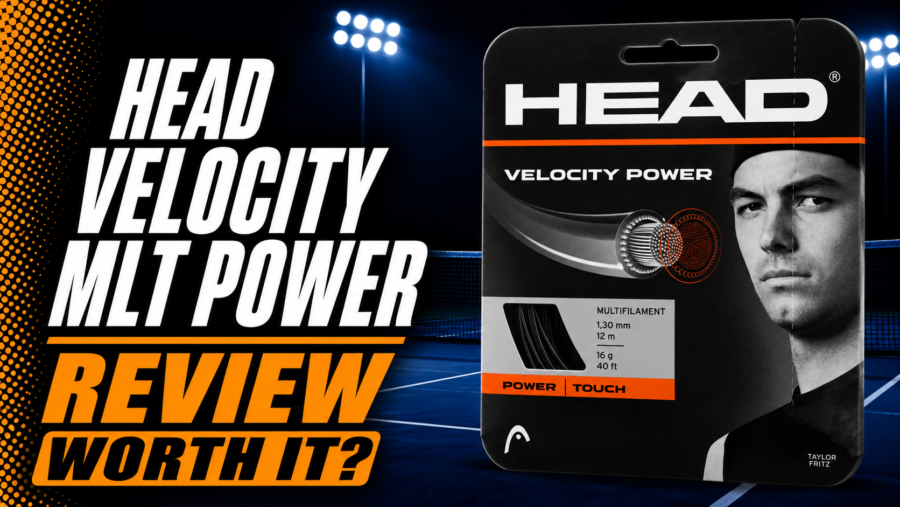
HEAD Velocity MLT Power is a round multifilament tennis string designed for easy pace, plush comfort and touch. It is the most power-oriented string in HEAD’s current range and is livelier than standard Velocity MLT.
The string uses thousands of synthetic microfilaments in a resin matrix. That flexible construction creates a high-energy response for compact and moderate swings, while its smooth exterior supports predictable movement.
Velocity MLT Power targets club and tournament players who want effortless depth without polyester firmness. The Tennis String Finder can help compare it with the more controlled standard version.
HEAD Velocity MLT Power Rating
| Category | Rating |
|---|---|
| Power | 9.5/10 |
| Spin | 6.5/10 |
| Comfort | 9/10 |
| Control | 6.5/10 |
These ratings align the official power positioning with independent testing that found exceptional pace, comfort and feel, alongside limited spin and control for advanced polyester users.
HEAD Velocity MLT Power Specifications
| Specification | Details |
|---|---|
| String type | Multifilament |
| Construction | Thousands of microfilaments in a resin matrix |
| Profile | Round |
| Surface | Smooth |
| Gauges | 16 / 1.30mm and 17 / 1.25mm |
| Colors | Black and Natural |
| Set length | Approximately 12m |
| Reel length | Approximately 200m |
HEAD does not publish a detailed fiber count or named coating for this Power version on the current product page. Unsupported construction specifics should therefore be avoided.
Material and Construction
Velocity MLT Power uses thousands of synthetic microfilaments held together inside a resin matrix. The fibers and resin flex as a system, producing more stretch and rebound than a solid polyester strand.
The profile is round and smooth. It does not have sharp edges, so spin comes from dwell time, movement and technique rather than geometric bite.
HEAD identifies Power as a separate version from standard Velocity MLT, but the current public specification does not explain the exact fiber or resin change. The supported conclusion is performance based: this version is designed and independently shown to be livelier.
As the fibers rub at the intersections, the surface can notch and fray. That wear is normal for multifilament and can reduce snapback before breakage.
HEAD Velocity MLT Power Performance
Power
Power is the string’s defining quality. Independent testing produced one of the highest power scores outside natural gut, confirming that the name reflects more than marketing.
Compact swings, defensive shots, serves and volleys receive substantial help from the stringbed. Players do not need maximum racket-head speed to create depth.
The same rebound can challenge fast swingers. In a powerful open-pattern racket, the launch may feel difficult to restrain without a thicker gauge or more controlled setup.
Power rating: 9.5/10
Spin
Velocity MLT Power offers moderate spin. Its smooth coating can support movement while fresh, but the round multifilament has no geometric edges.
Independent testers found enough rotation for general all-court play but not the rapid snapback expected from a spin-focused polyester. Frictional wear reduced spin as the test progressed.
The 1.25mm version provides easier ball interaction, while the 1.30mm version offers more stability and surface life.
Spin rating: 6.5/10
Control
Control is the principal trade-off for the string’s power. Players with compact and moderate swings can use the easy depth effectively, but advanced fast swingers may find the launch too lively.
Touch and directional placement are better than the numerical score alone suggests. The soft pocketing is useful at net and on shorter strokes, while repeated full-speed baseline swings expose the lower control ceiling.
As tension drops and the surface notches, launch can rise further. Useful control should determine replacement timing.
Control rating: 6.5/10
Comfort and Feel
Comfort and feel are exceptional. Independent testers reported plush pocketing, minimal harshness and a responsive impact on short strokes and volleys.
The feel is somewhat muted rather than crisp. Players who want direct feedback may prefer standard Velocity MLT, while those prioritizing softness may favor Power.
No string prevents injury or treats current pain. A comfortable construction can change impact feel, but persistent symptoms require qualified assessment.
Comfort rating: 9/10
Durability and Tension Maintenance
Physical durability is moderate. Independent testers observed frictional wear, notching and string displacement toward the end of the playtest.
Tension maintenance and useful playability were good for a powerful multifilament. The string remained comfortable, but declining surface slickness reduced spin and snapback.
The 1.30mm version provides more resistance. Heavy topspin players and frequent breakers should not expect polyester-level life from either gauge.
Choosing the Right Gauge
| Gauge | General characteristics |
|---|---|
| 16 / 1.30mm | Greater stability, control and physical resistance |
| 17 / 1.25mm | More power, feel and spin access with faster wear |
The 16 / 1.30mm version is the safest general starting point because the string is already highly responsive. Players using a dense pattern may prefer 1.25mm.
Full Bed or Hybrid Setup
Full Bed
A full bed maximizes easy power, comfort and pocketing. It suits compact and moderate swings, doubles players and anyone leaving a firm polyester.
Advanced fast swingers may need a more controlled string rather than raising tension dramatically.
HEAD Velocity MLT Power in the Mains With Polyester Crosses
Velocity MLT Power mains preserve much of the soft response, while a smooth polyester cross controls launch and supports movement.
The cross can notch the multifilament mains. This setup is firmer and less durable than a full soft bed for many players.
Polyester Mains With HEAD Velocity MLT Power Crosses
Polyester mains dominate control and spin. Velocity MLT Power crosses add pocketing and power, but do not make the setup equivalent to a full multifilament bed.
A round polyester is less abrasive than a shaped one and is generally preferable when preserving the cross is important.
General Tension Guidance
Velocity MLT Power can begin near a player’s established multifilament reference. Lower tension increases an already high launch, while higher tension can add control.
Large tension increases are not the best way to force a power string into an advanced control role. Standard Velocity MLT or a hybrid may be more logical.
Use the racket manufacturer’s range and account for pattern, head size and gauge. The Tennis String Tension Calculator provides broad guidance.
Who Should Use HEAD Velocity MLT Power?
Velocity MLT Power is best suited to:
- Club players with compact or moderate swings
- Players seeking easy depth and pace
- Doubles and serve-and-volley players
- Users prioritizing plush comfort and touch
- Players moving away from firm polyester
- Hybrid users wanting a powerful soft component
Who Should Avoid HEAD Velocity MLT Power?
Velocity MLT Power is less suitable for:
- Advanced fast swingers needing low launch
- Frequent multifilament breakers
- Heavy topspin players relying on polyester snapback
- Users who prefer crisp, direct feedback
- Players expecting maximum control from the Power label
- Anyone treating equipment as medical care
Pros and Cons
| Pros | Cons |
|---|---|
| Exceptional easy power | Limited control for very fast swings |
| Excellent comfort and pocketing | Moderate spin |
| Strong touch and feel | Frictional wear and string displacement |
| Two practical gauges | Lower physical durability than polyester |
| Good value for a high-performing multifilament | Can feel muted |
| Useful full-bed or hybrid component | Only two colors |
HEAD Velocity MLT Power Compared With Other Strings
Velocity MLT Power vs HEAD Velocity MLT
HEAD Velocity MLT is firmer, more controlled and more spin friendly. The Power version supplies easier depth and plusher pocketing.
Velocity MLT Power vs Wilson NXT Power
Wilson NXT Power is another premium power multifilament. Both emphasize comfort and pace, but their fiber construction, feel and price differ.
Velocity MLT Power vs Tecnifibre NRG2
Tecnifibre NRG2 uses Elastyl microfilaments, PU 400 and an SPL finish. Both are highly powerful, with NRG2 offering a more established premium construction.
Velocity MLT Power vs HEAD Reflex MLT
HEAD Reflex MLT provides premium comfort with a somewhat more controlled response and detailed low-friction construction. Velocity MLT Power is the more overtly power-focused choice.
Final Verdict
HEAD Velocity MLT Power is a compelling value for players who want maximum synthetic pace, comfort and touch. Independent testing supports its strongest claims and places its power close to the top of the multifilament category.
Its trade-offs are equally clear. Spin is moderate, aggressive hitters may struggle with launch, and frictional wear reduces snapback over time.
The 16 / 1.30mm gauge is the safest general choice because it adds stability to an already lively string. Players wanting more control should choose standard Velocity MLT rather than trying to suppress Power with extreme tension.
Frequently Asked Questions
Is Velocity MLT Power different from standard Velocity MLT?
Yes. It is a separate, more power-oriented multifilament with a plusher and livelier response.
Is it a polyester string?
No. It is a multifilament made from thousands of microfilaments in a resin matrix.
Which gauge should most players choose?
The 16 / 1.30mm version provides more stability and physical resistance, which complements the high power level.
Is Velocity MLT Power good for spin?
It provides adequate all-court spin but cannot match a shaped or low-friction polyester.
Is it comfortable?
Yes. Comfort and pocketing are among its strongest qualities, although no string can guarantee injury prevention.