
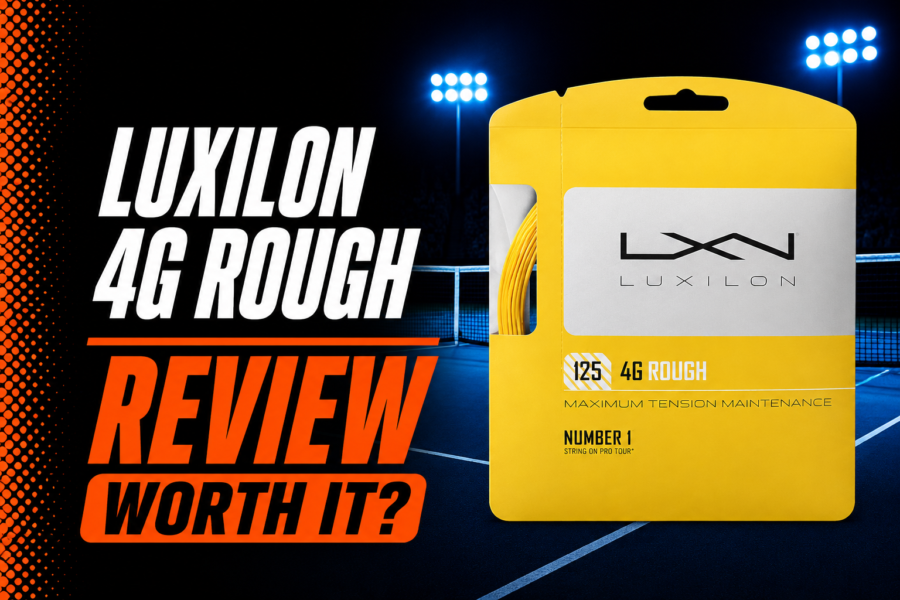
Luxilon 4G Rough is a textured poly-ether-ether monofilament designed for experienced players who prioritize control, spin access and resistance to breaking. It takes the firm, controlled foundation of standard 4G and adds a dented surface intended to increase ball bite and string flex.
The Rough version is not simply standard 4G with dramatically more spin. Its texture can improve the connection with the ball, but independent testing has not shown a decisive spin advantage over smooth 4G. The more noticeable differences are its slightly softer pocketing and the way its response can become livelier as the stringbed ages.
Luxilon 4G Rough is best suited to intermediate and advanced players with fast swings who can generate their own pace. Players who are unsure whether such a demanding string suits their game can use the Tennis String Finder to compare it with softer and more powerful alternatives.
Luxilon 4G Rough Rating
| Category | Rating |
|---|---|
| Power | 5/10 |
| Spin | 8.5/10 |
| Comfort | 6/10 |
| Control | 8.5/10 |
These ratings consider 4G Rough across the wider tennis-string market. Its low power, firm construction and strong break resistance suit aggressive players, but its comfort and useful playability duration should not be judged solely by the reputation of the standard 4G string.
Luxilon 4G Rough Specifications
| Specification | Details |
|---|---|
| String type | Polyester-type monofilament |
| Official material | Poly-ether-ether |
| Construction | Single monofilament with added nucleates |
| Profile | Round foundation with a dented texture |
| Surface | Rough treatment applied before final cooling |
| Gauge | 16L / 1.25mm |
| Color | Gold |
| Set length | Approximately 12.2m |
| Reel length | Approximately 200m |
| Made in | Belgium |
Some packaging and retailers may label the 1.25mm string as either 16 or 16L. The physical diameter is more useful than the traditional gauge label when comparing versions.
Material and Construction
Luxilon officially identifies the primary material in 4G Rough as poly-ether-ether. It is commonly grouped with polyester and co-polyester monofilaments because it produces the same general combination of control, spin potential, firmness and resistance to breaking.
The string contains one solid monofilament rather than the numerous bonded fibers found in multifilament strings. Luxilon also states that nucleates are added to improve strength and flexibility.
Its rough texture is created after the extrusion process but before the string has finished cooling. The surface is dented while the material remains soft, allowing Luxilon to create texture without cutting into the finished string.
This means 4G Rough is not a polygonal string with sharp geometric edges. It uses surface irregularities to increase ball contact and flex rather than relying on a square, pentagonal or octagonal profile.
The molecular chains within the material are arranged in a parallel direction. Luxilon says this reduces entanglement and limits creep, which is the gradual permanent stretching that contributes to tension loss.
No separate lubricating or spin coating is identified for 4G Rough. Its performance comes from its material formulation, textured surface and the controlled elasticity of the monofilament.
Luxilon 4G Rough Performance
Power
Luxilon 4G Rough is a low-powered string across the overall tennis-string market. It provides much less accessible depth than natural gut, multifilament or synthetic gut.
When freshly installed, its firm and controlled response allows fast-swinging players to accelerate without receiving excessive assistance from the stringbed. This can be especially useful in powerful rackets or open string patterns that would otherwise produce too much launch.
Its power can change as the stringbed settles. Independent evaluations have found that 4G Rough may become softer and livelier as it loses tension, creating more pocketing but potentially reducing the predictable response available when fresh.
Players with compact or slow swings should not expect the string to create effortless pace. Its best results come from committed swings and clean contact.
Power rating: 5/10
Spin
The textured surface gives 4G Rough excellent spin potential. Its dents create additional contact with the ball, while the monofilament construction supports the string movement and snapback associated with polyester-type strings.
This can help aggressive players shape topspin groundstrokes, produce kick on serves and keep faster swings inside the court. Its spin potential remains highly dependent on racket-head speed and technique.
The word “Rough” should not be interpreted as guaranteeing substantially more spin than standard 4G. Independent testing found very good access to spin but did not establish a decisive advantage over the smooth version.
4G Rough also produces spin differently from a sharply shaped string. It relies on surface texture and snapback rather than pronounced geometric edges.
Spin rating: 8.5/10
Control
Control is one of 4G Rough’s strongest characteristics, particularly while the stringbed is fresh. Its low power and firm response allow aggressive players to swing through the ball without an excessively high launch.
The string can be effective for redirecting pace, attacking short balls and controlling depth during fast baseline exchanges. It also provides a connected response for players who prefer clear feedback rather than a heavily dampened sensation.
Control may become less consistent as tension declines. Some independent evaluations found that the string became increasingly lively with use, causing the ball to launch more than expected.
For this reason, 4G Rough should not automatically be considered more consistent over time than smooth 4G. Its best control comes from monitoring the stringbed and replacing it when the response begins changing.
Control rating: 8.5/10
Comfort and Feel
4G Rough is slightly more flexible and forgiving than standard 4G, but it remains a firm performance string. The textured construction can create deeper pocketing and a softer sensation than the smooth version.
Its feel can change noticeably during use. The fresh stringbed may feel firm and controlled, while a settled stringbed can feel softer, more muted and livelier.
Players already comfortable with polyester may find 4G Rough reasonably forgiving for a control string. That does not make it comparable with natural gut or multifilament in absolute comfort.
Players with a history of elbow, wrist or shoulder discomfort should be cautious about using it in a full bed. A softer string or hybrid arrangement will normally provide better shock absorption.
Comfort rating: 6/10
Durability and Tension Maintenance
Luxilon 4G Rough offers excellent physical resistance to breaking. Its 1.25mm monofilament construction can withstand substantial impact and friction, making it suitable for players who regularly break softer strings.
The textured surface may gradually smooth or wear at the intersections. However, physical surface wear does not necessarily mean the string is close to breaking.
Break resistance must be separated from useful playability duration. The string can remain intact after its tension, elasticity, feel and launch characteristics have changed.
The underlying 4G construction is designed to reduce tension loss through its aligned molecular structure. However, independent testing has found that 4G Rough does not necessarily preserve its original response as effectively as smooth 4G.
Some players may experience a stable and controlled response for an extended period. Others may notice that it becomes softer and more powerful relatively quickly. Racket design, tension, swing speed and individual preference can all influence this change.
Signs that 4G Rough may need replacing include:
- A noticeably higher or less predictable launch
- Reduced directional control
- The response becoming excessively soft or springy
- A decline in snapback
- Strings remaining out of position
- Deep notching at the intersections
- Increasing impact discomfort
Players should not wait for the string to break if its response has already changed. The guide on how often to change tennis strings explains the factors that determine replacement frequency.
Choosing the Right Gauge
Luxilon 4G Rough is primarily available in 1.25mm. Unlike standard 4G, the Rough version does not provide a wide selection of commonly available gauges.
| Gauge choice | Availability | Expected effect |
|---|---|---|
| 1.25mm | Standard 4G Rough offering | Balanced spin, control and resistance to breaking |
| Thinner than 1.25mm | Not a standard current 4G Rough option | Would generally add responsiveness and spin access but reduce durability |
| Thicker than 1.25mm | Not a standard current 4G Rough option | Would generally increase stability and break resistance but requires another 4G version or string |
The 1.25mm version is appropriate for most players considering this string. It provides enough thickness for heavy hitting without completely sacrificing response and string movement.
Players who want a thicker and more stable option can consider smooth 4G in a thicker gauge. Players seeking a thinner and more responsive string will need to choose another product within or outside the Luxilon range.
Full Bed or Hybrid Setup
Full Bed
A full bed of 4G Rough produces the greatest amount of control, texture and physical durability. It is best suited to experienced polyester users with fast swings and no current arm discomfort.
This configuration can work particularly well in powerful rackets and open string patterns. The low-powered response helps control the additional launch created by those frames.
Players should expect the response to evolve as the stringbed settles. Anyone who strongly prefers an unchanging firm and crisp feel may find smooth 4G more predictable.
4G Rough in the Mains With Softer Crosses
Using 4G Rough in the mains preserves most of its control, texture and resistance to breaking. Adding multifilament or synthetic gut crosses can introduce more power, pocketing and comfort.
The overall setup will remain predominantly polyester-based because the mains usually have the greatest influence on performance. The rough mains may also create faster wear on the softer crosses than a smooth polyester would.
A multifilament such as Wilson NXT can create a more forgiving response. The softer crosses should be monitored for fraying and notching.
This arrangement suits players who want the main characteristics of 4G Rough but find a complete bed too firm or underpowered.
Softer Mains With 4G Rough in the Crosses
Installing natural gut or multifilament in the mains creates a more powerful and comfortable hybrid. 4G Rough in the crosses adds control and can reduce the launch of the softer main string.
A string such as Luxilon Natural Gut can provide the elasticity, tension stability and comfort that 4G Rough lacks in a full bed.
The textured crosses may increase friction against the softer mains and contribute to notching. Players prioritizing maximum gut durability and smooth snapback may prefer a smooth polyester cross instead.
This setup is most appropriate for players who want a premium blend of power, comfort and control rather than the firm response of full 4G Rough.
General Tension Guidance
Luxilon recommends installing 4G Rough at a lower tension than a comparable nylon string. The string’s fresh response is firm, so unnecessarily high tension can reduce power, pocketing and comfort.
The lower part of the racket manufacturer’s recommended range is a reasonable starting area for many experienced polyester users. Players should still account for their racket, string pattern, swing speed and previous setup.
A lower tension generally produces:
- More pocketing
- Easier depth
- Greater comfort
- A higher launch angle
- A softer initial response
A higher tension generally produces:
- A firmer stringbed
- A lower initial launch
- Less accessible power
- Reduced pocketing
- Greater impact feedback
The string can become livelier as it settles. Installing it extremely low to compensate for its initial firmness may produce too much launch after tension has declined.
Players using a powerful racket or open pattern may prefer a firmer starting point than someone using a dense, low-powered frame. Any adjustment should remain within the range recommended by the racket manufacturer.
Change only one major variable when evaluating the string. Keeping the same gauge and configuration while adjusting tension makes the result easier to understand.
The Tennis String Tension Calculator can provide a more individualized starting point.
Who Should Use Luxilon 4G Rough?
Luxilon 4G Rough is particularly suitable for:
- Intermediate and advanced players
- Experienced polyester users
- Players with fast and technically developed swings
- Aggressive baseliners who generate their own pace
- Players seeking a combination of spin and controlled power
- Frequent string breakers
- Players using powerful rackets or open string patterns
- Competitors who prefer a firm, connected response
- Players who want slightly more pocketing than standard 4G
- Players using polyester mains in a performance hybrid
The string is most effective when the player can generate sufficient racket-head speed to take advantage of its control and texture.
Who Should Avoid Luxilon 4G Rough?
4G Rough may be unsuitable for:
- Beginners who need accessible depth and forgiveness
- Players with compact or slow swings
- Players with current elbow, wrist or shoulder discomfort
- Anyone seeking the comfort of natural gut or multifilament
- Players who want substantial free power
- Players who expect the response to remain completely unchanged
- Players who rarely restring their rackets
- Players who prioritize tension stability above every other characteristic
- Players who want a wide choice of gauges
- Anyone selecting it only because “Rough” suggests automatic maximum spin
A softer material will usually be more appropriate for recreational players who do not require polyester’s control and break resistance.
Luxilon 4G Rough Pros and Cons
| Pros | Cons |
|---|---|
| Excellent control when fresh | Low accessible power |
| Strong spin potential | Firm compared with non-polyester strings |
| Textured surface adds ball bite | Spin advantage over smooth 4G is not guaranteed |
| Slightly softer feel than standard 4G | Response can become livelier as tension declines |
| Excellent resistance to breaking | Useful playability may end before breakage |
| Suitable for fast, aggressive swings | Limited to one commonly available gauge |
| Can control powerful rackets | Not recommended for beginners |
| Works in full-bed and hybrid setups | Textured surface can increase wear on softer hybrid strings |
| Less affected by moisture than natural gut | Premium price compared with many polyester strings |
Luxilon 4G Rough Compared With Other Tennis Strings
Luxilon 4G Rough vs Luxilon 4G
Standard Luxilon 4G has a smooth surface and a firmer, more consistently controlled response. It is the better choice for players who prioritize predictable tension behavior and do not need additional surface texture.
4G Rough offers more pocketing, slightly easier spin access and a softer sensation. However, it may become livelier and less controlled sooner than smooth 4G.
Choose 4G Rough for texture and a less rigid response. Choose standard 4G for firmer control and more dependable playability duration.
Luxilon 4G Rough vs Luxilon 4G Soft
Luxilon 4G Soft is designed to make the 4G response more forgiving without using the dented surface of 4G Rough.
4G Soft generally provides better comfort and more consistent playability. It still feels firm compared with multifilament, despite its name.
4G Rough provides greater surface texture and more direct access to ball bite. Players prioritizing spin texture may prefer Rough, while those wanting the more comfortable and stable 4G variation may prefer Soft.
Luxilon 4G Rough vs Luxilon ALU Power Rough
Luxilon ALU Power Rough produces a livelier, more explosive response. It is better suited to players who want additional pace, crisp feedback and spin without the extremely controlled character of the 4G family.
4G Rough is lower powered and more resistant to breaking. It provides greater confidence for players who need to control a powerful racket or very fast swing.
Choose ALU Power Rough for liveliness and immediate performance. Choose 4G Rough for lower power, firmness and physical durability.
Luxilon 4G Rough vs Babolat RPM Blast
Babolat RPM Blast uses a shaped profile and spin-focused surface treatment. Its construction creates more pronounced geometric bite than the dented texture of 4G Rough.
RPM Blast is suitable for players seeking a more defined spin-and-control response. 4G Rough provides strong spin but adds slightly deeper pocketing and a different progression as the stringbed settles.
Both strings require fast swings and sufficient polyester experience. Neither is designed for beginners or players who need maximum comfort.
Luxilon 4G Rough vs Solinco Hyper-G
Solinco Hyper-G has a square profile with clearly defined edges. It produces strong ball bite and a controlled trajectory for modern topspin play.
4G Rough uses dents rather than geometric edges. It can feel more flexible and connected, particularly once the stringbed has settled.
Hyper-G is the more obvious choice for players seeking aggressive shaped-string bite. 4G Rough is better for someone who wants textured spin, strong break resistance and the distinctive response of the 4G family.
Final Verdict
Luxilon 4G Rough is a demanding performance string that combines low power, excellent physical durability and strong spin potential. Its dented surface provides additional ball contact while creating a slightly softer and more flexible response than standard 4G.
The string should not be described as standard 4G with guaranteed superior spin and identical tension stability. Independent evaluations indicate that the rough version can become softer and livelier with use, sometimes reducing the control available when it is fresh.
Its 1.25mm gauge provides an effective balance of texture, string movement and resistance to breaking. It works best for intermediate and advanced players who generate their own pace and monitor their stringbed closely.
Players seeking the firmest and most consistent 4G response should choose the smooth version. Players seeking greater comfort should consider 4G Soft, Luxilon Element or a hybrid with natural gut or multifilament.
For the right player, 4G Rough provides an effective combination of control, spin access, pocketing and durability. Its limitations are low power, firm overall comfort and a response that may change before the string physically breaks.
Frequently Asked Questions
What type of string is Luxilon 4G Rough?
Luxilon 4G Rough is a textured poly-ether-ether monofilament. It is marketed within the polyester performance-string category and is commonly classified by retailers as a co-polymer monofilament.
Is Luxilon 4G Rough a shaped string?
It does not use a polygonal shape with defined edges. It has a round foundation with a dented surface texture created while the material is still cooling.
What is the difference between 4G and 4G Rough?
Standard 4G has a smooth surface and a firmer, more consistently controlled response. 4G Rough adds texture, more flex and slightly softer pocketing, but it may become livelier sooner.
Does 4G Rough produce more spin than standard 4G?
Its textured surface is designed to improve ball bite and spin access. However, independent testing has not established a decisive spin advantage over standard 4G.
Is Luxilon 4G Rough powerful?
It is low powered across the overall string market. Its response may become livelier as tension declines, but players must still generate most of their pace.
Does 4G Rough provide good control?
Yes. Its low power and firm fresh response provide excellent control for fast swings. Control may become less predictable if the stringbed becomes too soft or lively with continued use.
Is Luxilon 4G Rough comfortable?
It is slightly softer than standard 4G and offers reasonable comfort for a firm performance string. It remains much less comfortable than natural gut, multifilament or synthetic gut.
Is Luxilon 4G Rough arm-friendly?
It should not be considered arm-friendly in absolute terms. Players with current arm discomfort should generally avoid a full bed and consider a softer string material.
Is Luxilon 4G Rough suitable for beginners?
It is not recommended for most beginners. Its low power and firm response require developed technique, sufficient swing speed and reliable contact.
What gauge is Luxilon 4G Rough?
The standard current version is 1.25mm. Packaging may describe it as either 16 or 16L depending on the market.
Is Luxilon 4G Rough available in other gauges?
The Rough version is primarily sold in 1.25mm. Players wanting thinner or thicker options will normally need to choose standard 4G or another string.
Should 4G Rough be installed at a lower tension?
Luxilon recommends a lower tension than would be used for a comparable nylon string. The correct starting point still depends on the racket, string pattern, swing speed and desired response.
Can Luxilon 4G Rough be used in a full bed?
Yes. A full bed provides maximum control, texture and break resistance. It is best suited to experienced polyester users with fast swings.
Is Luxilon 4G Rough good in a hybrid?
Yes. It can be placed in the mains for greater control and spin or in the crosses to control a softer main string. Its textured surface may wear natural gut or multifilament faster than a smooth polyester cross.
How durable is Luxilon 4G Rough?
It provides excellent physical resistance to breaking. The 1.25mm monofilament can withstand heavy hitting better than most softer string materials.
Does Luxilon 4G Rough hold tension well?
Its molecular construction is designed to reduce tension loss, but its useful response is not necessarily as stable as smooth 4G. Some players may notice that it becomes softer and livelier before it breaks.
When should Luxilon 4G Rough be replaced?
It should be replaced when its launch becomes unpredictable, control declines, the response becomes excessively soft or springy, snapback decreases or discomfort begins to increase.
Is Luxilon 4G Rough affected by moisture?
Its synthetic construction is highly resistant to moisture and atmospheric conditions. It does not require the same moisture protection as natural gut.
Where is Luxilon 4G Rough made?
Current official product information identifies Belgium as its country of origin.