
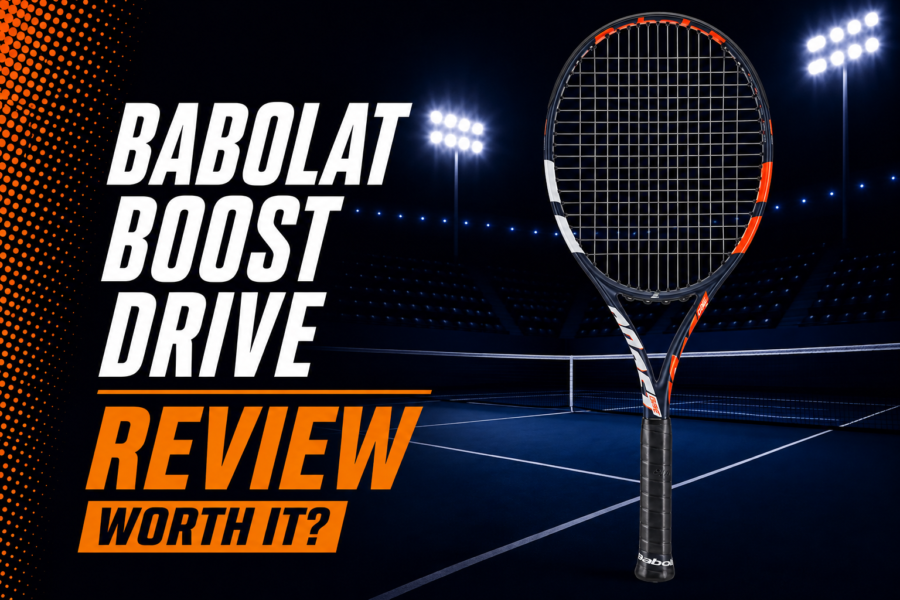
The Babolat Boost Drive is a full-length, pre-strung graphite racket intended for beginners, occasional players and improving juniors moving into an adult frame. Babolat does not attach a numbered generation to the current model, so it is best identified by its 680 cm² / 105 in² head, 260 g / 9.2 oz official unstrung weight, 16×19 string pattern and blue, orange and white cosmetic.
Within Babolat’s range, the Boost Drive is an entry-level option below the Evo and Pure families. Its large head, thick variable beam and slightly head-biased weight distribution prioritize accessible depth and a generous contact area, while its low static weight keeps preparation manageable for players who do not yet produce advanced racket-head speed.
This is not a lighter version of the performance-oriented Pure Drive, despite the shared Drive name. It is a separate entry-level design with a 105 in² head and Woofer System, aimed more at rally confidence and easy power than the precision, mass and higher-level stability expected from heavier competitive frames.
Babolat Boost Drive Score
| Category | Score |
|---|---|
| Power | 8.5/10 |
| Spin | 7.5/10 |
| Control | 6.5/10 |
| Comfort | 7.5/10 |
These scores are editorial estimates based on the Boost Drive’s verified specifications, construction, intended player profile and position within the wider tennis-racket market. They describe the racket as a complete setup rather than promising the same response for every player, string or tension.
Babolat Boost Drive Specifications
| Specification | Details |
|---|---|
| Head size | 680 cm² / 105 in² |
| Length | 685 mm / 27 in |
| Unstrung weight | 260 g / 9.2 oz, official tolerance ± 7 g |
| Strung weight | Approximately 275 g / 9.7 oz, retailer-measured |
| Unstrung balance | 34.5 cm / 13.6 in, official tolerance ± 7 mm |
| Strung balance | Approximately 351.8 mm / 3 points head heavy, retailer-measured |
| Swingweight | 290 official listed figure with string state not specified; approximately 312 strung, retailer-measured |
| Stiffness | 70 RA official listed figure; approximately 65 RA strung, retailer-measured |
| Beam width | 23 mm / 26 mm / 23 mm |
| String pattern | 16×19 |
| Composition | Graphite |
| Recommended tension | 23-25 kg / 51-55 lb |
| Grip | Babolat Syntec Uptake |
Babolat publishes the unstrung weight and balance with manufacturing tolerances, while the strung figures above come from a retailer sample. Finished weight, balance and swingweight can vary with frame tolerances, factory strings, replacement strings, grip size, overgrips, dampeners and other accessories.
Design, Materials and Technologies
Head Size, Beam and Frame Geometry
The 680 cm² / 105 in² head is larger than the 645 cm² / 100 in² head common to many performance rackets. That extra area can provide a broader useful contact zone and more string-bed deflection, which helps developing players retain depth when impact is not perfectly centered.
The 23 mm / 26 mm / 23 mm beam is widest through the hoop and narrows toward the tip and shaft. A beam of this profile is designed to return energy efficiently and support easy pace, although the result is less of the compact, low-powered response associated with thin control frames.
Forgiveness should not be confused with automatic accuracy. The larger head and lively string bed give the player more margin around the center, but directional control still depends on face angle, contact point, swing path and the predictability of the installed strings.
Weight, Balance and Swingweight
At 260 g / 9.2 oz unstrung, the Boost Drive is light enough for early preparation and short reaction swings. The official 345 mm unstrung balance places a meaningful share of that mass toward the head, which helps compensate for the low total weight by keeping more material behind the ball.
Retailer measurements of about 275 g / 9.7 oz strung, 351.8 mm balance and 312 swingweight show why static weight alone does not describe handling. The racket is light in the hand, yet the measured strung swingweight is substantial enough that the hoop can feel more present through the stroke than a similarly light, strongly head-light frame.
That distribution creates a useful tradeoff for its audience. It can provide easier depth and better resistance to slowing at impact, but players with very compact preparation may notice more tip weight than the 260 g label suggests.
Materials and Construction
Babolat lists the frame composition as graphite. This separates the Boost Drive from inexpensive one-piece aluminum recreational rackets and allows its mass, beam and stiffness to be tuned around an adult-length graphite structure.
Graphite construction is not evidence that every shot will be soft or stable. The frame remains very light, its official stiffness is 70 RA, and its response depends heavily on where the ball contacts the string bed and how the racket is strung.
The supplied factory string makes the racket ready for recreational use, but Babolat does not identify that factory string as a defining performance component on the official product page. Players should therefore treat the installed string as part of the purchased setup, not as a permanent specification of the frame.
String Pattern
The 16×19 pattern is relatively open and supports string movement, a higher launch window and access to spin when the player produces an upward swing path. In a 105 in² head, the spaces between strings can also contribute to useful depth and tolerance on slower swings.
An open pattern does not generate rotation by itself. Spin still requires racket-head speed, a suitable contact angle and strings that can move and recover, while flatter strokes may need more careful face control to prevent the lively launch from sending the ball long.
String spacing also affects durability. Players who develop faster, more vertical swings may move or notch strings sooner than players who hit flatter, and a softer multifilament will generally wear differently from a firm polyester.
Technologies
The verified frame technology is Babolat’s Woofer System. Babolat describes it as a frame-to-string interaction system intended to increase the time the ball and strings interact, with the claimed goals of improving control and comfort.
The reasonable construction-based inference is that the grommet and frame interface permits the string bed to contribute more noticeably to the response. It does not prove that the racket will be comfortable for every player, and it does not replace the effects of string material, gauge, tension, grip size or clean technique.
No current official product information supports adding Pure Drive technologies such as NF²-Tech 2.0, FSI Power, HTR System or Elliptic Frame Technology to this model. Those features belong to other Babolat ranges and should not be assumed from the Drive name.
Babolat Boost Drive Performance
Comfort and Feel
The Boost Drive combines a light graphite chassis with a thick beam and a firm official stiffness figure. A retailer’s strung sample measured softer at approximately 65 RA, but one sample does not erase Babolat’s 70 RA listing or the possibility of frame-to-frame variation.
The Woofer System and a soft string can make the string bed less abrupt, while the 105 in² head reduces the need to strike a very small central zone. Even so, low mass can transmit more reaction on off-center contact than a heavier frame, and comfort remains subjective and dependent on technique, strings, tension, grip size and the individual player.
Comfort score: 7.5/10
Power
Power is the Boost Drive’s clearest strength. The large head, 26 mm central beam, head-biased balance and approximately 312 retailer-measured strung swingweight are all consistent with accessible depth for compact to medium swings.
Players still learning to accelerate smoothly can use the frame’s energy return rather than forcing every ball. Faster hitters may need greater spin, a firmer string bed or more conservative targeting because the same lively response can reduce the margin for a flat, full-speed swing.
Power score: 8.5/10
Control
The racket offers practical control through its generous contact area and relatively consistent depth on moderate swings. That is useful control for sustaining rallies, but it is different from the low launch, mass-based precision of a smaller and thinner competitive frame.
Directional accuracy will come primarily from repeatable preparation, stable face angle and centered contact. The open 16×19 pattern and large head can launch the ball higher, so a player who swings aggressively through a flat trajectory may find the response less exact than a denser or smaller-headed alternative.
Control score: 6.5/10
Spin
The low static weight makes it possible for many developing players to accelerate the racket, while the 16×19 pattern allows the strings room to move. Those features create useful spin potential for topspin groundstrokes, slice serves and defensive lobs.
The head-biased setup means the Boost Drive is not automatically faster through the air than every heavier racket. Players still need an efficient low-to-high path and sufficient head speed, and the actual result will change with string type, surface condition and tension.
Spin score: 7.5/10
Maneuverability
The 260 g / 9.2 oz unstrung weight helps with takeback, recovery and quick adjustments near the body. This is particularly useful for beginners who are learning spacing and for doubles players who need to react to a ball arriving quickly.
Its measured strung swingweight and head-heavy balance moderate that advantage. The frame should remain easier to manage than a heavy performance racket, but it may not pivot as freely as a head-light racket with a lower swingweight.
Stability
The 105 in² hoop, wide beam and weight toward the head are designed to keep the racket moving through ordinary recreational pace. A measured strung swingweight around 312 can also provide more longitudinal stability than the low static weight suggests.
Resistance to twisting is a separate issue, and no verified twistweight is available for this exact model. Against heavy incoming shots or contact near the edge, the 275 g approximate strung mass can be displaced more easily than a 300 g unstrung performance frame, so solid preparation and central contact remain important.
Performance by Shot
Groundstrokes
From the baseline, the Boost Drive is suited to compact and medium-length swings that need help producing depth. The 105 in² head provides margin during developing footwork, and the open pattern lets a player add net clearance with topspin rather than relying only on a flat trajectory.
Forehands and two-handed backhands can benefit from the head-biased momentum, particularly when contact is in front. A one-handed backhand player who values rapid adjustment may prefer a more head-light setup, while a strong flat hitter may want a smaller head or firmer string response for tighter targeting.
Serves
Low static weight can make it easier to complete the service motion and explore slice or topspin. The large head and thick beam also support accessible pace for players whose timing is still developing.
Placement will still depend on a repeatable toss, coordinated acceleration and face control. The head-biased swingweight may help the racket continue through contact, but it can feel less nimble overhead for a player with a short or late motion.
Volleys and Net Play
The large hitting area is helpful on simple block volleys, and the light total weight supports quick positioning during doubles exchanges. The racket can redirect moderate pace without requiring a long swing, which suits newer net players.
Touch is more setup-dependent because the lively beam and factory string prioritize easy response. Against a hard passing shot, off-center volleys may expose the frame’s limited static mass, so compact technique and a firm wrist position are more reliable than trying to add a large swing.
Returns
On second-serve returns, the Boost Drive gives developing players enough head size and power to start the point with a controlled swing. Its maneuverability also helps when the server changes direction or targets the body.
Heavy first serves present a different demand. The measured swingweight can help on centered blocks, but the low total mass may be less settled on stretched contact, making a short backswing and early preparation preferable to a late, forceful cut.
String and Setup Considerations
The Boost Drive’s intended audience will often benefit from a comfortable synthetic gut or multifilament. These strings can preserve the easy depth of the 105 in² head and offer a more forgiving response than a firm full bed of polyester, especially for players with incomplete strokes or modest racket-head speed.
Natural gut can provide power, feel and tension maintenance, although its cost and sensitivity to moisture may be unnecessary for casual use. A hybrid can combine a durable main string with a softer cross, but the choice should follow the player’s actual string-breaking pattern and comfort needs rather than an assumption that every developing player requires polyester.
A full bed of polyester is usually most relevant only when the player swings fast enough to benefit from its lower launch and durability. If polyester is selected, a softer construction and sensible tension are more appropriate starting points than treating the top of the official range as a universal target.
Babolat’s 23-25 kg / 51-55 lb range is frame guidance, not a personalized prescription. The Tennis String Finder can help narrow material choices, while the Tennis String Tension Calculator can provide a structured starting point based on the complete setup and playing priorities.
Because strings add weight in the hoop, restringing can slightly change balance and swingweight. An overgrip and dampener add further mass, so players should evaluate the finished racket rather than assuming the printed unstrung figure describes on-court handling.
Build Quality and Durability
The graphite frame, molded bumper and grommet strip provide the expected protection for ordinary recreational use. The bumper shields the top of the hoop from routine court contact, while individual grommet barrels keep strings from bearing directly against exposed graphite.
Scratches, paint chips and scuffs on the bumper are usually cosmetic. A visible crack, a soft or distorted section of hoop, a rattling structural fragment or damaged grommet that lets a string contact the frame deserves inspection before further play.
Bumper and grommet components are wear items and may be replaceable when the correct set remains available for this exact model. Availability can change, so matching by model and drilling pattern is safer than assuming that Pure Drive or Boost Aero parts will fit.
No specific lifespan can be promised. Stringing practices, repeated court impacts, storage temperature, playing frequency and collision damage all influence durability, and a qualified stringer should inspect any frame whose condition is uncertain.
Who Should Use It?
The Boost Drive best suits beginners, occasional adults and juniors ready for a 27 in frame who want easy depth from compact to medium swings. It is also relevant to returning players who prioritize a large contact area and manageable static weight over the precision of a heavier competitive frame.
Its ideal user values power and forgiveness first, with useful but technique-dependent spin. The player should still be comfortable managing a head-biased balance, because the racket’s swingweight makes it more substantial through the stroke than its 260 g label alone implies.
Developing all-court players can grow with it while learning fuller strokes, serves and net positioning. Once incoming pace, swing speed or string breakage rises significantly, a more stable or more controlled frame may become a better match.
Who Should Avoid It?
Advanced players with fast, flat swings may find the 105 in² head and lively 16×19 response too powerful for precise attacking. A 98-100 in² frame with more mass, a more head-light balance or a denser string bed would provide a firmer platform and a lower launch window.
Players who are especially sensitive to firm frames should not assume that low weight guarantees comfort. The official 70 RA stiffness, limited static mass and factory string make a demo or carefully chosen softer setup important, and some players may prefer a more flexible Evo model.
Anyone who needs the quickest possible hand speed may also prefer a lower swingweight. Conversely, a player regularly facing heavy pace may want a heavier racket whose stability comes from greater total mass rather than concentrating a light frame’s weight toward the hoop.
Pros and Cons
| Pros | Cons |
|---|---|
| 105 in² head provides a generous contact area | Large, lively head offers less precision for fast flat swings |
| Thick beam and head-biased setup create accessible depth | Low total mass can twist on off-center contact against pace |
| Light static weight supports preparation and recovery | Approximate 312 strung swingweight is not as effortless as 260 g suggests |
| Graphite construction and Woofer System provide a capable entry-level platform | Official 70 RA stiffness makes comfort dependent on string and player |
Babolat Boost Drive Compared With Similar Rackets
The Babolat Boost Aero 2026 Review keeps the same 260 g official unstrung weight but uses a smaller 660 cm² / 102 in² head and a 340 mm unstrung balance. Retailer samples of both models reach about 275 g strung and 312 swingweight, so the main choice is not simply speed: the Boost Drive offers more head area and easier depth, while the Boost Aero offers a slightly more compact response and a balance starting closer to the handle.
The Babolat Evo Aero 2026 Review is the standard 275 g Gen2 model, with a 102 in² head, 320 mm unstrung balance and approximately 289 g retailer-measured strung weight. Its more head-light distribution, flexible measured response and dedicated Air Handle Touch, Evo Flax and Spin Alpha technologies make it the more controlled and comfort-oriented option for an improving player, while the Boost Drive remains easier to power with a short swing.
The Babolat Pure Drive Super Lite 2025 Review has a smaller 100 in² head and an even lower 255 g unstrung weight. Its approximate 295 strung swingweight and head-light measured balance make it faster to reposition, while Gen11 technologies target power and vibration filtering; the Boost Drive supplies a larger sweet spot and more measured swingweight, but the Pure Drive Super Lite offers a clearer path into Babolat’s performance family.
These comparisons also illustrate why model names cannot substitute for specifications. The best option depends on whether the player needs the Boost Drive’s head size and depth, the Evo Aero’s more flexible and head-light platform, or the Pure Drive Super Lite’s compact head and greater speed.
Final Verdict
The Babolat Boost Drive is a purpose-built entry-level graphite racket whose strongest qualities are accessible power, a generous 105 in² hitting area and manageable static weight. Its head-biased balance and retailer-measured swingweight give it more substance than the unstrung figure suggests, which can help depth but also reduces the impression of effortless maneuverability.
Its limitations are equally clear. Fast hitters may want more precision, players facing heavy pace may want more total mass, and comfort cannot be assumed from lightness because the frame carries a firm official stiffness rating.
For a beginner or recreational player with compact to medium strokes, it is a versatile route into a full-size graphite frame. The most important consideration is whether its lively, head-present response matches the player’s swing and string setup, rather than choosing it solely because 260 g sounds easy to handle.
Frequently Asked Questions
Is the Babolat Boost Drive suitable for beginners?
Yes. Its 105 in² head, low static weight and accessible power are designed around beginners and occasional players, although the head-biased balance should still be comfortable for the individual user.
Is the Boost Drive designed more for power or control?
It is designed primarily for power and forgiveness. Control comes from repeatable technique and setup, while the large head and open pattern produce a livelier response than a typical control racket.
Is the Babolat Boost Drive comfortable?
It can be comfortable with centered contact and an appropriate soft string, and the Woofer System is intended to influence string-bed interaction. Comfort remains subjective because the official frame stiffness is firm and the complete string, tension, grip and technique all matter.
What are the verified strung specifications?
A retailer sample measured approximately 275 g / 9.7 oz, 351.8 mm balance, 312 swingweight and 65 RA when strung. Those are approximate sample measurements, not guaranteed figures for every finished racket.
Can the Boost Drive generate topspin?
The 16×19 pattern and manageable static weight provide useful spin potential. The player must still create racket-head speed and an upward path, so the pattern should be viewed as an aid rather than an automatic source of spin.
How does it differ from the Boost Aero 2026?
The Boost Drive has a larger 105 in² head and a 345 mm official unstrung balance, while the Boost Aero uses a 102 in² head and 340 mm balance. The Drive emphasizes maximum forgiveness and depth, while the Aero offers a slightly more compact hitting platform.
What strings work well in the Boost Drive?
Synthetic gut and multifilament are sensible starting points for many beginners because they support depth and comfort. Polyester or a hybrid is more appropriate when swing speed, control needs and string wear justify it, with tension chosen for the complete player and setup.