
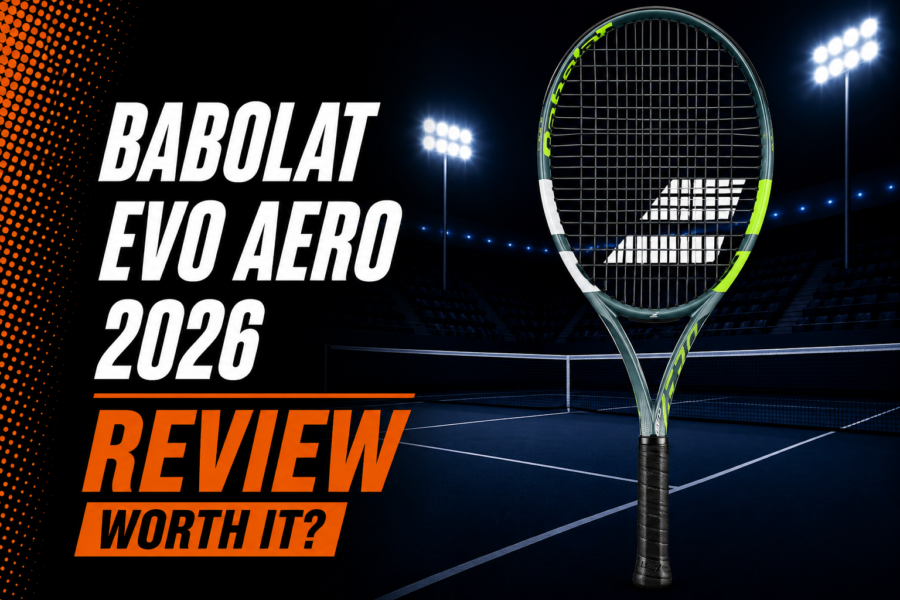
The Babolat Evo Aero 2026 is the standard 275 g / 9.7 oz model in Babolat’s second-generation Evo Aero range. Its official name is Evo Aero Gen2, and the exact version reviewed here has a 660 cm² / 102 in² head, 16×19 string pattern and grey with fluorescent-yellow cosmetic, rather than the lighter Evo Aero Lite or either pink version.
Babolat positions Gen2 for intermediate to advanced players who want to develop a topspin-based game with more forgiveness and less mass than a Pure Aero. The 102 in² head, 320 mm unstrung balance and flexible, vibration-focused construction create a profile centered on controlled power, spin access and relative comfort rather than maximum pace or tournament-level plow-through.
The Evo Aero occupies the middle ground between the beginner-focused Boost Aero and the more demanding Pure Aero family. It is heavier and more head light than the Boost model, adds Air Handle Touch, Evo Flax and Spin Alpha technologies, and remains more forgiving than Babolat’s 100 in² and 98 in² Pure Aero performance frames.
Babolat Evo Aero 2026 Score
| Category | Score |
|---|---|
| Power | 8/10 |
| Spin | 8.5/10 |
| Control | 8/10 |
| Comfort | 9/10 |
These scores are editorial estimates based on the Evo Aero Gen2’s verified specifications, construction, intended player profile and position within the wider tennis-racket market. They reflect the expected character of the exact 275 g model, not the lighter Evo Aero Lite and not a guarantee of how every string setup will perform.
Babolat Evo Aero 2026 Specifications
| Specification | Details |
|---|---|
| Head size | 660 cm² / 102 in² |
| Length | 685 mm / 27 in |
| Unstrung weight | 275 g / 9.7 oz, official tolerance ± 7 g |
| Strung weight | Approximately 289 g / 10.2 oz, retailer-measured |
| Unstrung balance | 32 cm / 12.6 in, official tolerance ± 7 mm |
| Strung balance | Approximately 326.4 mm / 5 points head light, retailer-measured |
| Swingweight | 280 official listed figure with string state not specified; approximately 307 strung, retailer-measured |
| Stiffness | Official listing: 64 RA without Air Handle Touch and 60 RA with Air Handle Touch, tolerance ± 3; approximately 59 RA strung, retailer-measured |
| Beam width | 23 mm / 26 mm / 23 mm |
| String pattern | 16×19 |
| Composition | Graphite with verified natural-flax inserts |
| Recommended tension | Not officially stated on the current Babolat product page; retailer guidance is 23-25 kg / 50-55 lb |
| Grip | Babolat Syntec Evo |
The official weight and balance are unstrung figures with manufacturing tolerances. The approximate strung weight, balance, swingweight and stiffness come from a retailer sample, and finished values can change with frame tolerances, string material and gauge, grip size, overgrips, dampeners and other accessories.
Design, Materials and Technologies
Head Size, Beam and Frame Geometry
The 660 cm² / 102 in² head provides more hitting area than the 645 cm² / 100 in² Pure Aero models without moving into a very large oversize format. That modest increase can help preserve depth and direction when contact drifts away from the center, which is useful for players refining timing and spacing.
The 23 mm / 26 mm / 23 mm beam is broad through the main hoop and narrower at the tip and shaft. It is designed to support energy return and torsional structure while retaining a familiar variable-beam shape, giving the racket more free depth than a thin control frame but a more composed response than many very stiff power designs.
Babolat also uses specialized aerodynamic sections as part of Spin Alpha. The manufacturer’s claim is that these sections help the frame move through the air and make spin generation easier; the reasonable inference is that reduced drag can assist racket-head acceleration, provided the player supplies an effective swing path.
Weight, Balance and Swingweight
The official 275 g / 9.7 oz unstrung weight places this model above ultra-light beginner rackets but below common 285-305 g performance frames. It offers enough material for a more settled response than the Boost Aero while remaining accessible to players who do not want the fatigue or timing demands of a heavier frame.
Its 320 mm unstrung balance is distinctly head light, and a retailer sample remained about 5 points head light at 326.4 mm after stringing. This distribution helps the racket pivot and recover, which supports topspin preparation and quick changes at net.
The approximately 307 retailer-measured strung swingweight adds useful momentum without making the racket exceptionally demanding. Static weight and swingweight describe different qualities: the Evo Aero is moderate in total mass, but its measured inertia still gives the hoop enough presence to drive through normal club-level pace.
Materials and Construction
Babolat lists graphite as the primary frame composition and verifies the addition of natural flax fibers at selected locations through Evo Flax. The manufacturer says those fibers reduce vibration and improve impact sensation, which is plausible as a damping strategy but does not establish a universal level of comfort.
The frame’s flexible measurements are notable within a market that often uses stiffer beams to generate power. Babolat lists 64 RA without the handle treatment and 60 RA with it, while a retailer sample measured about 59 RA strung, suggesting a softer overall response than the Boost Aero or Pure Drive families.
Flexibility can improve dwell sensation and reduce the sharpness of impact, but it can also absorb some energy that a very stiff frame would return immediately. The 102 in² head and 26 mm central beam help offset that tradeoff by supporting depth and forgiveness.
String Pattern
The 16×19 pattern supplies room for string movement and a launch window suited to modern topspin. Combined with the 102 in² head, it should provide easier net clearance than a dense 18×20 pattern, while the head-light balance helps the player accelerate upward through contact.
Not every 16×19 pattern behaves the same because the spacing and grommet layout determine how open the central bed actually is. The Evo Aero’s response should therefore be evaluated as a complete frame and string system rather than being assumed identical to the Boost Aero or Pure Aero.
Players who brush the ball aggressively may see faster notching or movement in a soft string. Flatter hitters can obtain a more predictable trajectory with an appropriate gauge and tension, but technique remains the primary source of directional control.
Technologies
Air Handle Touch is located in the handle and is described by Babolat as an impact and vibration-damping system. Its intended result is a softer handle response, although the player’s grip pressure, string setup and contact quality still determine how much vibration reaches the hand.
Evo Flax adds natural flax fibers at specific frame locations. Babolat connects the material to reduced vibration and improved sensation, while a cautious interpretation is that the insert modifies how certain frequencies travel through the graphite layup rather than eliminating impact load.
Spin Alpha combines the racket’s aerodynamic frame sections with its spin-oriented positioning. It may help a player accelerate the head, but it cannot create topspin without racket speed, a low-to-high path and appropriate face orientation.
The Woofer System manages interaction between the frame and string bed. Babolat claims longer ball-and-string contact for greater control and comfort; in practice, its influence remains inseparable from string type, tension and the open pattern.
Babolat Evo Aero 2026 Performance
Comfort and Feel
The Evo Aero Gen2 has a strong specification-based case for relative comfort. A retailer measured the strung frame near 59 RA, and Babolat combines a flexible graphite structure with Air Handle Touch and Evo Flax rather than relying on stiffness alone for performance.
That construction suggests a softer, more muted response than the firmer Boost Aero and Pure Drive lines, while the 289 g approximate strung mass offers more impact absorption than an ultra-light frame. Comfort still depends on technique, strings, tension, grip size and the individual player, and no racket can guarantee a comfortable outcome for every body or swing.
Comfort score: 9/10
Power
Power comes from the 102 in² head, 26 mm central beam, open pattern and approximately 307 strung swingweight. Those elements can produce useful depth for medium swings even though the flexible frame returns energy less abruptly than a high-RA power racket.
The player must still accelerate cleanly to obtain penetrating pace. The Evo Aero offers controlled assistance rather than the most explosive response in Babolat’s lineup, which should help improving players swing through the ball without every small face-angle error being magnified.
Power score: 8/10
Control
The head-light balance, flexible response and moderate swingweight support predictable acceleration and directional adjustment. Its 102 in² head remains forgiving, but the frame is less head heavy and less overtly lively than the Boost models, giving the player a broader range of controlled swing speeds.
This is still not a narrow-beam precision racket. Control comes from the player’s repeatable path and contact, while the 16×19 pattern creates a higher launch than a dense pattern and may require added spin or a firmer string for a fast, flat hitter.
Control score: 8/10
Spin
Spin potential is supported by the aerodynamic Spin Alpha geometry, head-light distribution and 16×19 pattern. Those features help the player create head speed and string movement, which can make topspin and slice trajectories easier to shape.
The racket does not manufacture rotation on a passive swing. Effective spin still requires acceleration, brushing contact and suitable strings, and the slightly larger head is valuable mainly because it offers margin while the player develops those mechanics.
Spin score: 8.5/10
Maneuverability
The 275 g unstrung weight and 320 mm balance make the Evo Aero easy to prepare relative to a 300 g performance frame. Its approximate 5-point head-light strung balance should be especially helpful on returns, quick volleys and running forehands where the racket must change direction rapidly.
The 307 measured swingweight prevents the frame from behaving like an insubstantial featherweight. It should remain accessible for its intended audience, but smaller or less-developed players should still assess whether the finished racket can be accelerated repeatedly with sound technique.
Stability
Moderate strung swingweight, a 26 mm central beam and approximately 289 g finished mass form a credible platform for club-level ball speed. The head-light balance does not mean the hoop lacks all momentum; it means more of the frame’s mass is distributed toward the hand than on the Boost models.
Against heavy pace, the Evo Aero will not resist displacement like a substantially heavier advanced frame. Off-center stability also depends on twistweight, which is not officially published for this model, so clean contact and compact blocking technique remain important.
Performance by Shot
Groundstrokes
The Evo Aero Gen2 is most coherent on topspin groundstrokes produced with medium to full swings. Its head-light balance supports preparation, the 102 in² head supplies margin, and the flexible response should help the player manage depth without an excessively abrupt launch.
Forehands can use Spin Alpha geometry and the open pattern to shape higher, safer trajectories. Two-handed backhands benefit from the moderate swingweight, while one-handed backhands may appreciate the maneuverability but should verify that the 102 in² hoop remains stable enough against pace.
Flatter drives are possible, although they demand deliberate face control. A player who hits through a low launch window may prefer a smaller head or denser pattern, while the Evo Aero is better aligned with net clearance and controlled rotation.
Serves
The head-light balance assists acceleration through the service motion and makes it easier to adjust the face for slice or kick. A 307 approximate strung swingweight offers enough inertia for useful pace when timing and kinetic-chain sequencing are sound.
The flexible frame is less likely to supply the sharp, immediate rebound of a stiff power racket. Servers should expect the best results from smooth acceleration and centered contact rather than trying to force speed with the arm alone.
Volleys and Net Play
At net, the 102 in² head and head-light balance help with reaction volleys and quick exchanges. The flexible construction may also provide a longer, less abrupt sensation on touch shots, although actual feel changes substantially with the installed string.
The frame can redirect moderate pace with compact technique. Against hard passing shots, its sub-300 g strung mass may be moved on off-center contact, so early positioning and a stable wrist are more dependable than a large volley swing.
Returns
The Evo Aero is quick enough to shorten preparation against first serves, and its moderate swingweight supports a centered block. On second serves, the 16×19 pattern and easy acceleration allow a player to attack with topspin while retaining useful margin over the net.
Late contact can still expose the limits of its mass. Returning players who routinely face advanced serve pace may prefer a heavier frame, while developing competitors should benefit from the balance between reaction speed and a reasonably substantial hoop.
String and Setup Considerations
Babolat recommends XALT, a multifilament, for the Evo Aero Gen2. That recommendation fits the frame’s comfort-oriented role and can preserve depth and feel for intermediate players who do not need the low-powered response or durability of polyester.
Synthetic gut is a practical alternative for balanced playability and cost. Natural gut can provide tension maintenance, power and feel, while a hybrid can combine a firmer main with a softer cross when the player needs additional control without committing to a full polyester bed.
Polyester is most appropriate for players who already generate sufficient speed to move and notch softer strings. A firm polyester at high tension can reduce the comfort advantages suggested by the flexible frame, so material, gauge and tension should be chosen together rather than treating the racket’s low RA as unlimited protection from a harsh setup.
The current Babolat product page does not publish a tension range for this exact model. Retailer guidance of 23-25 kg / 50-55 lb is a useful reference, but the Tennis String Finder and Tennis String Tension Calculator can help identify a more suitable starting setup based on string type, level and desired launch.
Strings, overgrips and dampeners also change the finished weight and balance. Players comparing a demo with a purchased frame should account for those additions and for Babolat’s ± 7 g and ± 7 mm official tolerances.
Build Quality and Durability
The graphite hoop includes a bumper and grommet system that protects the top edge and separates the strings from the frame. Those parts take routine abrasion during low volleys and string movement, and they should be inspected whenever the racket is restrung.
Paint chips and shallow bumper scuffs are generally cosmetic. Cracks through the graphite, deformation, soft areas, exposed fiber or a damaged grommet that allows string contact with the frame can indicate a structural or string-safety issue and deserve professional inspection.
Replacement bumper and grommet sets may be available, but they must match the Evo Aero Gen2 drilling pattern and head shape. Parts from the Boost Aero, Evo Aero Lite or Pure Aero should not be assumed compatible simply because the names are related.
Frame lifespan cannot be promised because it depends on impacts, stringing practices, storage, playing frequency and component availability. Keeping the bumper intact and avoiding excessive heat or repeated court strikes is more meaningful than assigning a fixed number of seasons.
Who Should Use It?
The Evo Aero 2026 best suits intermediate players with medium to full swings who want to develop topspin without carrying a heavy performance frame. It also suits advancing recreational players who value a head-light balance, a forgiving 102 in² head and a relatively flexible response.
All-court players can use its maneuverability for transitions and net play, while baseliners can exploit the open pattern and aerodynamic geometry. The player should have enough strength and coordination to manage an approximate 307 strung swingweight repeatedly, even though the static weight is moderate.
Juniors moving into an adult frame may find the standard 275 g version a useful bridge when the Lite feels too insubstantial. A supervised demo is advisable because body size, preparation and fatigue resistance vary widely among developing players.
Who Should Avoid It?
Advanced competitors who regularly absorb heavy pace may find the frame too light and may prefer a 285-305 g unstrung performance racket with greater mass-based stability. Fast, flat hitters who want a very low launch angle may also favor a 98-100 in² head or denser pattern.
Beginners who struggle to complete the swing could find the standard model more demanding than the Evo Aero Lite or Boost Aero. The 275 g unstrung figure is accessible for many adults, but the measured swingweight matters more than static weight alone when evaluating repeated handling.
Players who prefer a crisp, firm and highly direct response may find the flexible, vibration-filtered construction too muted. A firmer frame can provide that sensation, although comfort would still need to be assessed through the full string and grip setup.
Pros and Cons
| Pros | Cons |
|---|---|
| 102 in² head balances forgiveness with a manageable profile | Less precise than smaller, denser control frames |
| Head-light balance and Spin Alpha geometry support acceleration | Full spin potential still requires developed technique |
| Flexible measured response, Evo Flax and Air Handle Touch target comfort | Muted response may not suit players who prefer crisp feedback |
| Approximate 307 strung swingweight adds useful substance | Sub-300 g strung mass can be unsettled by heavy pace |
Babolat Evo Aero 2026 Compared With Similar Rackets
The Babolat Boost Aero 2026 Review has the same 102 in² head and 23 mm / 26 mm / 23 mm beam, but it is 15 g lighter unstrung and starts with a 340 mm balance rather than 320 mm. Its retailer-measured strung swingweight is slightly higher at about 312 despite the lower static weight, so the Boost offers more head-driven power for beginners, while the Evo Aero provides a more head-light, flexible and technology-rich platform for developing swings.
The Babolat Boost Aero Pink 2026 Review is technically the same frame as the standard Boost Aero and differs mainly in cosmetic. It remains a beginner-focused 260 g model with Woofer System only, whereas the standard Evo Aero Gen2 adds mass, Air Handle Touch, Evo Flax and Spin Alpha for greater control, relative comfort and stability.
The Babolat Pure Aero Team 2026 Review uses a smaller 100 in² head and sits in Babolat’s performance family. It is heavier at 285 g unstrung and is designed for more advanced spin production and a firmer, more precise response; the Evo Aero is more forgiving and flexible, while the Pure Aero Team should suit a faster player who wants a stronger connection to the competitive Aero platform.
For most progressing club players, the key choice is between the Boost’s easy depth, the Evo Aero’s balanced development profile and the Pure Aero Team’s higher performance ceiling. Cosmetic similarity to the Pure Aero Gen9 should not be mistaken for identical materials, mass or technology.
Final Verdict
The Babolat Evo Aero 2026, officially Evo Aero Gen2, is a well-defined intermediate frame rather than a diluted Pure Aero. Its head-light 275 g platform, 102 in² head, open pattern and approximately 307 strung swingweight support modern swing development, while its flexible construction and damping systems emphasize a softer response.
It offers a convincing blend of spin access, controlled power and maneuverability, but it does not have the mass or precision of a high-level competitive racket. Players who strike very flat, face heavy pace or demand crisp feedback may want a different specification profile.
For an improving topspin-oriented player, it is versatile enough for baseline, serve and net development without being excessively demanding. The most important decision is whether the standard 275 g model, rather than the Lite or a heavier Pure Aero, matches the player’s strength and swing tempo.
Frequently Asked Questions
Is the Babolat Evo Aero 2026 the Gen2 model?
Yes. Babolat’s official name is Evo Aero Gen2, and this review covers the standard 275 g grey and fluorescent-yellow version rather than the Lite or pink variants.
Is the Evo Aero 2026 suitable for beginners?
It can suit a coordinated beginner who is ready for a 275 g adult frame, but its primary fit is an improving intermediate player. A player who needs less swingweight may be better served by the Evo Aero Lite or Boost Aero.
Is it designed more for power, spin or control?
It balances all three, with particular support for controlled topspin. The 102 in² head and wide beam assist depth, while the head-light balance, flexible response and 16×19 pattern help the player shape the ball.
Is the Evo Aero considered a comfortable racket?
Its flexible measured stiffness, Air Handle Touch and Evo Flax make relative comfort a core design goal. Actual comfort remains individual and depends on technique, strings, tension and grip size.
What is its approximate strung weight and swingweight?
A retailer sample measured about 289 g / 10.2 oz strung with a 307 swingweight and 326.4 mm balance. Manufacturing tolerances and setup choices mean another finished frame may differ.
How does it differ from the Boost Aero 2026?
The Evo Aero is 15 g heavier unstrung, 20 mm more head light in official balance and includes additional damping and spin-related technologies. It targets developing intermediate play, while the Boost Aero prioritizes easy power and affordability for beginners and casual users.
What strings work well with the Evo Aero Gen2?
Babolat recommends XALT multifilament, which suits the comfort-oriented design. Synthetic gut, natural gut, hybrids and softer polyester can also work when selected around the player’s speed, desired launch, durability needs and comfort.