
Affiliate disclosure: This page contains affiliate links. If you make a purchase through one of these links, Tennis Overload may earn a commission at no additional cost to you.
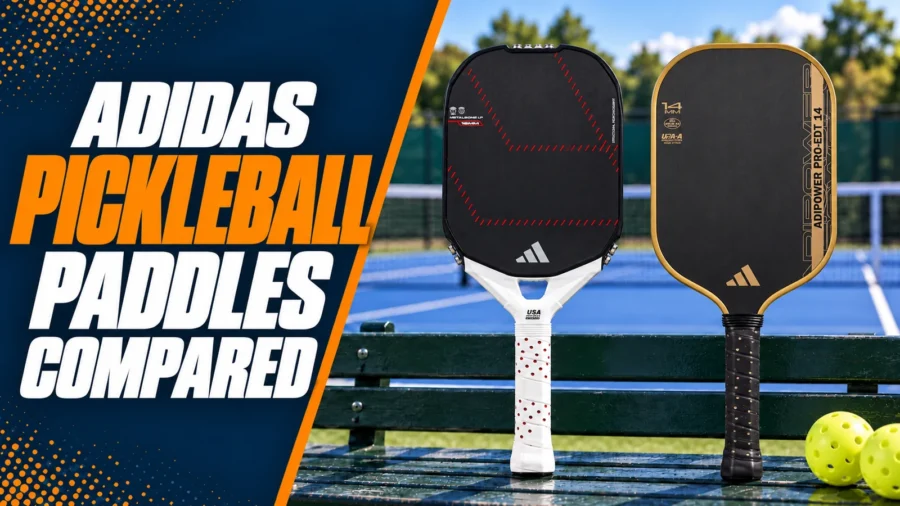
The adidas Metalbone LP is the best adidas pickleball paddle for an advanced player who wants an elongated shape, a 16mm polypropylene honeycomb core and adjustable balance. It is the most versatile premium option in the current range, but it is expensive and its long shape will not feel as quick at the kitchen as a broad, compact paddle.
The Metalbone LP S and Metalbone LP Team use EVA foam cores and are the most power-oriented models in this comparison. The 14.5mm Metalbone retains a polypropylene honeycomb core in a thinner build, while the Adipower Pro-EDT 14 suits aggressive players who want a direct response and room for a two-handed backhand.
These paddles are aimed mainly at experienced players. Beginners should first compare a wider range of forgiving options in the guide to the best pickleball paddles for every level.
adidas pickleball paddles at a glance
| Paddle | Core thickness | Shape | Standout feature | Best for | Main tradeoff |
|---|---|---|---|---|---|
| Metalbone LP | 16mm | Elongated | Polypropylene core and adjustable Weight & Balance System | Best overall | Premium price and less hand speed than a compact paddle |
| Metalbone LP S | 16mm | Elongated | EVA foam core plus adjustable balance | Maximum power | Demanding on dinks, blocks and resets |
| Metalbone 14.5 | 14.5mm | Elongated | Polypropylene core plus adjustable balance | Faster attacking play | Less settled than the 16mm LP on off-center contact |
| Adipower Pro-EDT 14 | 14mm | Elongated | Direct response and long handle | Drives, counters and two-handed backhands | Smaller margin for off-center contact |
| Metalbone LP Team | 16mm | Elongated | EVA foam core in a fixed-weight build | Lower-cost EVA power | No adjustable weight system and a lively soft-game response |
The table compares design intent rather than laboratory performance. Core material is especially important here: a 16mm EVA model can feel much more explosive than a thinner paddle with a polypropylene honeycomb core. Face material, weight distribution, handle length and construction also affect the response.
Best overall: adidas Metalbone LP
The Metalbone LP is the clearest all-around pick in the adidas performance range. Its 16mm low-density polypropylene honeycomb core, carbon frame and elongated shape are designed to balance reach, stability, control and power.
Its defining feature is the Weight & Balance System. Removable weights at the sides and top let you alter the paddle’s balance and feel rather than accepting one factory setup. Adding weight higher on the paddle can make it feel more forceful through contact, while removing weight can improve maneuverability.
The Spin Blade Max textured surface is intended to help the face interact with the ball. Texture can support spin, but technique, swing path, surface condition and the ball all matter. No legal paddle creates heavy spin without the correct stroke.
The elongated profile also has a real cost. It places more face area away from the hand and can feel slower in rapid exchanges than a wider paddle of similar static weight. Players who frequently make late contact at the kitchen may prefer a quicker shape.
Who should buy it?
Choose the Metalbone LP if you are an experienced all-court player who values reach and wants to tune balance. It is particularly logical for someone who already knows whether a head-heavier or quicker setup suits their game.
Skip it if you want a simple paddle with no setup decisions, or if price matters more than adjustability. The tuning system is useful only when you test changes methodically rather than moving weights before every session.
Best for maximum power: adidas Metalbone LP S
The Metalbone LP S combines a 16mm high-density EVA foam core with an elongated raw-carbon face, monocoque construction and the adjustable Weight & Balance System. Its core distinguishes it from the polypropylene Metalbone LP: the response is firmer, faster and substantially more power-oriented despite the shared thickness.
That explosive response can be useful on drives, counters and fast hands exchanges. It also makes touch more demanding. Dinks, blocks and resets can sit up or travel long unless the player softens the hands and controls face angle precisely, so this is not the control choice simply because it is 16mm thick.
Careful weight placement can improve stability and expand the usable hitting area, but it does not turn the EVA construction into a muted paddle. Players still learning the soft game should start with the fundamentals in how to play pickleball before paying for this specialized response.
Who should buy it?
Choose the Metalbone LP S if you already control a lively paddle and want maximum pace without giving up balance tuning. It suits an aggressive player who attacks from the baseline and looks to win fast exchanges at the kitchen.
Skip it if resets, dinks and defensive blocks are your main priorities. The standard Metalbone LP is the more predictable all-court option, while a widebody paddle with a lower swing weight may also be easier to position under pressure.
Best blend of speed and adjustability: adidas Metalbone 14.5
The Metalbone 14.5 keeps the elongated shape, carbon frame, textured surface, polypropylene honeycomb core and Weight & Balance System, but reduces core thickness to 14.5mm. Compared with the standard 16mm Metalbone LP, the thinner build can produce a more immediate response.
It is a strong fit for aggressive players who drive, counter and attack high balls, yet still want to alter the paddle’s balance. The adjustable system also gives it an advantage over fixed-weight thin paddles when you are trying to find a workable compromise between speed and stability.
The downside is a smaller comfort and forgiveness margin. A thinner, more direct paddle can send mishits long and may feel less settled on soft exchanges. Players who struggle to control depth should not assume the thinner model is automatically better because it feels lively in a short demo.
Who should buy it?
Choose the Metalbone 14.5 if you have compact preparation, create your own pace and want a faster response than the 16mm polypropylene LP. It is also the most logical Metalbone for a player who likes a thin core but refuses to give up balance tuning.
Skip it if your priority is absorbing pace or making off-center contact less punishing. The 16mm Metalbone LP is the safer adidas comparison for that brief.
Best for aggressive two-handed players: adidas Adipower Pro-EDT 14
The Adipower Pro-EDT 14 uses a 14mm low-density polypropylene honeycomb core, a raw carbon face and an elongated attack shape. Its listed 5.5in handle leaves more room for a second hand than many short-handled paddles, while the thinner core is designed for quick feedback.
The manufacturer lists a playing-weight range of 7.8–8.2oz, a 16.5in length and a 7.5in width. Those dimensions explain the intended use: extra reach and handle room, with less width than a conventional widebody shape.
This makes it a credible option for drives, counters and two-handed backhands. It is not the easiest choice for a player who regularly hits near the side edges, because a narrow elongated face offers less lateral hitting area.
Who should buy it?
Choose the Adipower Pro-EDT 14 if you want a fast, direct adidas paddle with room for two hands. It is also a useful alternative to the Metalbone 14.5 for players who do not need removable weights.
Skip it if you want the plushest reset response or the broadest sweet-spot geometry. The paddle rewards timing more than rescue shots.
Best performance value: adidas Metalbone LP Team
The Metalbone LP Team brings the 16mm elongated format, raw-carbon face, Spin Blade Max texture and an EVA foam core into a simpler package. It retains the Extra Power Grip concept, but it does not include the adjustable Weight & Balance System used on the premium Metalbone models.
That omission is not automatically a weakness. A fixed setup reduces complexity, and many players never alter removable weights after the first few sessions. The Team model can therefore be the smarter purchase when you want the explosive response of the EVA Metalbone LP S but do not need a tuning feature.
Its biggest limitations are the lively response on soft shots and the fixed balance. If the stock feel is not right, ordinary grip changes and rule-compliant edge weighting provide less integrated adjustment than the Metalbone system.
Who should buy it?
Choose the Metalbone LP Team if you want EVA-core power in a lower-cost, fixed configuration. It is the best value among these five for a confident attacking player who already likes the elongated shape.
Skip it if adjustability is the reason you are considering Metalbone or if you need a calm response on defensive blocks. In those cases, the polypropylene Metalbone LP is the more versatile starting point.
What about the adidas USA OLP WC2026 paddle?
The USA OLP WC2026 is a current themed option aimed at intermediate players. adidas describes it as a versatile paddle with a honeycomb polymer core and Spin Blade Gritt surface, but the available product information is not as complete as the specifications published for the Metalbone and Adipower models.
That makes it difficult to rank above the main performance line on construction alone. Buy it if the USA design and intermediate positioning are the main appeal, not because a tournament theme proves superior performance.
How to choose between these models
Start with shape, not the product name
All five main picks use elongated geometry. That generally favors reach, drives and two-handed backhands, while a wider paddle typically offers more face area across the horizontal axis. If you are unsure how paddle shape affects play, compare the equipment differences in tennis versus pickleball.
Do not confuse adidas pickleball paddles with adidas padel rackets. The sports use different courts, balls, rules and equipment, even when product families share names. The padel versus pickleball comparison explains the practical differences, while the guide to adidas padel rackets covers the padel range separately.
Compare core material before thickness
Thickness alone does not predict control in this range. The 16mm Metalbone LP uses polypropylene honeycomb and offers the most balanced response, while the 16mm Metalbone LP S and LP Team use EVA foam and produce considerably more pop. The 14mm and 14.5mm options feel direct, but their response still depends on core material, surface, construction and weight distribution.
Decide whether adjustability is worth paying for
The Metalbone LP, LP S and 14.5 use removable weights to change balance. That is valuable if you understand the problem you are trying to solve, such as improving hand speed or adding stability against pace.
Change one variable at a time and keep the setup long enough to judge it. Random changes make it impossible to separate a genuine improvement from normal day-to-day variation.
Check the exact model before sanctioned play
Paddle approval belongs to a specific submitted model, not every paddle made by a brand. Names, graphics and construction revisions can be similar while approval status differs.
Before a sanctioned event, check the exact model and identifying details against the current approved-equipment list and review the rules of pickleball. Do the same after adding tape or changing a grip, since modifications must remain within the current rules.
Which adidas pickleball paddle is best for you?
The Metalbone LP is the best overall adidas choice for an advanced player who wants a tunable 16mm elongated paddle with a familiar polypropylene response. Pick the Metalbone LP S for maximum EVA-core power, the Metalbone 14.5 for a quicker polypropylene response with adjustable balance, or the Adipower Pro-EDT 14 for aggressive play and a longer handle.
The Metalbone LP Team is the lower-cost route to the same power-oriented EVA concept without removable weights. Whichever model you choose, prioritize a shape, core and response that solve a real need in your game rather than paying for features you will not use.