
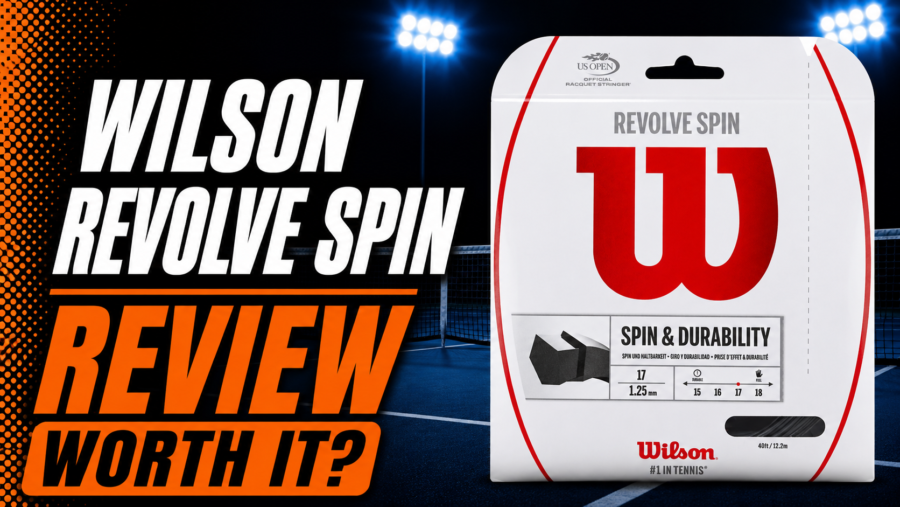
Wilson Revolve Spin is a five-sided co-polyester tennis string designed for advanced players who prioritize maximum spin and control over easy power. It builds on the low-friction concept of round Revolve while adding a pentagonal profile for stronger surface interaction with the ball.
Revolve Spin is firmer, deader and more specialized than standard Revolve. Its combination of sharp geometry, low free power and snapback rewards long, fast swings but can feel demanding for beginners and compact swingers.
The string is best suited to aggressive baseliners and experienced polyester users who generate their own pace. Players unsure whether that profile is appropriate can use the Tennis String Finder to compare it with round and softer alternatives.
Wilson Revolve Spin Rating
| Category | Rating |
|---|---|
| Power | 4.5/10 |
| Spin | 9.5/10 |
| Comfort | 7/10 |
| Control | 9.5/10 |
These ratings assess Revolve Spin against the complete tennis-string market. Its unusually low power is intentional and directly supports its exceptional control.
Wilson Revolve Spin Specifications
| Specification | Details |
|---|---|
| String type | Shaped co-polyester monofilament |
| Composition | Crosslink ester polymer with low-friction UHMW material |
| Profile | Pentagonal, with five sides |
| Surface | Smooth, low-friction treatment |
| Common gauges | 17 / 1.25mm and 16 / 1.30mm |
| Colors | Green and Black |
| Set length | Approximately 12.2m |
| Reel length | Approximately 200m |
Gauge, color and package availability can differ between regions and retailers.
Material and Construction
Revolve Spin is a single co-polyester monofilament based on a crosslink ester polymer formulation. Low-friction ultra-high-molecular-weight material is incorporated to support string movement and snapback.
The profile has five sides. These edges increase interaction with the ball, distinguishing Revolve Spin from the round standard Revolve.
Its spin design combines geometry and movement. The pentagonal shape supplies ball bite, while the low-friction surface lets the mains deflect and return when the stringbed is fresh.
Revolve Spin should not be described as relying on a rough coating. Its defining features are the five-sided extrusion and low-friction material, not an abrasive outer layer.
Some retailer descriptions conflict about the surface pattern, but Wilson’s established product positioning and the formal independent playtest identify the string as five-sided. That is the most consistent description to publish.
Wilson Revolve Spin Performance
Power
Revolve Spin is exceptionally low powered across the complete tennis-string market. Independent testing found a firm and dead response that required the player to supply nearly all of the pace.
This characteristic benefits strong hitters. They can accelerate aggressively without fearing that the stringbed will add excessive launch or send a flatter attack beyond the baseline.
The string is demanding for compact strokes. Beginners, defensive players and anyone who relies on the stringbed for depth will normally receive more help from round Revolve, synthetic gut or multifilament.
The thinner 1.25mm gauge is slightly more responsive than 1.30mm, but neither version should be considered power oriented.
Power rating: 4.5/10
Spin
Spin is Revolve Spin’s defining strength. Independent testing recorded exceptional rotation from the five edges, low-friction snapback and the confidence created by its controlled launch.
Topspin groundstrokes, sharp angles, dipping passing shots and spin serves can all benefit. The string lets a fast swinger accelerate vertically without an unwanted surge of free power.
The standard Revolve is already highly spin-friendly, so the difference will not be equally obvious to every player. Some of the advantage comes from greater confidence and speed rather than geometry alone.
Edge wear and notching eventually reduce performance. When the mains stop returning or shots lose their usual shape, useful spin may have declined before physical breakage.
Spin rating: 9.5/10
Control
Control is equally exceptional. Revolve Spin’s low rebound and firm response give advanced players a highly predictable trajectory on full swings.
Independent testers found that confidence increased as they learned how much acceleration the stringbed would accept. It was especially effective for attacking powerful rackets and directing pace close to the lines.
The control is player-dependent. A slower swing can produce short balls and a small effective hitting area, which feels demanding rather than precise.
Tension loss still occurs, but independent testing found the response remained consistent longer than expected. Control should nevertheless be monitored as the string ages.
Control rating: 9.5/10
Comfort and Feel
Revolve Spin feels firm, low powered and slightly muted. It is not designed as a comfort string, but independent testers did not find the impact excessively harsh within a suitable setup.
Lower tension increased pocketing for one tester, while another used a much firmer installation without discomfort. Those individual results show that tolerance varies and should not be turned into a universal recommendation.
Across the complete market, Revolve Spin is substantially less comfortable than natural gut, multifilament and synthetic gut. Its reasonable polyester comfort does not make it an arm-friendly material for every player.
Anyone with recurring elbow, wrist or shoulder discomfort should approach it cautiously and seek qualified medical guidance for persistent pain.
Comfort rating: 7/10
Durability and Tension Maintenance
Revolve Spin has excellent physical resistance to breakage. Its firm monofilament construction and available 1.30mm gauge suit players who strike the ball aggressively.
The five edges can gradually round off, while the string intersections notch. The set may therefore remain unbroken after its original bite and snapback have changed.
Independent testing found good playability duration for a co-polyester. Although tension declined, the response remained controlled and did not become immediately erratic.
Physical survival should still be separated from useful lifespan. Polyester can remain intact after elasticity, snapback or comfort has deteriorated, and waiting for a break can leave the string installed too long.
Reduced main-string return, a higher or less predictable launch and a materially harsher response are practical replacement signs.
Choosing the Right Gauge
Revolve Spin is documented in 1.25mm and 1.30mm gauges.
| Gauge | General characteristics | Best suited to |
|---|---|---|
| 17 / 1.25mm | More response, feel and easier edge engagement | Dense patterns and players prioritizing spin |
| 16 / 1.30mm | Firmer trajectory and greater physical resistance | Open patterns and frequent string breakers |
Both versions remain low powered. Players seeking a meaningfully livelier response should consider standard Revolve rather than relying only on a thinner gauge.
Full Bed or Hybrid Setup
Full Bed
A full bed maximizes Revolve Spin’s bite, control and physical durability. It is intended for experienced polyester users with fast swings.
The setup can be demanding in a stiff racket. A cautious tension and the 1.25mm gauge can improve pocketing without removing its control-focused character.
Revolve Spin in the Mains With Softer Crosses
Using Revolve Spin in the mains preserves its five-sided bite and restrained launch. Natural gut, multifilament or synthetic gut crosses add power and comfort.
The shaped mains can notch soft crosses as they slide, limiting hybrid lifespan. Players should choose this direction for performance balance rather than assuming it will be more durable.
Softer Mains With Revolve Spin in the Crosses
Natural gut or multifilament mains create a more powerful and comfortable response. Revolve Spin crosses add firmness and control.
The five-sided crosses increase friction and can restrict or wear the soft mains. Round Revolve is normally the more logical cross when snapback and preservation of expensive mains are priorities.
General Tension Guidance
Revolve Spin generally works best at a lower tension than the same player would use for synthetic gut or multifilament. Its firm, low-powered construction can become unnecessarily severe if copied directly from a nylon setup.
Players seeking more pocketing, depth and comfort can begin toward the lower portion of the racket manufacturer’s recommended range. Those wanting the firmest possible trajectory can make a modest upward adjustment only if the response remains comfortable.
Gauge, head size, pattern and racket stiffness all affect the result. An open pattern may provide more launch and edge interaction, while a dense pattern can emphasize control.
The Tennis String Tension Calculator can help organize these variables. Final adjustments should be based on actual ball flight and comfort rather than copying an advanced player’s setup.
Who Should Use Wilson Revolve Spin?
Revolve Spin is best suited to:
- Advanced and strong intermediate players with fast swings
- Aggressive baseliners seeking maximum spin and control
- Players who create their own pace
- Experienced polyester users who prefer a firm response
- Players taming powerful, open-pattern rackets
- Hybrid users seeking a shaped control main
Who Should Avoid Wilson Revolve Spin?
Revolve Spin is less suitable for:
- Beginners who need easy depth and forgiveness
- Players with compact or slow swings
- Players seeking natural-gut or multifilament comfort
- Anyone with recurring arm discomfort who has not been advised that polyester is suitable
- Hybrid users wanting a smooth, low-friction cross
- Players who leave polyester installed after its response declines
Pros and Cons
| Pros | Cons |
|---|---|
| Exceptional spin potential | Extremely low free power |
| Outstanding control for full swings | Demanding for beginners and compact swingers |
| Five-sided profile provides ball bite | Firm feel across the complete market |
| Strong physical resistance to breakage | Edges and snapback decline before breakage |
| Good playability duration for a co-polyester | Shaped surface can wear soft hybrid partners |
| Two practical gauge options | Less versatile as a cross than round Revolve |
Wilson Revolve Spin Compared With Other Strings
Revolve Spin vs Wilson Revolve
Wilson Revolve is round, softer and more pocketing. Revolve Spin adds five edges, lower power and greater directional control for the most aggressive swings.
Revolve Spin vs Babolat RPM Blast
Babolat RPM Blast uses an octagonal profile and slick surface. Both target heavy spin, while Revolve Spin provides an especially dead and controlled response.
Revolve Spin vs Solinco Hyper-G
Solinco Hyper-G is a square shaped control polyester with strong bite. Hyper-G offers a different launch and feel, while Revolve Spin uses five sides and UHMW-assisted movement.
Revolve Spin vs Volkl Cyclone
Volkl Cyclone is a shaped spin string available in more gauges. Cyclone feels crisper, while Revolve Spin is particularly firm, muted and control focused.
Revolve Spin vs Luxilon ECO Spin
Luxilon ECO Spin also uses a pentagonal profile. ECO Spin adds recycled feedstock and a somewhat more responsive current-generation feel, while Revolve Spin remains the lower-powered specialist.
Final Verdict
Wilson Revolve Spin is a specialized polyester for players who want the stringbed to restrain power and reward maximum acceleration. Its five-sided shape and low-friction material produce exceptional spin, while its dead response supplies outstanding control.
Those strengths make it unsuitable for many recreational players. It offers little free depth and feels firm compared with every nylon or natural-gut category.
For advanced baseliners and experienced polyester users who generate their own pace, Revolve Spin is a clear performance option. The 1.25mm gauge provides the more responsive starting point, while 1.30mm is intended for open patterns and frequent breakers.
Frequently Asked Questions
What shape is Wilson Revolve Spin?
It has a pentagonal profile with five sides. This distinguishes it from the round standard Revolve.
Is Revolve Spin powerful?
No. It is one of the lower-powered performance strings and expects the player to generate pace.
Does Revolve Spin provide more spin than Revolve?
Its five edges add geometric bite, but round Revolve is already highly spin-friendly. The difference varies with technique and setup.
Is Revolve Spin comfortable?
It is reasonably comfortable for a firm co-polyester when installed appropriately, but much less forgiving than nylon or natural gut.
Which gauge should I choose?
Choose 1.25mm for greater response and 1.30mm for a firmer trajectory and more physical durability.
Can Revolve Spin be used in a hybrid?
Yes, especially as a shaped main with a softer cross. Its edges can notch soft strings and make it a less suitable cross.
How long does Revolve Spin remain playable?
There is no fixed lifespan. Replace it when edge wear, reduced snapback, changing launch or harsher feel materially affects performance.