
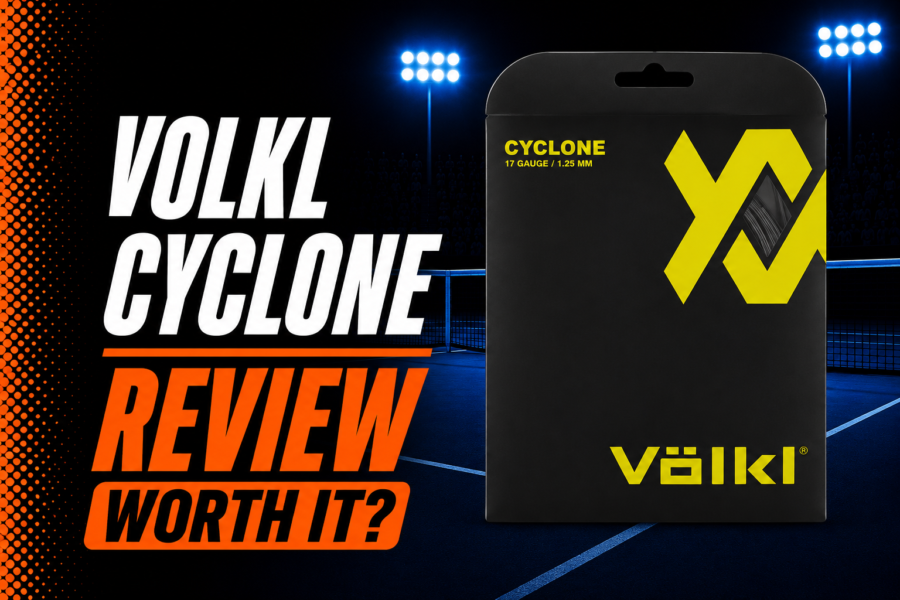
Volkl Cyclone is a ten-sided co-polyester tennis string designed for spin, control and durability at a relatively accessible price. It is one of Volkl’s core performance strings and should not be confused with Cyclone Tour, which uses a softer, twisted construction and produces a livelier response.
Cyclone targets intermediate and advanced players who generate their own racket-head speed. Its combination of sharp geometry, predictable power and useful pocketing has made it a popular alternative to more expensive shaped polyester strings.
The range is unusually broad. Volkl offers Cyclone in gauges from 1.35mm down to 1.10mm, which means the response can change substantially depending on the version selected. Players who are unsure whether a shaped polyester suits their strokes can use the Tennis String Finder before choosing a gauge.
Volkl Cyclone Rating
| Category | Rating |
|---|---|
| Power | 6.5/10 |
| Spin | 9.5/10 |
| Comfort | 6.5/10 |
| Control | 9/10 |
These ratings compare the standard, commonly used gauges with the full tennis-string market. The very thin 1.10mm version is livelier and more comfortable, while thicker versions are firmer and more controlled.
Volkl Cyclone Specifications
| Specification | Details |
| String type | Polyester monofilament |
| Composition | Co-polymer polyester |
| Shape | Ten-sided profile |
| Surface | Geometric, ridged surface with no separately named coating |
| Available gauges | 1.35mm, 1.30mm, 1.25mm, 1.20mm, 1.15mm and 1.10mm |
| Common colors | Black, Neon Yellow, Fluo Orange, Graphite and Neon Blue, depending on gauge and market |
| Set length | Approximately 12.2m |
| Reel length | Approximately 200m |
| Feel | Medium-firm, with gauge-dependent pocketing |
Not every color is offered in every gauge. Availability also changes by region, so the gauge should be selected before the color.
Material and Construction
Cyclone uses a co-polyester monofilament construction with ten defined sides. Volkl describes it as a medium-firm string whose geometry is intended to increase spin while preserving control and durability.
The ten-sided profile creates edges that can interact with the ball’s felt. Those edges contribute to bite, but shape alone does not create spin. Spin also depends on swing speed, swing path, string-to-string friction, tension, gauge and the ability of the mains to move and return after impact.
Volkl does not identify a separate surface coating or publish the detailed polymer formula on its current product pages. Claims about a proprietary coating should therefore be avoided. The confirmed technology is the ten-sided co-polymer geometry.
Cyclone’s very wide gauge range is part of its construction story. A 1.35mm Cyclone stringbed has more material, greater stability and a firmer response than the 1.10mm version. Independent playtesting of the 1.10mm string found markedly higher launch, comfort and pocketing than the thicker 1.30mm version. A review that treats every gauge as identical misses one of the product’s most important variables.
Volkl Cyclone Performance
Power
Cyclone is medium-low powered across the wider string market. It gives players less free depth than natural gut, multifilament or synthetic gut, but it is not completely inactive by polyester standards.
The commonly used 1.25mm and 1.30mm gauges suit long, fast swings because their controlled response allows the player to accelerate without an excessively high launch. Independent playtests have described the thicker version as having enough pop for a co-polyester while remaining predictable at lower tensions.
Gauge changes the result. The 1.10mm and 1.15mm versions stretch more readily, pocket the ball more deeply and launch it at a higher angle. They can help players who want Cyclone’s shape without the deader response of a thick polyester, but flatter hitters may need time to control the livelier trajectory.
Power rating: 6.5/10.
Spin
Spin is Cyclone’s defining strength. The ten-sided profile gives the string multiple edges, while its controlled power encourages aggressive racket-head speed. That combination supports heavy topspin, biting slice and movement on spin serves.
Independent playtests have consistently rated Cyclone among the strongest spin strings in its category. The 1.10mm version produced exceptionally high spin scores because its thin diameter combined easy pocketing with aggressive ball bite.
The string does not manufacture spin for a player with a flat or slow swing. It amplifies the rotation created by technique. Spin can also decline before the string breaks if the mains become deeply notched or stop returning toward position.
Spin rating: 9.5/10.
Control
Cyclone provides excellent control for players who swing quickly. Its medium-firm response and moderate power help produce a predictable trajectory, while added rotation can bring aggressive shots back inside the baseline.
Published playtests of the 1.30mm version gave control especially high marks. Testers reported confidence when aiming close to the lines and when using lower tensions, although the exact result remains dependent on racket and technique.
The thinnest gauges trade some of that locked-in control for easier depth and a higher launch. Players who hit flatter through the court may prefer 1.25mm or 1.30mm, while heavy topspin players can often manage the extra lift of 1.20mm or thinner.
Control rating: 9/10.
Comfort and Feel
Cyclone is more comfortable than its medium-firm polyester identity might suggest, particularly in thinner gauges. Independent playtests of the 1.30mm version reported useful pocketing and above-average co-polyester comfort, while the 1.10mm version felt noticeably softer and more forgiving.
That does not make Cyclone equivalent to a multifilament or natural gut. It remains a polyester monofilament, and its response can become harsh in a stiff, light racket, at high tension or after its elasticity has declined.
The feel is crisp and connected rather than plush. Players accustomed to polyester often appreciate that direct feedback. Players with a history of elbow, wrist or shoulder discomfort should consider a softer string or a hybrid instead of assuming that a thinner Cyclone is automatically safe.
Comfort rating: 6.5/10.
Durability and Tension Maintenance
Physical durability and playability duration must be evaluated separately. Physical durability is the resistance to notching and breakage. Playability duration is the time during which the string retains acceptable control, feel, elasticity and snapback.
Cyclone has good break resistance, especially in 1.25mm, 1.30mm and 1.35mm. Its co-polyester construction suits players who break nylon strings frequently. The shaped edges can wear with use, however, and a string can remain intact after its spin response and elasticity have changed.
Independent playtests found the 1.30mm version maintained useful control and spin through a normal polyester test period, although some loss of pop appeared after repeated use. The 1.10mm version performed surprisingly well for such a thin string, with testers reporting strong tension and playability retention during their test. That does not guarantee equal life for a heavy string breaker because there is still less material to wear through.
Cyclone should be replaced when it feels unusually board-like, launches unpredictably, remains displaced, loses its familiar response or becomes deeply notched. Waiting for polyester to break can leave a player using a physically intact but functionally exhausted stringbed.
Choosing the Right Gauge
| Gauge | Expected response | Best suited to |
| 1.35mm | Firmest, most stable and most resistant to breakage; lowest feel and spin access | Extreme string breakers and very open patterns |
| 1.30mm | Maximum control and strong physical durability with a firm response | Powerful hitters, flatter drives and open patterns |
| 1.25mm | Balanced spin, control, feel and durability | Most intermediate and advanced Cyclone users |
| 1.20mm | Easier pocketing and spin with less stability and break resistance | Denser patterns and players wanting a livelier response |
| 1.15mm | Higher launch, added feel and easier acceleration | Players who do not break strings often and want more forgiveness |
| 1.10mm | Most lively, comfortable and spin-friendly version; least material to resist wear | Dense patterns, moderate breakers and players prioritizing spin and feel |
The 1.25mm gauge is the safest starting point because it represents Cyclone’s core balance. Choose 1.30mm when durability and trajectory control matter more. Move thinner when a thick version feels too firm or when a dense pattern needs more response.
Full Bed or Hybrid Setup
Full Bed
A full bed gives Cyclone’s ten-sided mains and crosses the most direct influence over spin, control and feel. It suits experienced polyester users with long, fast strokes.
Gauge and tension should be considered together. A thin Cyclone at the same tension as a thick version will usually feel livelier and produce a higher launch. Players moving from nylon or multifilament should not copy the same tension automatically.
Cyclone in the Mains With Softer Crosses
Using Cyclone in the mains with natural gut, multifilament or synthetic gut crosses preserves much of its spin-oriented identity while adding pocketing and comfort. The mains dominate the response, so the setup remains more controlled than a soft-string full bed.
The main trade-off is wear. Cyclone’s edges can notch a soft cross, and the added friction can eventually restrict string movement. A smooth, durable cross is usually more practical than an especially delicate multifilament.
Softer Mains With Cyclone in the Crosses
Natural gut or multifilament mains with Cyclone crosses create a more powerful and comfortable hybrid. The soft mains dominate feel and energy return, while Cyclone can reduce launch and add some control.
This orientation does not deliver the same bite as Cyclone mains. It may also shorten the life of the soft mains because the shaped crosses can increase notching. Volkl’s own V-Fuse hybrid demonstrates that both orientations are possible, but the correct choice depends on whether comfort or spin is the higher priority.
General Tension Guidance
Cyclone normally works best below the tension a player would use for nylon or multifilament. The goal is to preserve pocketing without creating an uncontrolled launch.
Lower tension generally increases depth, comfort and dwell time. Higher tension can lower the launch and sharpen directional response, but it also makes the stringbed firmer and may reduce the useful playing window.
Use the racket manufacturer’s range as the boundary, then account for gauge, head size, string pattern and personal history. A 1.10mm Cyclone setup should not be treated exactly like 1.30mm Cyclone. The Tennis String Tension Calculator can provide a starting point, but small controlled adjustments give more useful information than a universal number.
Who Should Use Volkl Cyclone?
Cyclone is best suited to:
- Intermediate and advanced players with developed strokes
- Aggressive baseliners who use topspin to control depth
- Players who generate their own pace and want a predictable response
- Polyester users seeking strong value
- Players who want a broad selection of gauges
- Frequent nylon-string breakers who need more physical durability
Who Should Avoid Volkl Cyclone?
It may be a poor fit for:
- Beginners with short or slow swings
- Players who need effortless power from the stringbed
- Players with current arm discomfort or a history of sensitivity to polyester
- Players who leave polyester installed long after its response has changed
- Flat hitters who choose an ultra-thin gauge without accounting for its higher launch
Pros and Cons
| Pros | Cons |
| Exceptional spin potential | Less free power than nylon, multifilament or natural gut |
| Excellent control on fast swings | Polyester construction is not suitable for every arm |
| Six gauges cover very different needs | Response changes enough by gauge to make blind recommendations unreliable |
| Strong value compared with many premium co-polyesters | Shaped profile can notch soft hybrid partners |
| Good physical durability in thicker gauges | Useful playability can end before the string breaks |
| More pocketing than many firm control polys | Very thin gauges can launch higher on flat strokes |
Volkl Cyclone Compared With Other Strings
| String | Main difference from Cyclone | Better choice when |
| Solinco Hyper-G | Square profile with a firmer, more muted control identity | Maximum directional control and a lower-powered feel are priorities |
| Babolat RPM Blast | Octagonal premium co-polyester with a slick surface and a more dampened response | You want a dense, controlled feel with elite spin and price is secondary |
| Tecnifibre 4S | Square, very low-powered and firmer | You produce all your own pace and want the lowest launch possible |
| Babolat RPM Team | Octagonal low-density co-polyester positioned as the softer RPM option | You prefer Babolat’s more muted response and a simpler gauge range |
| Luxilon ALU Power | Round profile with a more distinctive crisp feel and controlled liveliness | Feel and precision matter more than aggressive shaped bite or price |
Final Verdict
Volkl Cyclone remains a highly relevant shaped polyester because it combines elite spin, excellent control, broad gauge choice and strong value. Its correct construction is a ten-sided co-polyester, not merely a generic gear shape, and the range includes far more than the single 1.25mm gauge often shown in brief reviews.
The 1.25mm version offers the most balanced introduction. The 1.30mm version favors durability and a lower launch, while 1.20mm and thinner versions add pocketing, comfort and spin at the cost of stability and some break resistance.
Cyclone is not a beginner power string and should not be described as universally arm-friendly. For an experienced player with fast strokes, however, it offers one of the clearest combinations of spin-based control and value in the polyester category.
Frequently Asked Questions
Is Volkl Cyclone round or shaped?
It is shaped. Volkl specifies a ten-sided co-polyester profile designed to enhance spin and control.
Is Volkl Cyclone the same as Cyclone Tour?
No. Standard Cyclone is a medium-firm ten-sided co-polyester. Cyclone Tour is a softer, twisted version with a livelier response.
Is Volkl Cyclone comfortable?
It is reasonably comfortable for a shaped co-polyester, especially in thin gauges, but it remains firmer than multifilament or natural gut. Comfort depends on gauge, tension, racket and the age of the stringbed.
Which Cyclone gauge is best?
The 1.25mm version is the best all-around starting point. Choose thicker for stability and break resistance, or thinner for more pocketing, launch and spin access.
Does Cyclone hold tension well?
Independent playtests indicate respectable playability duration for a polyester, including surprisingly good results from the 1.10mm version. It still loses tension and elasticity over time, and useful life can end before breakage.
Can beginners use Volkl Cyclone?
Most beginners will receive more useful power and comfort from synthetic gut or multifilament. Cyclone is more appropriate once a player has developed consistent contact, sufficient swing speed and a genuine need for polyester control or durability.
Is Cyclone good in a hybrid?
Yes. Cyclone mains with a soft cross emphasize spin and control, while soft mains with Cyclone crosses emphasize comfort and power. Its edges can notch soft strings, so hybrid life may be shorter than expected.
When should Cyclone be replaced?
Replace it when control, comfort or snapback changes noticeably, even if it has not broken. Deep notching, strings remaining out of position and an unusually harsh or unpredictable response are practical warning signs.