
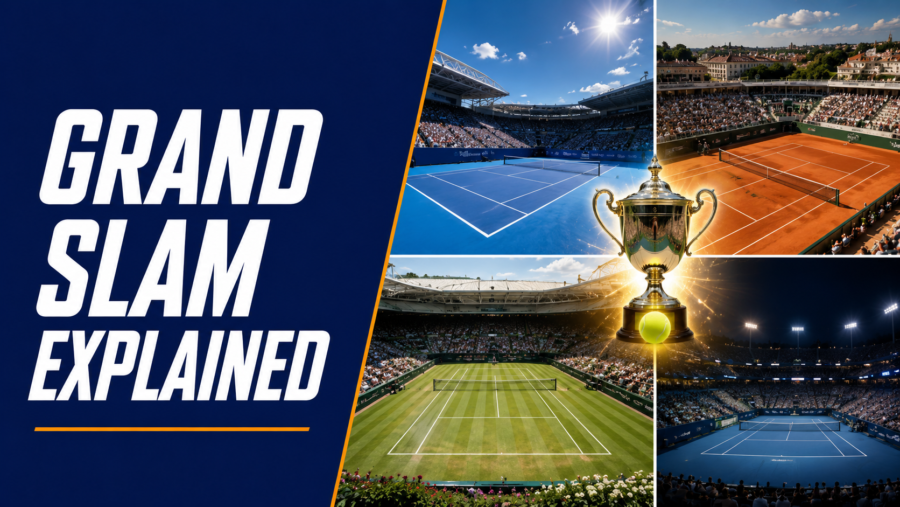
A Grand Slam in tennis has two closely related meanings. The four Grand Slam tournaments, also called the majors, are the Australian Open, Roland Garros, Wimbledon and the US Open. Winning all four in the same calendar year is the achievement properly known as “the Grand Slam.”
Fans also describe one major championship as a Grand Slam title. That usage is widely understood, but it is different from completing the four-tournament sweep.
What are the four Grand Slam tournaments?
The four majors form the highest tier of individual tennis competition. They take place in the same order each season, moving from hard court to clay, grass and back to hard court.
| Tournament | Usual time of year | Location | Current surface |
|---|---|---|---|
| Australian Open | January | Melbourne Park, Melbourne | Hard court |
| Roland Garros | Late May to early June | Stade Roland-Garros, Paris | Clay |
| Wimbledon | Late June to July | All England Club, London | Grass |
| US Open | Late August to September | USTA Billie Jean King National Tennis Center, New York | Hard court |
The schedule makes versatility essential. Players have only a short transition from the slow, high-bouncing clay in Paris to the lower bounce and different movement demands of grass in London.
The two hard-court majors do not play identically either. Climate, court pace, balls and tournament conditions all affect how a match unfolds, even when the broad surface category is the same. This guide to how tennis court surfaces differ explains the main playing characteristics.
Australian Open
The Australian Open is the first major of the calendar year. It has been held at Melbourne Park since 1988 and is known for summer heat, lively crowds and night sessions.
Its main singles draws contain 128 players. Direct acceptances are joined by wild cards and qualifiers, creating seven rounds from the first round to the final.
Roland Garros
Roland Garros is the only major played on clay. The surface slows many shots, produces a higher bounce and rewards movement, patience and point construction.
The event is often called the French Open in English, but Roland Garros is its official name. Rafael Nadal’s 14 men’s singles titles are the record at any one major and the clearest example of dominance at a single Grand Slam tournament.
Wimbledon
Wimbledon is the oldest of the four championships and the only one still played on grass. Its traditions include an all-white clothing rule for competitors and matches staged at the All England Club.
Grass changes as the fortnight progresses, particularly around the baselines. A closer look at what makes Wimbledon’s grass special covers the surface and its maintenance.
US Open
The US Open is the final major of the year. It is played on hard courts in Flushing Meadows, New York, and is noted for evening sessions and an energetic atmosphere.
The tournament has moved between venues and played on grass, clay and hard courts during its history. The complete US Open guide covers its modern venue, draws and spectator basics.
What does “winning the Grand Slam” mean?
Winning the Grand Slam means capturing all four major titles in the same discipline during one calendar year. A singles player must therefore win the Australian Open, Roland Garros, Wimbledon and the US Open from January through September.
The wording matters. A player who wins one major is a Grand Slam champion, but has not won the Grand Slam as a four-event achievement.
Only five players have completed the calendar-year Grand Slam in singles:
| Player | Year | Discipline |
|---|---|---|
| Don Budge | 1938 | Men’s singles |
| Maureen Connolly | 1953 | Women’s singles |
| Rod Laver | 1962 | Men’s singles |
| Rod Laver | 1969 | Men’s singles |
| Margaret Court | 1970 | Women’s singles |
| Steffi Graf | 1988 | Women’s singles |
Laver is the only player to do it twice and the only man to complete the feat during the Open Era. Graf added Olympic singles gold in Seoul to her four majors in 1988, creating the calendar-year Golden Slam.
The Grand Slam has also been achieved in men’s doubles, women’s doubles, mixed doubles and wheelchair disciplines. Each record belongs to its own draw rather than being combined with singles.
What is a Career Grand Slam?
A Career Grand Slam means winning all four majors at least once in the same discipline over any number of seasons. The titles do not need to be consecutive or won in a particular order.
Nine men have completed a Career Grand Slam in singles. Fred Perry, Don Budge and Roy Emerson completed their sets before the Open Era. Rod Laver completed one in 1962 and then won all four again in 1969, after the Open Era began.
The Open Era men’s singles list, with the year each player completed the set, is:
- Rod Laver, 1969
- Andre Agassi, 1999
- Roger Federer, 2009
- Rafael Nadal, 2010
- Novak Djokovic, 2016
- Carlos Alcaraz, 2026
Alcaraz completed his set by winning the 2026 Australian Open. At 22, he became the youngest man to achieve a Career Grand Slam.
The women’s singles career list spans both amateur and Open Era champions. Doris Hart, Maureen Connolly, Shirley Fry, Margaret Court, Billie Jean King, Chris Evert, Martina Navratilova, Steffi Graf, Serena Williams and Maria Sharapova have all won each of the four.
Calendar Slam, non-calendar Slam and Golden Slam
Several similar terms are used when discussing the majors. They describe different achievements and should not be treated as interchangeable.
Calendar-year Grand Slam
This is the traditional Grand Slam: all four majors won in one calendar year. It begins at the Australian Open and ends at the US Open.
Non-calendar-year Grand Slam
This means holding all four major titles consecutively across two calendar years. Serena Williams did it twice, from the 2002 Roland Garros through the 2003 Australian Open and from the 2014 US Open through Wimbledon 2015.
Novak Djokovic held all four men’s singles titles at once from Wimbledon 2015 through Roland Garros 2016. These runs are extraordinary, but they are not calendar-year Grand Slams.
Golden Slam
A calendar-year Golden Slam adds Olympic gold in the same discipline to all four majors in one year. Graf remains the only singles player to accomplish it, in 1988.
A Career Golden Slam is less restrictive. It requires all four majors and Olympic gold at some point in a career. Olympic tennis is still a separate event, as explained in the guide to tennis at the Olympic Games.
Surface Slam
“Surface Slam” is an informal term for winning major titles on hard court, clay and grass in one season. It is not a separate official championship, but it highlights the adaptability required across the calendar.
Why are the majors more important than other tournaments?
The majors have the largest place in tennis history, attract the deepest international fields and award the maximum 2,000 ranking points to a singles champion. Their long draws also require a winner to navigate seven main-draw matches.
Men’s main-draw singles matches at the majors are best of five sets, while women’s main-draw singles matches are best of three. Major qualifying matches are generally best of three, except the final round of Wimbledon men’s qualifying, which is best of five. Draw structures can be easier to follow with this explanation of rounds, sets and tennis draws.
Each major also holds doubles, mixed doubles, junior and wheelchair competitions. Formats can differ by event and discipline, so the rules for one draw should not be assumed to apply to every other draw.
Who runs the Grand Slams?
The majors are not ordinary ATP or WTA tournaments. Tennis Australia organizes the Australian Open, the French Tennis Federation organizes Roland Garros, and the USTA organizes the US Open. Wimbledon is owned and organized through a joint management structure involving the All England Club and the Lawn Tennis Association.
The International Tennis Federation works with all four through the Grand Slam Board and provides governance, officiating and administrative support. ATP and WTA rankings still award points for results at the events.
How do Grand Slam matches work?
The core rules of tennis remain the same, but each major publishes its own event regulations. These cover draw composition, scheduling, final-set procedures, player conduct and competition-specific formats.
All four majors now use a 10-point match tie-break at 6-6 in the deciding set for main-draw singles. Earlier eras used different final-set systems, which is one reason match-length records need historical context. The general guide to how tennis tie-breaks work explains the scoring sequence.
Players can enter a major through direct acceptance based on ranking, by receiving a wild card or by winning through qualifying. A major result can sharply change a player’s ranking because of the points available, although points from the previous year’s event also drop from the calculation. The overview of tennis world rankings explains that rolling system.
Grand Slams compared with other major tennis events
ATP Masters 1000 and WTA 1000 tournaments are important tour events, but winning one does not count as a major title. The ATP Finals and WTA Finals are elite season-ending competitions with limited fields and different formats.
Olympic medals also stand alone, while the Davis Cup and Billie Jean King Cup are national team competitions. A player can build an exceptional career in those events without adding to a Grand Slam title count.
“Major” and “Grand Slam tournament” refer only to the Australian Open, Roland Garros, Wimbledon and the US Open. There is no official fifth major.
The simple definition
The four Grand Slam tournaments are the Australian Open, Roland Garros, Wimbledon and the US Open. Each individual winner earns a major title.
Winning all four in one calendar year is the Grand Slam. Winning all four at any point in a career is a Career Grand Slam, while adding Olympic gold creates a Golden Slam or Career Golden Slam depending on when the victories occur.
Frequently asked questions
Is winning one major called a Grand Slam?
It is commonly called a Grand Slam title, and the winner is a Grand Slam champion. More precisely, winning all four majors in the same calendar year is “the Grand Slam.”
Are there four or five Grand Slams in tennis?
There are four. The Olympics, ATP Finals, WTA Finals and leading tour events are prestigious, but none is a fifth major.
Which Grand Slam is the hardest to win?
There is no objective answer. Each demands seven main-draw wins, but the surface, weather, schedule and quality of a player’s game on that surface change the challenge.
Do Grand Slam qualifying matches count as main-draw wins?
No. Qualifying has its own draw and statistics. A qualifier who reaches the main draw begins the main event in the first round, even after winning several qualifying matches.
Do doubles and wheelchair titles count as Grand Slam titles?
Yes, within their specific disciplines. Record lists should identify singles, doubles, mixed doubles or wheelchair competition instead of combining unlike draws without explanation.