
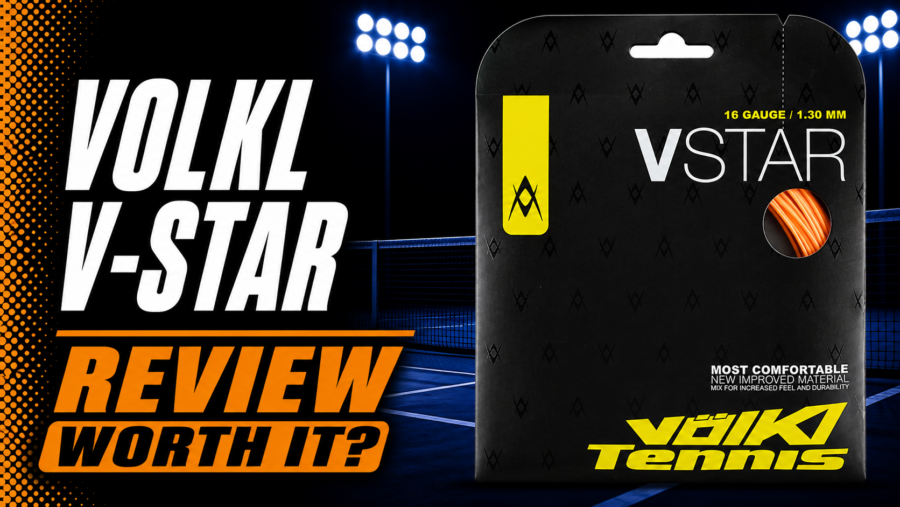
Volkl V-Star is a smooth co-polyester tennis string designed to provide a softer, livelier response than many traditional control polys. It occupies the comfort-oriented position in Volkl’s monofilament range, trading sharp geometric bite for pocketing, power and broad gauge choice.
The round string uses an advanced co-polymer matrix intended to improve elasticity, durability and tension behavior. Independent playtesting has confirmed above-average polyester comfort and useful power, while also identifying tension loss as its main limitation.
V-Star is best suited to healthy intermediate and advanced players who want polyester control without an excessively rigid impact. The Tennis String Finder can help compare it with soft multifilaments and shaped polys.
Volkl V-Star Rating
| Category | Rating |
|---|---|
| Power | 7/10 |
| Spin | 8.5/10 |
| Comfort | 8/10 |
| Control | 8/10 |
These ratings compare V-Star with the complete string market. Its comfort and power are impressive for a co-polyester but remain below natural gut and premium multifilament.
Volkl V-Star Specifications
| Specification | Details |
|---|---|
| String type | Co-polyester monofilament |
| Profile | Round |
| Surface | Smooth finish |
| Gauges | 16 / 1.30mm, 17 / 1.25mm, 18 / 1.20mm, 18L / 1.15mm and 19 / 1.10mm, depending on color |
| Colors | Silver, Neon Yellow, White and Fluo Orange, depending on market |
| Set length | Approximately 12m |
| Reel length | Approximately 200m |
| Primary benefits | Comfort, power and all-court control |
Not every color is manufactured in every gauge. Availability should be checked before choosing a specific combination.
Material and Construction
V-Star uses a single-strand co-polyester construction with a smooth round exterior. It does not contain multifilament fibers or natural gut.
Volkl describes advanced material technology designed to create one of the softer responses in its polyester range. The material bends and pockets the ball more readily than many firm control monofilaments.
The round surface supports sliding and snapback without relying on edges. This makes V-Star less abrasive in hybrids and gives flat hitters a clean, consistent launch.
Its softer matrix also explains the maintenance tradeoff. Greater elasticity can produce useful power when fresh, but tension loss may create a livelier or less predictable response over time.
Volkl V-Star Performance
Power
V-Star offers above-average power for a polyester. Independent testing found easier depth than with firm Volkl options such as Cyclone or V-Torque.
The power is still controlled relative to multifilament. Players with medium and fast swings can drive the ball through the court without receiving an excessively springy response.
Thinner gauges feel livelier. Compact swingers who need effortless depth should still choose nylon, multifilament or natural gut.
Power rating: 7/10
Spin
V-Star generates strong spin through smooth movement, pocketing and snapback. Independent playtesting gave it high spin scores despite its round profile.
It does not grip the felt with sharp edges. Players who depend on geometric bite will receive a more aggressive response from V-Square or V-Torque Tour.
Spin can remain useful after the initial break-in, but it declines when notching and tension loss prevent consistent return.
Spin rating: 8.5/10
Control
Control is good for a lively co-polyester. The monofilament construction keeps full swings predictable, while spin helps bring depth inside the baseline.
V-Star is less locked-in than firm tournament polys. Fast hitters using powerful rackets may need the thicker gauge or a lower-powered alternative.
Independent feedback indicates that control can change after an early tension drop. Players should judge the useful response rather than waiting for breakage.
Control rating: 8/10
Comfort and Feel
Comfort is V-Star’s clearest advantage. Independent laboratory and playtest feedback place it among the softer co-polyesters, with good ball pocketing and reduced harshness.
The feel is smooth and responsive. Some players prefer this elastic character, while users accustomed to crisp strings may consider it too soft or disconnected.
V-Star remains polyester. Players with current arm pain should select a more elastic material and seek appropriate professional guidance.
Comfort rating: 8/10
Durability and Tension Maintenance
Physical durability is good, particularly in 1.30mm and 1.25mm. The solid strand resists breakage better than most multifilaments.
The very thin gauges exchange physical life for response and spin. Open-patterned rackets and heavy topspin can wear through 1.15mm or 1.10mm quickly.
Tension maintenance is the main weakness identified in independent testing. The string can lose tension early and become more elastic. Replace it when launch becomes inconsistent, even if the strand remains intact.
Choosing the Right Gauge
| Gauge | General characteristics |
|---|---|
| 16 / 1.30mm | Greatest stability and physical resistance |
| 17 / 1.25mm | Best general balance of power, spin and control |
| 18 / 1.20mm | More pocketing and spin with faster wear |
| 18L / 1.15mm | Very lively response for dense patterns |
| 19 / 1.10mm | Maximum feel and rotation with limited longevity |
The 17 / 1.25mm gauge is the most versatile choice. Thinner versions make sense in dense patterns, while frequent breakers should use 1.30mm.
Full Bed or Hybrid Setup
Full Bed
A full bed maximizes V-Star’s soft-poly pocketing and smooth snapback. It suits healthy players transitioning from a firmer polyester.
Because the string is lively for its category, there is no need to combine very high tension with a powerful racket without testing gradually.
Volkl V-Star in the Mains With Softer Crosses
V-Star mains provide smooth polyester control, while natural gut or multifilament crosses add power and comfort. The round profile is less abrasive than a sharply shaped main.
The polyester will still notch the soft crosses and the setup remains monofilament-led.
Softer Mains With Volkl V-Star Crosses
Natural gut or multifilament mains dominate power and feel. V-Star crosses control launch and provide a smooth track for main-string movement.
This is one of V-Star’s most logical hybrid uses because its round surface supports snapback without aggressive edges.
General Tension Guidance
V-Star should generally start below the tension used for nylon or multifilament. Its monofilament construction already provides containment.
Lower tension increases pocketing and comfort. Higher tension produces a firmer launch but may reduce the character that distinguishes V-Star.
Stay within the racket manufacturer’s range and make small changes. The Tennis String Tension Calculator offers broad guidance.
Who Should Use Volkl V-Star?
V-Star is best suited to:
- Healthy intermediate and advanced players
- Polyester users wanting more comfort and power
- All-court players who prefer a round response
- Players using dense string patterns
- Hybrid users needing a smooth co-polyester
- Competitors willing to monitor tension loss
Who Should Avoid Volkl V-Star?
V-Star is less suitable for:
- Beginners needing maximum nylon comfort
- Players with current arm discomfort
- Heavy hitters wanting the lowest possible launch
- Users seeking sharp edge-driven spin
- Players who rarely restring polyester
- Frequent breakers considering the thinnest gauges
Pros and Cons
| Pros | Cons |
|---|---|
| Very comfortable for a co-polyester | Tension loss can alter control |
| Above-average polyester power | Less bite than shaped strings |
| Smooth, predictable profile | Still firmer than multifilament |
| Five possible gauges | Thin gauges have limited physical life |
| Strong snapback while fresh | Color and gauge availability varies |
| Useful hybrid cross | Too lively for some advanced hitters |
Volkl V-Star Compared With Other Strings
V-Star vs Volkl Cyclone Tour
Volkl Cyclone Tour uses a twisted ten-sided profile for stronger bite and even more liveliness. V-Star is rounder and cleaner through contact.
V-Star vs Volkl V-Torque Tour
Volkl V-Torque Tour provides sharper spin and stronger control. V-Star is softer and better for players prioritizing pocketing.
V-Star vs HEAD Lynx Touch
HEAD Lynx Touch is a round co-extruded poly with controlled pocketing. Both are accessible monofilaments, while V-Star offers more gauges and a softer, livelier identity.
V-Star vs Luxilon Element
Luxilon Element is another comfort-oriented monofilament. Element has its own muted Multi-Mono construction, while V-Star provides a smoother conventional co-poly response.
Final Verdict
Volkl V-Star is a convincing soft co-polyester for players who want more pocketing and depth without abandoning monofilament control. Its smooth profile, broad gauge range and responsive matrix make it versatile in full beds and hybrids.
Its biggest limitation is tension behavior. A string that remains unbroken can become too lively or less predictable, so timely replacement matters.
The 17 / 1.25mm version is the best starting point. Use thicker for stability or thinner when a dense pattern and frequent restringing justify the tradeoff.
Frequently Asked Questions
Is Volkl V-Star shaped?
No. It is a smooth, round co-polyester monofilament.
Is V-Star comfortable?
It is highly comfortable for polyester, but less forgiving than natural gut or multifilament.
Which gauge should most players choose?
The 17 / 1.25mm version offers the most balanced response.
Does V-Star hold tension well?
Volkl emphasizes tension performance, but independent testing identified noticeable tension loss as its main weakness.
Is it suitable as a hybrid cross?
Yes. Its smooth round surface makes it a logical control cross under natural gut or multifilament mains.
Is V-Star a good choice for heavy string breakers?
The thicker gauges provide useful physical resistance, but V-Star is chosen mainly for its softer polyester response. Frequent breakers should monitor both notching and loss of control rather than assuming an intact stringbed remains fresh.