
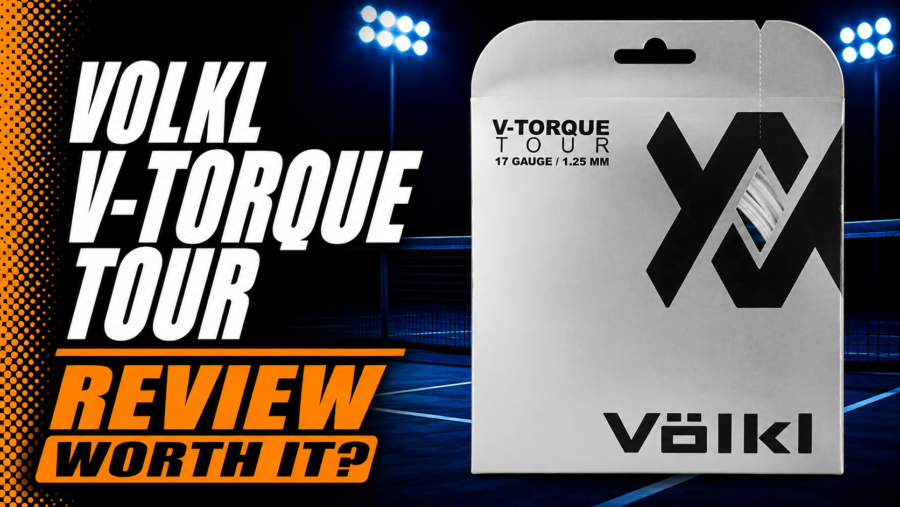
Volkl V-Torque Tour is a twisted six-sided co-polyester tennis string designed for players who want exceptional spin and control with more pocketing than a traditional firm polyester. It sits between the firmer original V-Torque and the livelier Cyclone Tour in Volkl’s shaped-string range.
Volkl uses a patented extrusion process to create a twisted cog-like profile. The geometry supplies pronounced ball bite, while a softer co-polymer formulation gives the string a medium-firm rather than rigid response.
V-Torque Tour targets healthy intermediate and advanced players with fast, spin-oriented swings. Independent playtesting has rated it especially highly for spin, control and feel. The Tennis String Finder can help compare it with round and square alternatives.
Volkl V-Torque Tour Rating
| Category | Rating |
|---|---|
| Power | 7/10 |
| Spin | 9.5/10 |
| Comfort | 7.5/10 |
| Control | 9/10 |
These ratings place V-Torque Tour across the complete string market. Its comfort is strong for a control co-polyester, not equivalent to a multifilament.
Volkl V-Torque Tour Specifications
| Specification | Details |
|---|---|
| String type | Co-polyester monofilament |
| Profile | Twisted six-sided cog shape |
| Manufacturing | Patented extrusion process |
| Gauges | 16 / 1.30mm, 17 / 1.25mm, 18 / 1.20mm and 19 / 1.10mm |
| Color | White |
| Set length | Approximately 12m |
| Reel length | Approximately 200m |
| Primary benefits | Spin, control and feel |
The four-gauge range is a major strength. Availability can vary, especially for the thinnest version.
Material and Construction
V-Torque Tour uses a co-polyester monofilament made from a softer material blend than the original V-Torque. It remains a solid polyester strand rather than a multifilament bundle.
Its six-sided profile is twisted during extrusion, creating a cog-like exterior. The raised edges increase interaction with the ball, while the twisting changes the contact angle along the string.
This differs from V-Square’s straight four-sided geometry and Cyclone’s ten-sided gear profile. V-Torque Tour combines edge grip with additional pocketing and a less rigid response.
The shape can abrade soft hybrid partners and notch at the intersections. Careful installation is required, particularly with the thin 1.10mm version.
Volkl V-Torque Tour Performance
Power
V-Torque Tour provides medium power for a polyester. It is more responsive than the original V-Torque and many firm control strings, but it still expects the player to supply racket-head speed.
Independent testing found useful depth without an uncontrollable launch. The string’s pocketing helps on defensive shots and moderate swings, while the shaped profile keeps aggressive trajectories manageable.
The 1.10mm and 1.20mm versions feel livelier. Players using powerful open-patterned rackets may prefer 1.25mm or 1.30mm.
Power rating: 7/10
Spin
Spin is outstanding. The six edges, twisted profile and controlled response allow players to brush rapidly through the ball and create steeply dipping trajectories.
Independent playtesters have awarded V-Torque Tour near-maximum spin scores. The thinner gauges increase bite and pocketing further, although they trade away physical life.
The advantage declines as the edges wear and notching limits snapback. Fresh-string performance should not be projected indefinitely.
Spin rating: 9.5/10
Control
V-Torque Tour provides excellent control for medium-to-fast swings. Its firm-enough structure prevents excessive launch, while the spin profile brings aggressive shots down inside the lines.
The response is more forgiving than many control polys without becoming as springy as Cyclone Tour. This makes it useful for players who want precision but dislike a completely dead stringbed.
Control can decline during the third stage of its life as tension loss and reduced snapback alter the launch. Replacement should be based on response, not breakage alone.
Control rating: 9/10
Comfort and Feel
Comfort is above average for a shaped control polyester. The softer co-polymer formulation produces useful ball pocketing and a connected medium-firm feel.
Independent testing praised its response on both full swings and touch shots. It is less harsh than the original V-Torque, while remaining crisper than very soft polys such as V-Star.
It is still unsuitable as an injury-management string. Natural gut and multifilament provide substantially greater elasticity for players prioritizing maximum comfort.
Comfort rating: 7.5/10
Durability and Tension Maintenance
Physical durability is good in 1.30mm and 1.25mm. The thin 1.20mm and 1.10mm versions emphasize response and may break much faster under heavy spin.
Independent playtesting found useful performance for roughly a typical co-polyester cycle, with a noticeable decline after sustained hard hitting. This should not be converted into a universal hour count because playing style and setup vary widely.
Replace the string when control, feel or spin deteriorates. A polyester can remain physically intact after its useful elasticity has declined.
Choosing the Right Gauge
| Gauge | General characteristics |
|---|---|
| 16 / 1.30mm | Maximum control and physical resistance |
| 17 / 1.25mm | Best overall balance of spin, feel and durability |
| 18 / 1.20mm | Greater pocketing and bite with faster wear |
| 19 / 1.10mm | Maximum response and spin with limited longevity |
The 17 / 1.25mm gauge is the safest starting point. Dense patterns can benefit from thinner options, while open patterns and frequent breakers should move thicker.
Full Bed or Hybrid Setup
Full Bed
A full bed produces the most consistent spin and control. It suits healthy players who already use polyester and understand that it requires timely replacement.
The string’s control allows a moderate tension rather than an unnecessarily rigid installation.
Volkl V-Torque Tour in the Mains With Softer Crosses
V-Torque Tour mains preserve shaped bite, while natural gut or multifilament crosses add depth and comfort. This orientation creates a more forgiving spin hybrid.
The twisted edges can saw through soft crosses. A durable, smooth partner is preferable.
Softer Mains With Volkl V-Torque Tour Crosses
Soft mains dominate power and feel, while V-Torque Tour crosses add firmness. The shaped cross can restrict main-string movement and accelerate wear.
A round polyester is usually a more efficient cross when maximum snapback is the goal.
General Tension Guidance
V-Torque Tour should normally start below a nylon or multifilament reference. Its monofilament construction and shaped profile already provide control.
Lower tension adds pocketing, power and comfort. Higher tension flattens launch but can remove the feel that distinguishes V-Torque Tour from firmer polys.
Stay within the racket manufacturer’s range and adjust in small steps. The Tennis String Tension Calculator offers general guidance.
Who Should Use Volkl V-Torque Tour?
V-Torque Tour is best suited to:
- Intermediate and advanced topspin players
- Healthy competitors with fast swings
- Players seeking shaped bite with useful pocketing
- Aggressive baseliners and kick servers
- Users who find V-Torque too firm
- Players willing to restring polyester regularly
Who Should Avoid Volkl V-Torque Tour?
V-Torque Tour is less suitable for:
- Beginners and compact swingers
- Players with current arm discomfort
- Users wanting effortless multifilament power
- Players who leave polyester installed indefinitely
- Soft-string hybrid users needing maximum cross life
- Flat hitters who prefer a completely smooth response
Pros and Cons
| Pros | Cons |
|---|---|
| Exceptional spin | Still firm across the wider market |
| Excellent control | Shaped profile can abrade soft crosses |
| Strong feel for a co-polyester | Useful life ends before physical breakage for many players |
| Four gauge choices | Thin gauges can be fragile |
| More comfortable than original V-Torque | Limited free power for short swings |
| Good balance of bite and pocketing | White is the principal color |
Volkl V-Torque Tour Compared With Other Strings
V-Torque Tour vs Volkl V-Square
Volkl V-Square uses a straight square profile for maximum raw bite. V-Torque Tour feels softer and more pocketing while retaining exceptional spin.
V-Torque Tour vs Volkl Cyclone Tour
Volkl Cyclone Tour is ten-sided, softer and more powerful. V-Torque Tour offers a firmer, more precise trajectory.
V-Torque Tour vs Solinco Tour Bite
Solinco Tour Bite is square and crisper. Both suit advanced spin hitters, but V-Torque Tour provides more comfort and pocketing.
V-Torque Tour vs Tecnifibre 4S
Tecnifibre 4S is a four-sided control poly with a firmer response. V-Torque Tour’s twisted six-sided shape produces a different mix of grip and feel.
Final Verdict
Volkl V-Torque Tour is one of the stronger choices for players who want shaped-poly spin without an extremely rigid response. Its twisted six-sided profile, medium-firm feel and broad gauge range produce exceptional bite with excellent control.
It remains a specialist polyester, not a comfort string for beginners or injured players. Its preferred response can also fade before the strand breaks.
The 17 / 1.25mm gauge offers the best general balance. Thinner gauges suit dense patterns and frequent restringers, while 1.30mm provides the greatest stability.
Frequently Asked Questions
How many sides does V-Torque Tour have?
It has a twisted six-sided cog profile created through a patented extrusion process.
Is it softer than regular V-Torque?
Yes. Volkl uses a softer co-polymer material, and independent testing describes greater comfort and power.
Which gauge should most players choose?
The 17 / 1.25mm version balances spin, control, feel and durability.
Is V-Torque Tour suitable for beginners?
Generally no. It is designed for players with developed, faster swings.
How long should it stay installed?
There is no universal hour count. Replace it when launch, snapback or feel changes meaningfully, even if it remains unbroken.
Does the twisted shape last forever?
No. Repeated movement gradually rounds the edges and creates notching at the intersections. Spin can decline before the string breaks.