
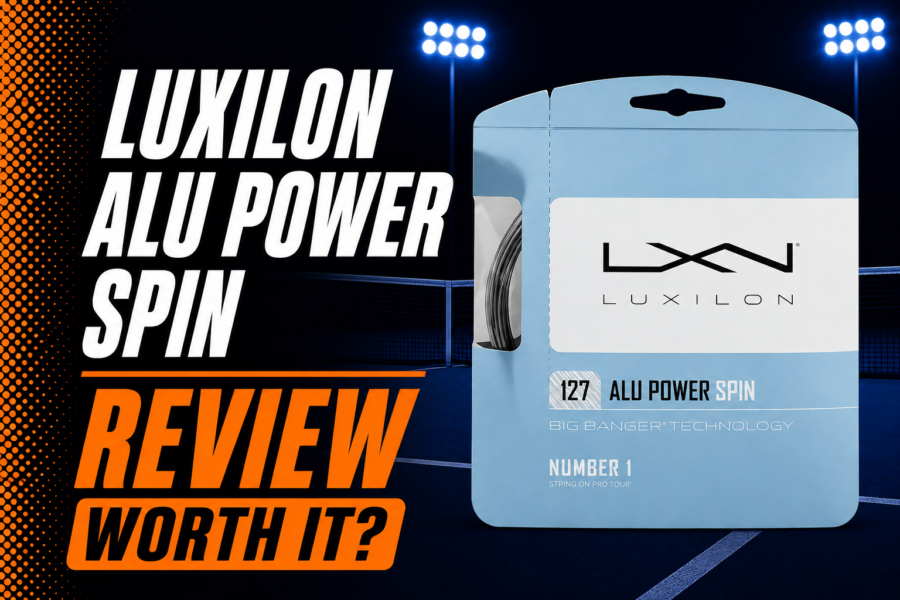
Luxilon ALU Power Spin is a five-sided polyester tennis string created for experienced players who want the control and connected response of the ALU Power family with a more spin-focused profile. Its pentagonal shape distinguishes it from round ALU Power and the dented surface of ALU Power Rough.
The string is designed for long, fast swings. It provides a predictable, relatively low-powered response that allows aggressive players to accelerate while using its edges and snapback to shape the ball. This makes it particularly relevant to heavy baseline hitters and players who want more trajectory control from a shaped polyester.
ALU Power Spin is not an easy-power or comfort string. It remains firm and demanding when compared with natural gut, multifilament or synthetic gut. Players deciding whether that profile fits their game can use the Tennis String Finder to compare it with softer or livelier alternatives.
Luxilon ALU Power Spin Rating
| Category | Rating |
|---|---|
| Power | 6/10 |
| Spin | 9.5/10 |
| Comfort | 6/10 |
| Control | 9/10 |
These ratings compare ALU Power Spin with the complete tennis-string market, not only with other firm performance polyesters.
Luxilon ALU Power Spin Specifications
| Specification | Details |
| String type | Shaped polyester monofilament |
| Composition | Poly-ether-ether formulation with aluminum |
| Shape | Pentagonal with five defined sides |
| Surface | Shaped rather than separately textured |
| Confirmed gauge | 1.27mm |
| Color | Silver |
| Set length | Approximately 12.2m |
| Reel length | Approximately 200m to 220m, depending on market |
| Made in | Belgium |
Reel size and package availability can differ between regions and retailers.
Material and Construction
ALU Power Spin uses the poly-ether-ether and aluminum formulation associated with the ALU Power family. It is a single monofilament rather than a bundle of soft fibers.
Its defining construction feature is the pentagonal profile. Five sides create edges that can interact with the ball during a brushing stroke. The shape also changes how the strings contact and slide against one another compared with a completely round monofilament.
The string should not be described as relying on a separate rough coating. Its geometry provides the primary surface feature. Spin still comes from several factors working together, including edge interaction, snapback, racket-head speed, string pattern and swing path.
The 1.27mm diameter is slightly thicker than the common 1.25mm performance-polyester gauge. This adds material for stability and resistance to wear, although shaped edges can round off or notch as the stringbed ages.
ALU Power Spin retains the controlled, connected character expected from the family. The shape does not turn it into a soft or highly elastic string, and its best performance requires the player to supply acceleration.
Luxilon ALU Power Spin Performance
Power
ALU Power Spin provides moderate response within the performance-polyester category but remains low powered across the full string market. Independent playtesting has found that advanced players can access useful pace, while less developed strokes may find it firm and underpowered.
Its controlled launch encourages the player to swing freely. A long, fast stroke can generate penetrating depth because the stringbed stays predictable under acceleration. A short or hesitant stroke receives much less assistance.
Players should therefore view its power as controllable response rather than free pace. Natural gut, multifilament and synthetic gut are all easier sources of depth for players who cannot consistently activate a firm monofilament.
Power rating: 6/10
Spin
Spin is ALU Power Spin’s defining strength. Independent evaluations have recorded exceptional spin potential, supported by its five-sided profile and the confidence its low-powered response gives aggressive players.
The edges can increase interaction during upward or across-the-ball contact. String movement and snapback also contribute, so the result is not based on shape alone. A worn or notched stringbed may produce a different response even if the string has not broken.
Fast topspin swings, kick serves and biting slices are the clearest applications. Players with flatter mechanics can still benefit from control, but they may not use enough of the string’s defining capability to justify it over regular ALU Power.
Spin rating: 9.5/10
Control
ALU Power Spin offers excellent control. Its limited free power and stable response let advanced players attack the ball without an excessively springy launch.
The added spin potential also supports control by helping the ball clear the net and return inside the baseline. This is particularly valuable for aggressive baseliners who use height and rotation to create margin during full swings.
Directional accuracy remains strong on flatter drives, returns and serves. Control can decline as elasticity and snapback fade, which is why an unbroken polyester should not automatically be considered fully playable.
Control rating: 9/10
Comfort and Feel
ALU Power Spin has a firm, connected and relatively low-powered feel. Independent testers have generally treated comfort as acceptable for experienced polyester users rather than as a strength across the broader market.
The response provides clear information at impact, which can help accomplished players judge contact and trajectory. Players accustomed to nylon or natural gut are more likely to experience it as rigid and demanding.
Comfort depends heavily on racket stiffness, pattern density, tension and contact quality. Players with recurring elbow, wrist or shoulder discomfort should approach a full bed cautiously and normally consider a softer string or hybrid. Persistent pain requires professional medical advice rather than an equipment-only solution.
Comfort rating: 6/10
Durability and Tension Maintenance
ALU Power Spin provides good physical resistance to breakage. Its polyester monofilament construction and 1.27mm diameter give frequent hitters more wear resistance than most multifilament strings.
The pentagonal shape introduces a separate issue. Its edges can wear and the strings can notch as they slide across one another. The string may remain intact after its original surface definition, elasticity and snapback have begun to decline.
Independent testing has produced solid durability results but more mixed impressions of useful playability duration. This distinction matters. Break resistance describes whether the string snaps, while playability duration describes how long it maintains acceptable control, spin, feel and response.
No fixed replacement schedule fits every player. Fast swings, open patterns, frequent play and high friction can shorten useful life. Reduced spin, strings remaining displaced, weaker depth control or a noticeably harsher response are practical restringing signals.
Choosing the Right Gauge
The confirmed ALU Power Spin gauge is 1.27mm. It should not be confused with the 1.25mm diameter used by several other ALU Power versions.
| Gauge | General characteristics | Best suited to |
| 1.27mm | Stable, controlled and resistant to wear while retaining useful string movement | Fast-swinging intermediate and advanced players seeking the intended spin-focused response |
Players cannot choose between multiple commonly documented diameters within this model, but they can still alter launch and feel through racket choice, tension and hybrid orientation.
Full Bed or Hybrid Setup
Full Bed
A full bed maximizes ALU Power Spin’s controlled launch, shaped-string interaction and consistent feel. It is best suited to intermediate and advanced players who already use polyester successfully.
The setup can be demanding in a stiff racket or dense pattern. Players moving from synthetic gut or multifilament should expect less easy depth and a firmer impact.
ALU Power Spin in the Mains With Softer Crosses
Using ALU Power Spin in the mains preserves most of its spin and control identity. Natural gut, multifilament or synthetic gut in the crosses can add power, pocketing and comfort.
This is the logical hybrid direction when ALU Power Spin should remain the dominant string. Its pentagonal mains can notch and wear a soft cross more quickly than a smooth polyester, so the hybrid may break sooner than a full bed even if it feels better while fresh.
Luxilon Natural Gut offers a premium option, while multifilament or synthetic gut can lower the cost.
Softer Mains With ALU Power Spin in the Crosses
Placing natural gut or multifilament in the mains creates a more powerful and comfortable setup. ALU Power Spin in the crosses helps control launch and adds firmness.
The softer mains dominate the overall feel, but the shaped cross can create extra friction and notching. Players prioritizing free main-string movement will usually find a round, smooth polyester cross more suitable than ALU Power Spin in this orientation.
General Tension Guidance
ALU Power Spin generally performs best at a lower tension than the same player would choose for synthetic gut or multifilament. Polyester is less elastic, and the string’s shape and controlled response already provide substantial trajectory management.
Players seeking additional pocketing, depth and comfort can begin toward the lower part of the racket manufacturer’s recommended range. Players wanting a firmer trajectory can move upward gradually, provided the stringbed does not become uncomfortably rigid.
Racket stiffness, head size, pattern density and hybrid direction all affect the result. The Tennis String Tension Calculator can provide a starting point, while a qualified stringer can refine it using the player’s current setup and feedback.
Who Should Use Luxilon ALU Power Spin?
ALU Power Spin is best suited to:
- Intermediate and advanced players with long, fast swings
- Aggressive baseliners who create heavy topspin
- Players who prioritize spin and control over easy power
- Polyester users who like a firm, connected response
- Players seeking a five-sided alternative within the ALU Power family
- Frequent string breakers who need good physical resistance to wear
Who Should Avoid Luxilon ALU Power Spin?
ALU Power Spin is less suitable for:
- Beginners who need easy depth and forgiveness
- Players with compact or slow swings
- Players seeking plush natural-gut or multifilament comfort
- Flatter hitters who do not need a specialized shaped string
- Arm-sensitive players who have not been advised that polyester is appropriate
- Hybrid users who want the smoothest possible cross beside soft mains
Pros and Cons
| Pros | Cons |
| Exceptional spin potential | Firm and relatively low powered |
| Excellent control on fast swings | Demanding for beginners and slower strokes |
| Five-sided profile adds clear product differentiation | Only one confirmed gauge |
| Connected and predictable response | Shaped surface can wear soft hybrid partners |
| Good resistance to physical breakage | Peak spin and snapback can decline before breakage |
| Effective for heavy topspin and kick serves | Less comfortable than nylon and natural gut |
Luxilon ALU Power Spin Compared With Other Strings
ALU Power Spin vs Luxilon ALU Power
Luxilon ALU Power uses a round profile and offers a cleaner, more uniform response. ALU Power Spin adds five sides for stronger shape-based interaction. Spin better suits heavy topspin hitters, while standard ALU Power may appeal to players who combine flatter drives with moderate spin.
ALU Power Spin vs Luxilon ALU Power Rough
Luxilon ALU Power Rough begins with a round base and adds dents rather than geometric edges. Rough generally feels more flexible and responsive. Spin provides the more defined shaped-string response and the highest spin emphasis.
ALU Power Spin vs Luxilon 4G
Luxilon 4G is round and built around tension stability, predictability and control. ALU Power Spin supplies more geometric bite and a livelier ALU character, while 4G better suits players prioritizing long-lasting consistency.
ALU Power Spin vs Babolat RPM Blast
Babolat RPM Blast uses an octagonal profile and a slick surface treatment. Both target fast-swinging spin players. ALU Power Spin offers a crisp, connected ALU response, while RPM Blast is usually experienced as firmer and more muted.
ALU Power Spin vs Volkl Cyclone
Volkl Cyclone is a shaped co-polyester with strong spin and control at a lower typical price. ALU Power Spin offers a more premium, direct feel, while Cyclone may provide better value for players whose main requirement is shaped-polyester spin.
Final Verdict
Luxilon ALU Power Spin is a specialized shaped polyester for advanced acceleration. Its pentagonal profile, controlled response and strong connection make it highly effective for heavy topspin, aggressive baseline patterns and kick serves.
Its strengths come with familiar performance-polyester limitations. It offers limited free power, firm comfort and a useful response that can decline before the string physically breaks.
For a developed player who wants one of the most spin-focused members of the Luxilon range, ALU Power Spin has a clear purpose. Players seeking easier depth, softer impact or a smooth hybrid cross should choose a different construction.
Frequently Asked Questions
What shape is Luxilon ALU Power Spin?
It has a pentagonal profile with five sides. The geometry distinguishes it from round ALU Power and the dented surface of ALU Power Rough.
Does ALU Power Spin produce more spin than regular ALU Power?
Its five-sided profile gives it stronger shape-based interaction, and independent testing supports exceptional spin potential. The result still depends on racket-head speed, swing path and string movement.
Is ALU Power Spin powerful?
It can feel responsive within the polyester category, but it is low powered across the full tennis-string market. It performs best for players who generate their own pace.
Is ALU Power Spin comfortable?
Comfort is acceptable for experienced polyester users but not comparable with natural gut or multifilament. Racket stiffness and tension can make the setup more or less demanding.
Is ALU Power Spin suitable for beginners?
It is generally not the best choice. Beginners normally benefit from the easy depth, comfort and forgiveness of synthetic gut or multifilament.
Is ALU Power Spin better in the mains or crosses of a hybrid?
It is usually more logical in the mains, where its shape can influence spin and control. As a cross, its edges can increase wear on soft mains.
How should a player know when ALU Power Spin is no longer playable?
Reduced snapback, less spin, strings staying out of position, weaker control or harsher impact can indicate that useful playability has ended even if the string remains unbroken.