
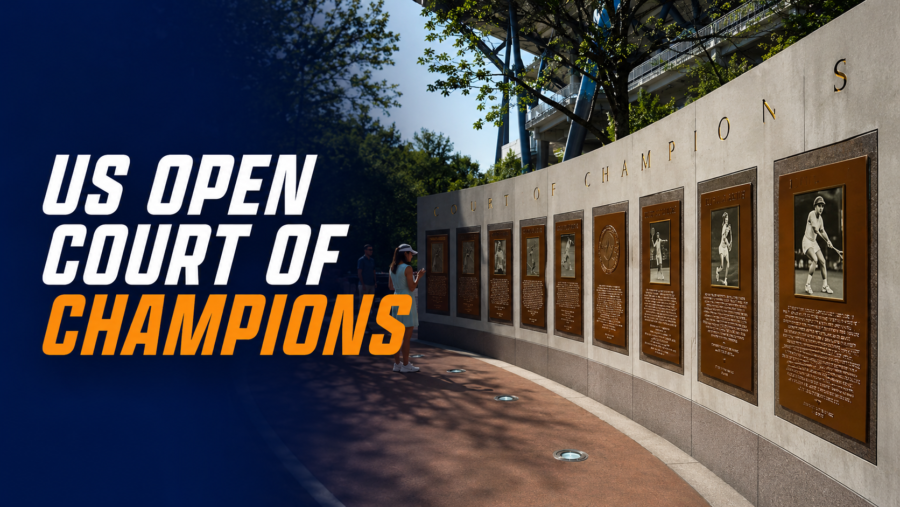
The US Open Court of Champions is a permanent outdoor memorial honoring a selective group of the greatest singles champions in the history of the U.S. Championships and US Open. Despite its name, it is not a playable tennis court. It is a pavilion where visitors can see individual monuments to chosen legends alongside a complete roll of the tournament’s singles champions.
The Court was introduced in 2003 to give the players who shaped the tournament a lasting place on the grounds of the USTA Billie Jean King National Tennis Center. It connects the modern event in Flushing Meadows with a history that began in 1881, which is explored more broadly in this guide to US Open history and records.
What Is the US Open Court of Champions?
The Court of Champions is the US Open’s tournament-specific hall of honor. Each inductee receives an individual permanent monument or plaque celebrating what that player achieved at the U.S. Championships or US Open and why the player remains important to the event.
The official description identifies it as a 9,000-square-foot outdoor pavilion featuring a complete listing of every men’s and women’s singles champion since the tournament began in 1881. The area was later relocated as part of renovations to the National Tennis Center’s South Campus, but its purpose remained the same.
This distinction matters. The complete champions roll records everyone who won the singles title, while the individual monuments recognize a smaller, specially selected group. Winning the tournament places a name in its history, but it does not automatically produce a Court of Champions induction.
Where Is It Located?
The Court of Champions is located at the USTA Billie Jean King National Tennis Center in Flushing Meadows, Queens. The venue’s current visitor information places it between Fountain Plaza and Courts 10 and 13.
It is part of the tournament grounds rather than a room inside Arthur Ashe Stadium. Spectators can encounter the display while moving between courts and other public areas during the US Open. The complete guide to the US Open explains how the stadiums, outer courts and grounds fit together.
Access outside the tournament can depend on venue operations, events and seasonal closures. Anyone planning a separate visit should first check whether the National Tennis Center is open to the public rather than assuming every part of the grounds will be accessible.
Why Was the Court of Champions Created?
The USTA created the Court to recognize the players whose performances and influence helped transform the tournament into one of the world’s leading sporting events. Former USTA president Judy Levering later explained that the organization wanted to do more to honor how important its champions had been, both to the event and to American tennis.
Its introduction in 2003 also came 25 years after the tournament moved from Forest Hills to Flushing Meadows. The pavilion gave the newer venue a visible connection to champions from every stage of the competition, including the pre-1968 U.S. Championships and the modern US Open.
The six inaugural inductees were deliberately drawn from different periods. Jimmy Connors and Chris Evert represented the Open Era, Bill Tilden and Helen Wills represented the earlier Golden Era, while Rod Laver and Billie Jean King won U.S. singles titles on both sides of the 1968 divide.
Who Can Be Inducted?
The current US Open website does not publish a formal eligibility rulebook or a public nomination form for the Court of Champions. Its current description says that the honor celebrates the greatest singles champions in tournament history.
Historical eligibility language published for the 2019 induction required a player to have won at least one U.S. Championships or US Open singles title and to have been retired from singles at the tournament for at least five years. The current US Open site does not confirm whether that exact wording remains in force, and satisfying it never guaranteed induction.
Under that formulation, a doubles title alone was not enough, and an active or recently retired singles champion had to wait. More importantly, clearing the minimum conditions only made a player eligible for consideration. Selection remained a separate judgment about the player’s US Open achievements and legacy.
Players Currently Honored
The current official Court of Champions roll lists the following players. The number in parentheses is each player’s U.S. Championships or US Open singles title total.
| Induction year | Men | Women |
|---|---|---|
| 2024 | None | Pauline Betz Addie (4) |
| 2019 | None | Kim Clijsters (3) |
| 2016 | None | Tracy Austin (2) |
| 2014 | Tony Trabert (2) | None |
| 2013 | None | Monica Seles (2) |
| 2012 | Andre Agassi (2) | None |
| 2011 | Pancho Gonzalez (2) | None |
| 2010 | Ken Rosewall (2) | Margaret Osborne duPont (3) |
| 2009 | Arthur Ashe (1) | None |
| 2008 | Pete Sampras (5) | Molla B. Mallory (8) |
| 2007 | None | Althea Gibson (2) |
| 2006 | Don Budge (2) | Martina Navratilova (4) |
| 2005 | Ivan Lendl (3) | Maureen Connolly (3) |
| 2004 | John McEnroe (4), Jack Kramer (2) | Steffi Graf (5), Margaret Court (5) |
| 2003 | Jimmy Connors (5), Bill Tilden (7), Rod Laver (2) | Chris Evert (6), Helen Wills (7), Billie Jean King (4) |
The group includes dominant record holders, defining Open Era stars and champions whose importance went beyond a title count. Many of the women honored here also feature among the greatest women’s tennis players of all time, but the Court focuses specifically on what they meant to the New York tournament.
Mallory’s record eight women’s singles titles, Tilden’s six consecutive championships and Evert’s run of four straight titles represent sustained dominance. Other choices recognize defining moments, such as Ashe winning the first men’s title of the Open Era, Gibson breaking racial barriers, and Budge and Connolly completing historic calendar-year Grand Slams.
The selections also show that raw totals are not the only consideration. Ashe won one singles title, while Trabert’s monument recognizes both his championships and his later contribution as a broadcaster and ambassador. Seles and Clijsters are remembered not only for winning, but also for the resilience and connection with the tournament that defined their careers.
How Are Players Selected?
Historically, international tennis media played a central role. For the inaugural class, a nominating group of international journalists assembled the candidate list and a wider media vote selected three men and three women.
The official tournament history also states that Althea Gibson’s 2007 induction resulted from an international media vote. Tony Trabert was selected in 2014 by an international tennis media panel from a group of past champions.
Those historical procedures should not be presented as a guaranteed current formula. The USTA does not now publish a standing annual ballot, the names of a permanent selection committee or a fixed number of places. The announcement of Pauline Betz Addie’s 2024 induction, for example, did not identify a panel or public vote.
Inductions are also not annual. The official list contains several gaps, including five years between Clijsters in 2019 and Betz Addie in 2024. A champion can therefore satisfy the historical minimum conditions and still wait indefinitely for selection.
Past selection descriptions indicate that the evaluation considered both performance at the tournament and the player’s influence on its growth and identity. Title totals, repeated finals, historic firsts, sportsmanship, longevity and cultural importance can all help explain a choice, but the USTA has not published a modern points system that assigns formal weight to those factors.
How the Pavilion Honors Tournament History
The pavilion preserves two different levels of history in one place. The comprehensive champions list provides the factual record from 1881 onward, while the individual plaques tell selected stories about the players who most strongly shaped the tournament.
That format allows visitors to see continuity between the earlier U.S. Championships and the US Open at Flushing Meadows. Pre-Open champions such as Tilden, Wills, Mallory and Betz Addie appear beside modern figures such as Graf, Agassi, Sampras and Clijsters.
The plaques are intended to remain on the grounds permanently. When Betz Addie was inducted in 2024, her family joined an on-court ceremony in Arthur Ashe Stadium and unveiled a replica of the plaque that would be enshrined at the National Tennis Center.
The selective monuments should not be confused with other tournament displays that list champions. For example, the Honey Deuce souvenir cup has featured names of past singles winners as part of its commemorative design. That is a broad historical roll on a collectible cup, while the Court of Champions is a permanent honor reserved for selected legends.
Court of Champions vs the International Tennis Hall of Fame
The Court of Champions is sometimes described informally as a US Open hall of fame, but it is separate from the International Tennis Hall of Fame in Newport, Rhode Island.
| Category | US Open Court of Champions | International Tennis Hall of Fame |
|---|---|---|
| Main purpose | Honors a player’s legacy at one tournament | Honors achievement and impact across international tennis |
| Location | USTA Billie Jean King National Tennis Center, New York | Newport, Rhode Island |
| Player connection | Focuses on U.S. Championships and US Open singles champions | Does not require a US Open title |
| Other categories | The Court honors singles champions | Also inducts contributors and wheelchair tennis figures |
| Waiting period | Historically required five years away from US Open singles | Current Player Category requires five calendar years without being a significant tour competitor |
| Selection | Historically used international media panels; current procedure is not publicly detailed | Uses a formal nomination and ballot process, an official voting group and a fan-vote bonus |
| Election threshold | No current public percentage or points formula | Requires at least 75% through the official vote and any fan-vote bonus |
Many Court of Champions members are also International Tennis Hall of Famers, but membership in one does not automatically lead to the other. A Hall of Famer may never have won the US Open singles title, while an eligible US Open champion may not have the complete international career required for Hall of Fame election.
The simplest way to read the pavilion is to treat its full champions roll as the answer to who won and its individual monuments as the answer to whom the tournament chose to immortalize.