
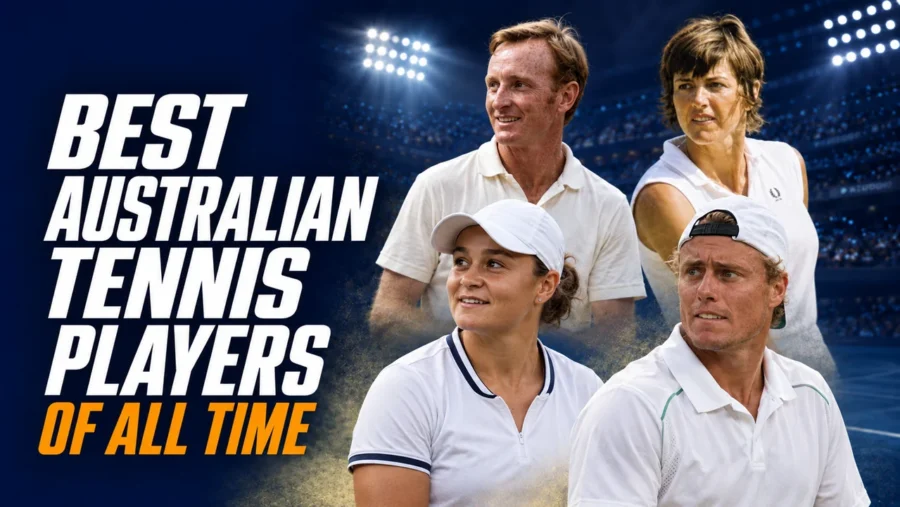
Rod Laver is the strongest overall choice as Australia’s greatest tennis player. He remains the only player to win two calendar-year Grand Slams in singles, completing the sweep in 1962 and again in 1969. Margaret Court is the country’s most decorated major champion, with 24 singles titles and 64 across all disciplines.
Australia has produced so many champions that no cross-era ranking can be definitive. This list weighs singles majors most heavily, followed by sustained dominance, all-surface success, doubles and team achievements, era context and influence on the sport.
The greatest Australian tennis players ranked
The ranking includes men’s, women’s and wheelchair tennis. Achievements are judged within each discipline because draw sizes, eligibility and competitive structures are not directly interchangeable.
| Rank | Player | Singles majors | Defining achievement |
|---|---|---|---|
| 1 | Rod Laver | 11 | Only player with two calendar-year Grand Slams |
| 2 | Margaret Court | 24 | Record 64 major titles across all disciplines |
| 3 | Ken Rosewall | 8 | Elite longevity despite 11 years away from amateur majors |
| 4 | Roy Emerson | 12 | Career Grand Slam in both singles and doubles |
| 5 | John Newcombe | 7 | 26 total majors and ATP world No.1 |
| 6 | Evonne Goolagong Cawley | 7 | Seven singles majors and world No.1 |
| 7 | Frank Sedgman | 5 | 22 total majors in five remarkable years |
| 8 | Dylan Alcott | 15 quad singles | Calendar-year Golden Slam in 2021 |
| 9 | Ashleigh Barty | 3 | Major singles titles on all three current surfaces |
| 10 | Neale Fraser | 3 | 19 total majors and four Davis Cup titles as captain |
| 11 | Lew Hoad | 4 | Won three of the four singles majors in 1956 |
| 12 | Lleyton Hewitt | 2 | 80 weeks at world No.1 |
These are career major totals, not only Open Era results. The Open Era began in 1968, when professionals were permitted to compete alongside amateurs at the traditional championships.
1. Rod Laver
Laver won 11 major singles titles: three Australian Championships, two French Championships, four Wimbledons and two US titles. His 1962 sweep came as an amateur, while the 1969 Grand Slam came after tennis opened its majors to professionals.
That second sweep is central to his No.1 position, but the missing years matter too. Laver turned professional after 1962 and was barred from the traditional majors from 1963 through 1967, removing five prime seasons from his official major record.
His adaptability went far beyond the four majors. The left-hander won on grass, clay, hard courts, carpet and indoor surfaces, and Rod Laver Arena now carries his name. His achievements also stand out among the strangest records in Wimbledon history.
2. Margaret Court
No Australian has won more major singles titles than Court’s 24. She captured 11 Australian titles, five at Roland Garros, five in the United States and three at Wimbledon.
Court completed the calendar-year Grand Slam in 1970. She also won 19 women’s doubles and 21 mixed doubles majors, giving her a recognized total of 64, including two shared Australian mixed titles.
Her records span the amateur and Open eras, with 13 singles majors before 1968 and 11 after it. Court’s on-court achievements place her at the front of any discussion of the greatest women’s tennis players, even though comparing field depth and travel across eras remains difficult.
3. Ken Rosewall
Rosewall won eight traditional singles majors between 1953 and 1972. His first came at the Australian Championships as an 18-year-old, while his last arrived at the same event when he was 37.
Like Laver, Rosewall spent much of his prime outside the amateur majors after turning professional. He was ineligible from 1957 until the Open Era and instead became a dominant force on the professional circuit, winning 15 leading professional championships that are not included in his Grand Slam total.
He reached four Wimbledon singles finals across a 20-year span without winning the title. His compact backhand, anticipation and extraordinary longevity make a simple eight-title count an incomplete description of his career.
4. Roy Emerson
Emerson won 12 major singles titles and 16 men’s doubles majors. His total of 28 remains the recognized men’s record across singles and doubles.
He completed a Career Grand Slam in singles by winning all four championships and remains the only man to win all four in both singles and doubles. Six Australian singles titles and eight winning Davis Cup teams underline his importance during Australia’s dominant 1960s.
All 12 singles titles came while the majors were restricted to amateurs. That era context keeps him below Laver and Rosewall here, but his versatility and durability make him one of the most complete champions in the sport’s history.
5. John Newcombe
Newcombe collected seven major singles titles, including three at Wimbledon, two in Australia and two in the United States. He also reached No.1 in the ATP rankings and became one of the defining serve-and-volley players of his era.
His doubles record is even larger. Newcombe won 17 men’s doubles majors and two mixed doubles titles, bringing his career total to 26.
Newcombe was also part of five winning Australian Davis Cup teams and later captained the country to the 1999 title. His US victories connect him to a long list of champions honored in the US Open Court of Champions.
6. Evonne Goolagong Cawley
Goolagong Cawley won seven major singles titles from 18 finals. Her collection includes four Australian Opens, the 1971 Roland Garros title and Wimbledon victories in 1971 and 1980.
The 1980 championship made her the first mother to win Wimbledon singles since Dorothea Lambert Chambers in 1914. Goolagong Cawley also reached four consecutive US Open finals from 1973 through 1976.
The WTA retrospectively recognized her in 2007 as having held world No.1 for two weeks in 1976, after missing ranking records were found.
Her elegant movement and touch made her one of tennis’s most distinctive champions. A Wiradjuri woman, she also became a transformative First Nations sporting figure and has helped create tennis opportunities for Indigenous young people across Australia.
7. Frank Sedgman
Sedgman amassed 22 major titles between 1948 and 1952, including five in singles. He won the Australian singles title twice, the US title twice and Wimbledon once.
His best work extended across every draw. Sedgman and Ken McGregor completed the men’s doubles Grand Slam in 1951, and Sedgman finished with nine men’s doubles and eight mixed doubles majors.
He helped Australia regain and retain the Davis Cup from 1950 through 1952, beginning the nation’s postwar golden age. His net skills, fitness and success with multiple partners make him one of Australia’s most accomplished all-event players.
8. Dylan Alcott
Alcott won 15 quad wheelchair singles majors and eight doubles majors. His seven consecutive Australian Open singles titles from 2015 through 2021 made him the dominant home champion of his period.
In 2021, he won all four majors and Paralympic singles gold in Tokyo to complete the calendar-year Golden Slam. He retired after the 2022 Australian Open while ranked world No.1.
Alcott’s position is based on more than a trophy count. He helped move wheelchair tennis onto major show courts and mainstream broadcasts, changing expectations for the visibility of Para sport in Australia.
9. Ashleigh Barty
Barty won three major singles titles on three surfaces: Roland Garros in 2019, Wimbledon in 2021 and the Australian Open in 2022. Her home triumph made her the first Australian singles champion in Melbourne since Chris O’Neil in 1978.
She spent 121 total weeks at WTA world No.1 and finished three straight seasons at the top from 2019 through 2021. Barty also won the 2018 US Open women’s doubles title before retiring at 25 as the reigning No.1.
A proud Ngarigo woman, Barty served as Tennis Australia’s National Indigenous Tennis Ambassador and has promoted participation in First Nations communities.
Her serve, forehand and sliced backhand translated across the different tennis court surfaces. That range, combined with sustained ranking dominance, earns her a place above several Australians with one more major but less time at the modern game’s summit.
10. Neale Fraser
Fraser won three major singles titles, taking the US Championships in 1959 and 1960 before adding Wimbledon in 1960. In both US title years, he swept the singles, doubles and mixed doubles events.
His career total reached 19 majors: three singles, 11 men’s doubles and five mixed doubles. Fraser never won his home singles championship, losing three Australian finals, including a 1960 match against Laver after holding match point.
Fraser’s national-team legacy extended well beyond playing. He captained Australia for 24 years and led the country to Davis Cup titles in 1973, 1977, 1983 and 1986.
11. Lew Hoad
Hoad won four major singles titles and was widely regarded by his peers as one of the most powerful talents of the 1950s. In 1956 he captured the Australian Championships, Roland Garros and Wimbledon before Rosewall stopped him in the US final.
His major collection also included eight men’s doubles titles and one mixed doubles title. Hoad then turned professional in 1957, ending his access to the amateur majors until the Open Era began.
Injuries and the divided amateur-professional system limit his official numbers. At his peak, however, his explosive serve, athleticism and attacking game could overwhelm the strongest players of his generation.
12. Lleyton Hewitt
Hewitt won the 2001 US Open and 2002 Wimbledon, then reached two more major singles finals. He also won the 2000 US Open men’s doubles title with Max Mirnyi.
At 20, Hewitt became the youngest ATP world No.1 at the time, a record later broken by Carlos Alcaraz. He spent 80 weeks on top and finished both 2001 and 2002 as year-end No.1.
His speed, return and competitive intensity helped Australia win the 1999 and 2003 Davis Cups. Hewitt’s ranking record carries significant weight because it came during a deep, fully international professional era. The mechanics behind that achievement are covered in the guide to how tennis world rankings work.
Other Australian champions who deserve mention
Australia’s depth makes the final places especially difficult. Several major champions could reasonably enter a longer version of the list.
- Ashley Cooper: Won four singles majors and eight overall. He captured three of the four singles championships in 1958.
- Lesley Turner Bowrey: Won Roland Garros singles in 1963 and 1965, plus 11 doubles and mixed doubles majors for 13 overall.
- Pat Rafter: Won back-to-back US Opens in 1997 and 1998, reached two Wimbledon finals and held ATP world No.1 for one week. The evolution of the event where he peaked is detailed in the history of the US Open.
- Samantha Stosur: Defeated Serena Williams to win the 2011 US Open and reached No.4 in singles. She also won four women’s doubles and three mixed doubles majors and became doubles world No.1.
- Nancye Wynne Bolton: Won six Australian singles championships between 1937 and 1951, along with 14 doubles and mixed titles at her home major.
- Tony Roche: Won Roland Garros singles in 1966 and became an exceptional doubles champion, collecting 13 men’s doubles majors.
Mark Edmondson also holds a unique place as the last Australian man to win the Australian Open singles title, in 1976. His victory as the world No.212 remains one of the greatest home upsets in major history.
Why Australia produced so many champions
Australia’s climate, widespread grass and hard courts, strong domestic championships and national coaching system helped build a deep talent base. Harry Hopman’s Davis Cup culture then turned individual champions into an exceptionally successful team.
Travel also shaped the record book. Australian players of the 1950s and 1960s often toured overseas together for months, practicing with other elite countrymen and learning to compete on several surfaces.
The professional pathway is now global and more expensive, but the underlying progression from junior events to international competition remains. The overview of how players become tennis professionals explains that modern route.
Who is Australia’s greatest tennis player?
Laver gets the narrow overall choice because no other player has completed two calendar-year Grand Slams, and he lost five prime seasons of major eligibility after turning professional. Court has the strongest statistical case, with 24 singles majors and a record 64 across all disciplines.
Rosewall’s longevity, Emerson’s all-event versatility, Newcombe’s 26 majors, Goolagong Cawley’s seven singles titles, Alcott’s Golden Slam and Barty’s modern No.1 run all support different definitions of greatness. The most honest answer identifies the criteria before naming the player.