
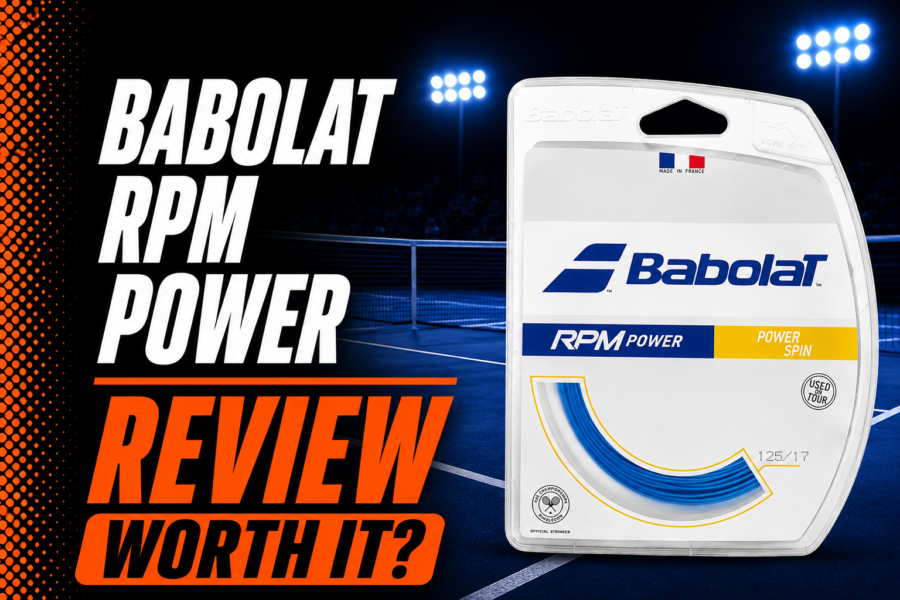
Babolat RPM Power is a round co-polyester tennis string designed for players who want a livelier response without giving up the control and durability associated with polyester. It occupies a different position within the RPM family than the more spin-focused RPM Blast and RPM Rough.
The word “Power” needs some context. RPM Power is lively and responsive compared with many control-oriented polyester strings, but it does not provide the effortless depth of natural gut or a powerful multifilament. It performs best when paired with long, fast swings that can activate the stringbed.
Babolat RPM Power Rating
| Performance category | Rating |
|---|---|
| Power | 8/10 |
| Spin | 8/10 |
| Comfort | 7/10 |
| Control | 8/10 |
RPM Power provides a strong balance of pace, spin and control for a polyester string. Its smooth construction does not produce the same direct bite as a shaped polyester, but its coated surface supports effective string movement and snapback.
Babolat RPM Power Specifications
| Specification | Details |
|---|---|
| Material | Co-polyester |
| Construction | Monofilament |
| Shape | Round |
| Available gauges | 17/1.25mm and 16/1.30mm |
| Colors | Electric Blue and Electric Brown, depending on market |
| Surface | Smooth with an additional coating |
| Set length | Approximately 12m |
| Reel length | Approximately 200m, depending on availability |
| Country of origin | France |
| String type | Lively, control-oriented polyester |
| Recommended use | Full bed or hybrid |
RPM Power uses a solid co-polyester monofilament with a round profile. Babolat combines this material with a specialized extrusion process intended to produce more power than a conventional control-focused monofilament.
The string also receives an additional coating that contributes to its distinctive response and impact sound. Its smooth surface allows the mains and crosses to slide against each other, supporting snapback-based spin without relying on sharp edges.
This construction separates RPM Power from the shaped strings in the RPM family. It is designed to produce a cleaner, livelier response that suits players who combine flatter drives with moderate or heavy topspin.
Babolat RPM Power Performance
Power
Power is one of RPM Power’s defining characteristics, particularly when it is compared with firmer and more control-oriented polyester strings. Its response should provide additional pace and depth without becoming excessively springy.
Players with long, committed swings should find it easier to drive the ball through the court than with a lower-powered polyester. The livelier response can also benefit serves and attacking shots from inside the baseline.
However, the word “Power” is relative to the polyester category. Players with short or slow swings should not expect the effortless depth provided by natural gut or a powerful multifilament.
Power rating: 8/10
Spin
RPM Power provides better spin than its round profile might suggest. Its smooth coated surface allows the strings to slide and return toward their original position, supporting snapback when the player generates sufficient racket-head speed.
The spin response differs from that of a shaped polyester. RPM Power produces rotation primarily through string movement rather than pronounced edges gripping the ball.
This makes it particularly suitable for players who combine flatter drives with controlled topspin. Players seeking maximum surface bite may still prefer a shaped option such as RPM Blast or RPM Rough.
The thinner 1.25mm version should provide the easiest access to string movement and responsiveness. The thicker 1.30mm version prioritizes stability and resistance to breakage.
Spin rating: 8/10
Control
RPM Power provides good control for a relatively lively polyester. Its monofilament construction limits excessive stringbed movement and supports confident acceleration through contact.
The string should work particularly well for aggressive baseliners and all-court players who redirect pace, attack shorter balls and drive through the court. It provides enough control for full swings without feeling as low powered as some traditional polyester strings.
Control will be strongest while the stringbed remains fresh and responsive. As tension, elasticity and snapback decline, the launch can become less predictable even if the strings have not broken.
Players using powerful rackets or open string patterns may need time to adjust to RPM Power’s livelier response.
Control rating: 8/10
Comfort and Feel
RPM Power is relatively comfortable by polyester standards. Its response is more forgiving than that of some firmer control strings, although it remains considerably less arm-friendly than natural gut or a soft multifilament.
The string combines a crisp impact sound with a somewhat dampened or muted sensation. Some players may appreciate this distinctive response, while others may prefer a firmer and more directly connected feel.
The coating can also create squeaking or friction noises while the string is being installed. This is associated with the surface treatment and does not necessarily indicate that the string is damaged.
Players with a history of tennis elbow, wrist discomfort or shoulder problems should be cautious about using RPM Power in a complete bed. A softer string or hybrid arrangement may produce a more forgiving setup.
Comfort rating: 7/10
Durability and Tension Maintenance
RPM Power provides solid physical durability. Its co-polyester monofilament construction makes it considerably more resistant to breakage than natural gut and most multifilament strings.
The 1.30mm version should offer the greatest resistance to notching and breaking. The thinner 1.25mm gauge prioritizes response and string movement but may wear more quickly for aggressive topspin players.
Physical durability and playability duration are different qualities. RPM Power can remain intact after its elasticity and snapback have started declining. The strings may begin staying out of position, and the stringbed can feel firmer or less predictable.
Tension maintenance is respectable for a performance polyester. Some independent evaluations have found its response more consistent over time than RPM Blast, although useful lifespan will depend on the racket, string pattern, gauge, tension and playing style.
Players should replace the string when snapback, comfort or control noticeably declines rather than waiting indefinitely for it to break. For additional guidance, see how often you should change tennis strings.
Choosing Between 1.25mm and 1.30mm
The 1.25mm gauge provides the more responsive setup. It allows greater string movement and should offer easier access to spin, feel and ball speed.
The 1.30mm version contains more material and should resist notching and breaking more effectively. It is the more practical option for frequent string breakers, powerful hitters and players using open string patterns.
| Gauge | Best suited to |
|---|---|
| 1.25mm | Spin, responsiveness, feel and easier acceleration |
| 1.30mm | Durability, stability and slightly greater control |
The 1.25mm gauge is the most balanced starting point for players who do not regularly break polyester. The 1.30mm version makes more sense when physical durability is the main concern.
Players who are unsure which string or gauge best matches their game can use the Tennis String Finder.
Full Bed or Hybrid Setup?
Full Bed of RPM Power
A complete bed preserves RPM Power’s balance of controlled power, spin and durability. It is most appropriate for intermediate and advanced players who are already comfortable with polyester strings.
This setup can complement a control-oriented racket by adding a slightly livelier response. It can also work in a powerful frame when the player has enough racket-head speed to control the additional depth.
Players who find firm polyester uncomfortable should avoid installing RPM Power throughout the entire stringbed.
RPM Power Mains and Softer Crosses
Placing RPM Power in the mains preserves more of its control, snapback and physical durability. A multifilament or synthetic gut cross can add comfort, power and ball pocketing.
A softer cross such as Babolat Xcel can produce a more forgiving setup than a complete bed of RPM Power. The polyester mains will still determine most of the hybrid’s overall response.
The softer crosses may fray or break before the polyester mains. Players should inspect both materials regularly rather than judging the setup only by the condition of RPM Power.
Softer Mains and RPM Power Crosses
Installing natural gut or multifilament in the mains allows the softer material’s power, comfort and feel to dominate. RPM Power crosses can reduce the launch and add a measure of polyester control.
This configuration suits players who want only a limited amount of polyester influence. It will not provide the same durability or polyester-dominant response as placing RPM Power in the mains.
The polyester crosses may eventually notch the softer mains. A qualified stringer can help determine whether this arrangement makes sense for the player’s racket and string-breaking frequency.
Tension Guidance
RPM Power should always be installed within the racket manufacturer’s recommended tension range. Because it is a polyester monofilament, it generally does not require the same tension a player might use with natural gut or multifilament.
A starting point around the lower or middle part of the recommended range will usually preserve more comfort and responsiveness. Players experiencing excessive launch can make a modest upward adjustment during the next restring.
An unnecessarily high tension can reduce comfort and make the stringbed feel overly demanding. Players who still find RPM Power too firm at a suitable tension should consider a hybrid or a softer string rather than continuing to reduce tension indefinitely.
The correct setup also depends on the gauge, racket stiffness, head size, string pattern and swing speed. The Tennis String Tension Calculator can provide a practical starting point before discussing the final setup with a stringer.
Who Should Use Babolat RPM Power?
RPM Power makes the most sense for:
- Intermediate and advanced players
- Players with long, fast swings
- Aggressive baseliners and all-court players
- Players who generate most of their own power
- Players wanting more pace from a polyester
- Players who find RPM Blast too firm or low powered
- Players who combine flatter drives with moderate topspin
- Players seeking snapback without a sharply shaped profile
- Experienced polyester users
- Players willing to restring when performance declines
The string is particularly suitable for players who want to hit through the court without abandoning polyester-style control. It can also benefit players who prefer a clean, round-string response over the stronger surface bite of a shaped polyester.
Who Should Avoid It?
RPM Power may not be suitable for:
- Beginners with short or developing strokes
- Players needing effortless depth
- Players prioritizing maximum comfort
- Players sensitive to polyester strings
- Players seeking the strongest shaped-string bite
- Players wanting an extremely firm and low-powered response
- Players who leave polyester installed for several months
- Players who expect the string to remain playable until it breaks
The word “Power” should not lead developing players to assume that RPM Power is an easy-power beginner string. It still requires racket-head speed and developed technique.
Pros and Cons
| Pros | Cons |
|---|---|
| Lively response for a polyester | Less free power than natural gut or multifilament |
| Good balance of power and control | Less direct bite than a shaped polyester |
| Effective snapback-based spin | Can feel firm in a complete bed |
| Relatively comfortable for polyester | Not ideal for slow or compact swings |
| Solid resistance to breakage | Playability can decline before breakage |
| Available in two useful gauges | Distinctive coated feel may not suit everyone |
Babolat RPM Power Compared With Other Strings
Babolat RPM Power vs RPM Blast
Babolat RPM Blast uses a shaped profile and places a stronger emphasis on spin and control. It provides a firmer, lower-powered and more locked-in response.
RPM Power is round, livelier and relatively more comfortable. Its spin comes more from string movement and snapback than from aggressive surface bite.
Choose RPM Blast for stronger shaped-string spin and a firmer response. Choose RPM Power for more pace, forgiveness and a cleaner connection with the ball.
Babolat RPM Power vs RPM Rough
Babolat RPM Rough uses a textured, shaped surface intended to produce additional interaction with the ball. It is aimed more directly at players seeking pronounced bite and spin.
RPM Power has a smoother, rounder construction. It provides a more direct response for players who drive through the ball while still producing useful spin through snapback.
Choose RPM Rough when surface bite and heavy topspin are the priorities. Choose RPM Power when controlled power and a cleaner response matter more.
Babolat RPM Power vs RPM Team
Babolat RPM Team offers a more forgiving interpretation of the RPM formula. It suits players who want spin and control with a softer overall response.
RPM Power places greater emphasis on a crisp, lively launch and pace through the court. It should appeal more to aggressive players who want additional speed without leaving the polyester category.
Choose RPM Team for greater forgiveness. Choose RPM Power for a livelier and more attacking response.
Babolat RPM Power vs Luxilon ALU Power
Luxilon ALU Power is another round co-polyester associated with a crisp, controlled and responsive feel. Both strings target experienced players who want a high-performance monofilament without a sharply shaped profile.
ALU Power is known for its direct connection and controlled response. RPM Power uses a distinctive coating and provides a somewhat more dampened sensation while emphasizing additional pace within the RPM family.
The better choice depends largely on feel. Players seeking a sharper and more direct response may prefer ALU Power, while those wanting a livelier RPM option may prefer RPM Power.
Final Verdict
Babolat RPM Power is a lively, round co-polyester designed for players who want more pace without giving up polyester-style control. Its smooth coated surface also supports better spin than its round profile might initially suggest.
The string is best suited to intermediate and advanced players with long, fast swings. It should work particularly well for aggressive baseliners and all-court players who combine flatter drives with controlled topspin.
Its name should not be interpreted as effortless power. Natural gut and multifilament strings remain more suitable for players with compact strokes or those prioritizing comfort.
RPM Power’s main appeal is its balance. It provides useful power, good control, effective snapback and relatively forgiving comfort within the polyester category. Players who find RPM Blast too firm or underpowered should consider it one of the most logical alternatives in the RPM family.
Frequently Asked Questions
What is Babolat RPM Power made from?
RPM Power is a co-polyester monofilament manufactured in France. It has a round profile and an additional surface coating.
Is RPM Power a shaped string?
No. RPM Power has a round profile. It produces most of its spin through string movement and snapback rather than sharp edges.
Is Babolat RPM Power actually powerful?
It is powerful relative to many control-oriented polyester strings. However, it does not provide the effortless power of natural gut or a lively multifilament.
Does RPM Power provide good spin?
Yes. Its smooth coated surface allows the strings to slide and return toward their original position. It does not provide the same direct bite as a shaped polyester, but its snapback supports effective spin.
Is RPM Power comfortable?
It is relatively comfortable for a polyester string. It remains firmer and less arm-friendly than natural gut, multifilament or synthetic gut.
Is RPM Power suitable for beginners?
It is generally better suited to intermediate and advanced players with developed strokes. Beginners needing easy depth and comfort will usually benefit more from a softer string.
Which RPM Power gauge should I choose?
Choose 1.25mm for greater responsiveness, feel and spin. Choose 1.30mm for improved stability and resistance to breakage.
Does RPM Power maintain tension well?
Its tension maintenance is respectable for a performance polyester. It will still lose tension and elasticity over time, and players should replace it when snapback, comfort or control noticeably declines.
Can RPM Power be used in a hybrid?
Yes. RPM Power can be used in either the mains or crosses. Using it in the mains preserves more polyester control and spin, while using a softer string in the mains prioritizes comfort and power.
Why does RPM Power squeak during stringing?
The additional surface coating can create friction noises while the string is being installed. This does not necessarily indicate that the string is damaged.
Is RPM Power better than RPM Blast?
Neither string is universally better. RPM Power is round, livelier and relatively more forgiving. RPM Blast is shaped, firmer and more focused on spin and control.
Is Babolat RPM Power worth considering?
It is worth considering for players who want a livelier polyester with good control, useful snapback and solid durability. Players seeking effortless power, maximum comfort or aggressive shaped-string bite should choose a different string.