
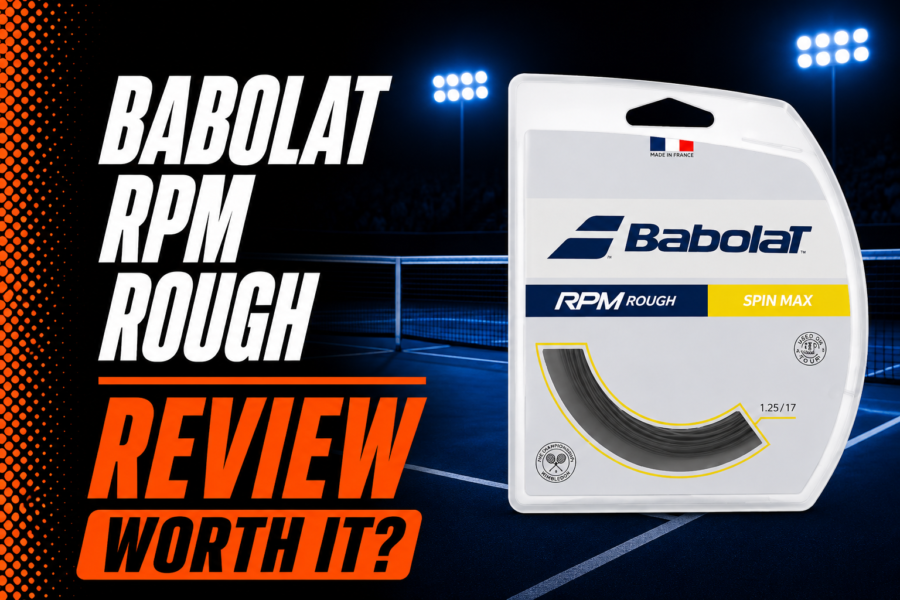
Babolat RPM Rough is a spin-focused co-polyester string designed for players who want a livelier and more forgiving alternative to the original RPM Blast. It combines an octagonal profile with a rough surface intended to improve ball interaction while maintaining the physical durability expected from a polyester monofilament.
Despite the similar name, RPM Rough does not simply provide more spin and otherwise perform exactly like RPM Blast. Its greater elasticity produces more power and comfort, but the livelier response can provide less control and lose predictability more quickly as the string ages.
Babolat RPM Rough Rating
| Performance category | Rating |
|---|---|
| Power | 6.5/10 |
| Spin | 9/10 |
| Comfort | 6.5/10 |
| Control | 7/10 |
RPM Rough provides excellent spin and above-average power for a co-polyester. It is also more comfortable than standard RPM Blast, although its tension maintenance and long-term control are notable weaknesses.
Babolat RPM Rough Specifications
| Specification | Details |
|---|---|
| Material | High-density co-polyester |
| Construction | Monofilament |
| Shape | Octagonal |
| Surface | Rough, textured finish |
| Common gauges | 17/1.25mm and 16/1.30mm |
| Additional gauge | 15L/1.35mm in selected markets |
| Colors | Dark grey, red and yellow, depending on availability |
| Set length | 12m |
| Reel length | 200m |
| Country of origin | France |
| String type | Lively, spin-focused polyester |
RPM Rough uses a solid co-polyester monofilament with an eight-sided profile. Its surface also contains a noticeable rough texture, distinguishing it from the smoother standard RPM Blast.
Babolat adds an embossed logo treatment intended to reduce friction between the strings. Reduced string-to-string friction can help the mains move and return while also limiting premature wear.
Babolat RPM Rough Performance
Power
RPM Rough is more powerful than standard RPM Blast and livelier than many control-focused polyester strings. Its greater elasticity allows the ball to leave the string bed with less effort.
This makes it more accessible to intermediate players who want polyester spin without the extremely low-powered response of a traditional firm co-polyester. It can also help aggressive players produce depth when they are not perfectly positioned.
The additional power has a tradeoff. Players with very fast swings may find that the launch becomes harder to control after the string loses tension, especially when attempting flatter shots.
Power rating: 6.5/10
Spin
Spin is the primary reason to consider RPM Rough. Its octagonal shape and textured surface are designed to interact with the ball, while the co-polyester construction allows the strings to slide and snap back.
The string should provide strong topspin, slice and kick-serve potential when it is fresh. It is especially suited to players who already use fast, upward swings.
However, a rougher surface does not automatically produce more spin than standard RPM Blast. String movement and snapback are major parts of spin production, and the textured surface can eventually contribute to notching.
As notching develops, the mains may stop returning as efficiently. Independent testing found excellent initial spin but a noticeable reduction after several hours of use.
Spin rating: 9/10
Control
RPM Rough provides good control when freshly installed, but it is not as precise or low powered as standard RPM Blast. Its greater elasticity creates a higher launch and more energetic response.
Players who use spin to control their shots should receive better results than players who hit predominantly flat. The extra ball rotation can help aggressive shots drop inside the baseline.
Control may decline as tension falls. The string can become springier and less predictable before it physically breaks, making regular performance checks important.
Control rating: 7/10
Comfort and Feel
RPM Rough is softer and more elastic than standard RPM Blast. This gives it more ball pocketing and a less demanding response than many firm polyester strings.
It remains a co-polyester, so its comfort should only be considered relative to other polyester strings. Natural gut, multifilament and RPM Soft remain more appropriate for players who prioritize a genuinely soft string bed.
The response can also become more muted or inconsistent as tension declines. Some players may appreciate the dampened sensation, while others may prefer the more direct feedback of a firmer string.
Comfort rating: 6.5/10
Durability and Tension Maintenance
RPM Rough has good resistance to physical breakage. Its co-polyester monofilament construction makes it suitable for players who quickly break multifilament or synthetic gut.
Its playability duration is much less impressive. Independent testing identified tension loss, notching and declining control as the string’s main weaknesses.
This means RPM Rough may remain intact after its best performance has ended. Players should not use the absence of breakage as the only reason to keep it installed.
Signs that the string may need replacing include reduced snapback, inconsistent depth, an unexpectedly high launch, declining spin or a string bed that feels increasingly unresponsive. See how often to change tennis strings for more guidance.
Choosing the Right RPM Rough Gauge
The 1.25mm and 1.30mm versions are the most widely available choices. A thicker 1.35mm option may also be available in selected markets or reel formats.
| Gauge | Best suited to |
|---|---|
| 1.25mm | Spin, responsiveness and easier acceleration |
| 1.30mm | Durability, stability and slightly more control |
| 1.35mm | Frequent string breakers seeking maximum resistance |
The 1.25mm gauge is the better starting point for players prioritizing spin and responsiveness. Its thinner construction should allow greater string movement, although it can notch and break sooner.
The 1.30mm gauge provides additional material and should last longer for heavy hitters. It may also create a slightly firmer and more controlled response.
The 1.35mm option is intended primarily for frequent string breakers. Most recreational and intermediate players will not need that level of thickness.
Players who are uncertain about gauge or string material can use the Tennis String Finder for a personalized starting point.
Full Bed or Hybrid Setup?
Full Bed of RPM Rough
A complete bed maximizes RPM Rough’s spin characteristics and physical durability. It is suitable for intermediate to advanced players with developed strokes who want a lively polyester response.
This setup will still feel firmer than a multifilament or natural gut string bed. Players new to polyester should avoid installing it at an unnecessarily high tension.
RPM Rough With a Softer Cross
Combining RPM Rough mains with a softer cross can add comfort and power. The RPM Rough mains will continue to provide most of the setup’s spin and control characteristics.
A softer cross may make the string bed more accessible, but hybrid durability will depend on the second string. Rough polyester can wear through a softer cross more quickly than a smooth polyester.
Softer Mains With RPM Rough Crosses
Placing a softer string in the mains allows comfort and power to dominate. RPM Rough crosses can reduce power and add some control, although the rough surface may increase wear on soft mains.
Players mainly interested in RPM Rough’s spin characteristics will generally receive more of them by using it in the mains.
Players wanting a ready-made, more comfortable RPM combination can also consider the RPM Blast and RPM Soft hybrid.
Tension Guidance
RPM Rough should be installed within the racket manufacturer’s recommended range. Its greater power allows it to tolerate a slightly firmer setup than standard RPM Blast, but the correct tension depends on the player, racket and gauge.
Players moving from multifilament or synthetic gut should remember that RPM Rough remains a polyester. Copying the same tension without considering the material difference may create an unnecessarily firm response.
The Tennis String Tension Calculator can provide a starting point before discussing the final setup with a stringer.
Who Should Use Babolat RPM Rough?
RPM Rough makes the most sense for:
- Intermediate to advanced players
- Topspin-focused baseliners
- Players seeking a livelier polyester
- Players who find standard RPM Blast too firm or underpowered
- Players who generate moderate to high racket-head speed
- Players who regularly break softer strings
- Players willing to restring when performance declines
- Players who want multiple gauge and color choices
Its additional power makes it more accessible than RPM Blast, but players still need developed strokes to benefit fully from its spin-focused design.
Who Should Avoid It?
RPM Rough may not be suitable for:
- Beginners with short or developing strokes
- Players seeking maximum comfort
- Players who leave polyester installed for several months
- Players prioritizing tension maintenance
- Flat hitters seeking highly predictable control
- Players who dislike muted or springy polyester
- Players who want the lowest-powered possible response
- Players unwilling to replace strings before they break
Players who need substantially more comfort should consider Babolat RPM Soft rather than relying on the word “softer” in comparisons with RPM Blast.
Pros and Cons
| Pros | Cons |
|---|---|
| Excellent initial spin | Below-average tension maintenance |
| More power than RPM Blast | Control can decline as tension drops |
| Relatively comfortable for polyester | Notching can reduce snapback |
| Strong physical durability | Less precise than standard RPM Blast |
| Textured octagonal construction | May feel muted to some players |
| Multiple gauges and colors | Still firm compared with non-polyester strings |
RPM Rough Compared With Other Strings
RPM Rough vs RPM Blast
Babolat RPM Blast is firmer, lower powered and more controlled. Its slicker response can also preserve snapback more effectively, which is why RPM Rough should not automatically be rated higher for spin.
RPM Rough is softer, livelier and easier to use. It makes more sense for players who like RPM Blast’s general character but want more power and comfort.
Choose RPM Blast for maximum control and predictable full swings. Choose RPM Rough for easier depth, comfort and strong initial spin.
RPM Rough vs RPM Team
Babolat RPM Team is another more accessible option within Babolat’s polyester range. It offers a forgiving response without relying on RPM Rough’s pronounced surface texture.
RPM Rough places a greater emphasis on textured spin. RPM Team may suit players looking for a more conventional balance of spin, control and comfort.
RPM Rough vs RPM Power
Babolat RPM Power focuses more heavily on easy pace and a responsive feel. RPM Rough provides greater surface texture and a stronger spin identity.
RPM Power is more appropriate for players wanting depth and speed through the court. RPM Rough better suits players who shape their shots with topspin.
RPM Rough vs Luxilon ALU Power Rough
Luxilon ALU Power Rough provides a more direct and control-oriented response. RPM Rough is generally livelier and more forgiving, but it may feel less connected and predictable.
Both strings are designed for players wanting spin from a textured polyester. RPM Rough prioritizes easier power and comfort, while ALU Power Rough places greater emphasis on feedback and control.
RPM Rough vs Solinco Hyper-G
Solinco Hyper-G uses a square profile and provides a lower-powered, more control-focused response.
RPM Rough is livelier and more textured. Hyper-G better suits players seeking a firm and predictable trajectory, while RPM Rough suits players wanting easier depth from their spin string.
Final Verdict
Babolat RPM Rough is a lively, spin-focused co-polyester that provides more power and comfort than standard RPM Blast. Its textured octagonal construction can generate excellent initial spin, especially for players with fast upward swings.
Its greatest weakness is not physical durability but playability duration. Tension loss and notching can reduce snapback, control and consistency before the string breaks.
Players who want RPM Blast’s demanding precision should remain with the original. Players who prefer a softer response, easier depth and strong spin may find RPM Rough the more accessible option.
Frequently Asked Questions
Is RPM Rough the same as RPM Blast Rough?
Yes. The string was widely known as RPM Blast Rough, while current Babolat product listings generally call it RPM Rough.
What is RPM Rough made from?
It is made from high-density co-polyester and uses a solid monofilament construction. It is manufactured in France.
Is RPM Rough textured?
Yes. It combines an octagonal profile with a rough, textured outer surface.
Does RPM Rough produce more spin than RPM Blast?
Not necessarily. RPM Rough provides excellent initial spin, but standard RPM Blast can produce more predictable snapback and control. Independent testing rated the original RPM Blast slightly higher for spin.
Is RPM Rough more powerful than RPM Blast?
Yes. RPM Rough is more elastic and produces easier depth than the lower-powered standard RPM Blast.
Is RPM Rough softer than RPM Blast?
It is softer and more comfortable than RPM Blast, but it remains a polyester monofilament. It will still feel firmer than natural gut, multifilament or RPM Soft.
Is RPM Rough suitable for beginners?
It is more accessible than RPM Blast, but it is still better suited to intermediate and advanced players with developed strokes. Most beginners will receive more benefit from a softer string.
Does RPM Rough hold tension well?
Tension maintenance is one of its weaknesses. The string can lose predictability and spin as tension drops and notching prevents effective snapback.
Which RPM Rough gauge should I choose?
Choose 1.25mm for greater spin and responsiveness. Choose 1.30mm for more durability and stability. The 1.35mm gauge is mainly appropriate for frequent string breakers.
Can RPM Rough be used in a hybrid?
Yes. It can be paired with RPM Soft, multifilament or natural gut. However, its rough surface may wear through a softer cross more quickly than a smooth polyester.
How long does RPM Rough last?
Its physical lifespan depends on gauge, racket pattern and hitting style. Its best playing period may end well before it breaks, so players should monitor tension, snapback, spin and control.
Is RPM Rough worth considering?
It is worth considering for topspin players who want more power and comfort than RPM Blast. Players prioritizing precision or tension maintenance may prefer a different polyester.