
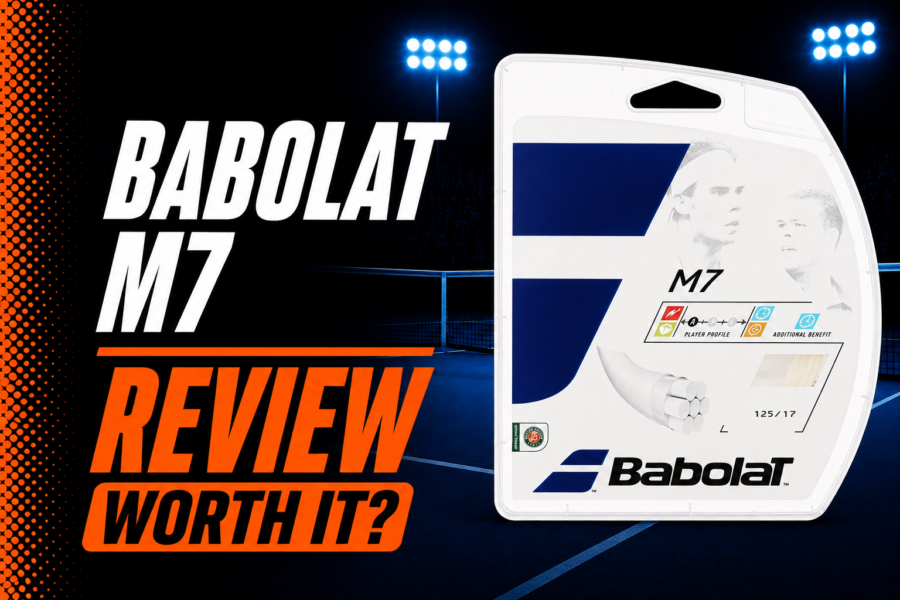
Babolat M7 is an older polyamide tennis string built from seven comparatively large monofilament strands. It is commonly placed in the multifilament category because it combines multiple flexible elements, but its architecture is different from a conventional multifilament made from hundreds or thousands of fine fibers.
M7 was designed to balance comfort, controllable power and improved resistance to wear. It targets beginners, intermediate players and club competitors who want a softer response than polyester without choosing an especially lively premium multifilament.
The string is no longer prominent in Babolat’s current global range, and remaining stock can vary considerably by region. That makes accurate product identification important. Players considering current alternatives can compare it with Babolat AddiXion+ or use the Tennis String Finder.
Babolat M7 Rating
| Category | Rating |
|---|---|
| Power | 8/10 |
| Spin | 6/10 |
| Comfort | 8.5/10 |
| Control | 7.5/10 |
These ratings compare M7 with the wider tennis-string market. They are editorial estimates based on its construction, published product information, laboratory data and independent evaluations.
Babolat M7 Specifications
| Specification | Details |
| String type | Multi-strand polyamide string, commonly categorized as multifilament |
| Composition | Polyamide |
| Construction | Seven polyamide monofilament strands |
| Shape | Round |
| Surface | Smooth; specialist listings describe a silicon and co-polyamide outer treatment |
| Known gauges | 1.25mm and 1.30mm |
| Color | Natural |
| Set length | Marketed as approximately 12m; some older 1.25mm stock has been reported slightly shorter |
| Availability | Older product with limited regional stock |
Specifications can differ across remaining inventory. Buyers should check the gauge and usable set length shown by the retailer, particularly when stringing an oversize head or a pattern that requires extra material.
Material and Construction
M7’s name refers to its seven-strand construction. Each element is a polyamide monofilament, and the strands work together to create a more flexible response than a single firm polyester monofilament.
This design should not be described as a conventional microfiber bundle. The distinction matters because the larger strands contribute to the string’s crispness and resistance to fraying, while the polyamide material provides elasticity and impact absorption.
The outer profile is round and smooth. Some specialist product listings identify a silicon and co-polyamide coating, but Babolat no longer provides a current global M7 technical page that confirms the detailed formulation. The safest established description is therefore seven polyamide monofilament strands with a smooth exterior.
M7 is also not natural gut. Descriptions such as “gut-like” refer to its intended combination of comfort, power and feel, not to its material. Natural gut remains more elastic and generally maintains its playing characteristics longer, while M7 offers a synthetic, lower-cost alternative.
Babolat M7 Performance
Power
M7 provides easy depth compared with polyester. Polyamide stretches and returns energy more readily than a firm co-polyester, so players with compact or moderate strokes should receive useful help from the stringbed.
Its response is more controlled than an extremely soft, springy multifilament. The seven-strand structure gives the string a slightly crisper identity, which can make the power feel easier to direct.
The exact power level depends on gauge, tension and racket. The thinner 1.25mm version should feel more responsive, while the thicker 1.30mm version should produce a more stable and slightly firmer launch.
Power rating: 8/10.
Spin
M7 has a round, smooth surface and does not use sharp edges for ball bite. Its spin comes primarily from technique, string movement and the thinner gauge’s ability to pocket the ball.
The 1.25mm version can provide adequate spin for all-court and moderate-topspin players. It will not deliver the aggressive bite or sustained snapback associated with a shaped co-polyester.
As M7 wears, the strands can notch at their intersections. Once notching restricts movement, spin response can decline even if the string has not broken.
Spin rating: 6/10.
Control
M7 offers good control within the comfort-string category. The seven larger strands give it a crisper and more connected response than some very soft multifilaments, which helps players judge depth and direction.
It still launches the ball more readily than a low-powered polyester. Players with long, very fast strokes may find that M7 does not provide enough trajectory control in a powerful racket or open pattern.
For beginners and intermediate players, the balance is more useful. The string provides enough free depth to avoid forcing the swing while retaining a predictable response for rallying, returns and volleys.
Control rating: 7.5/10.
Comfort and Feel
Comfort is one of M7’s primary strengths. Its polyamide strands flex more readily than polyester and are intended to reduce impact shock, creating a forgiving stringbed for recreational and club play.
The feel is soft but not completely muted. Independent descriptions consistently position M7 as comfortably crisp, with useful feedback and touch rather than the board-like response of a firm monofilament.
M7 should still be evaluated as part of the full racket setup. A high tension, stiff frame or badly worn stringbed can reduce comfort. No string should be expected to prevent or treat an arm injury.
Comfort rating: 8.5/10.
Durability and Tension Maintenance
Physical durability is the time a string resists fraying, notching and breakage. Useful playability duration is the time it retains acceptable power, comfort, control and feel. M7 can perform differently in these two areas.
The seven-strand architecture was positioned as more durable than strings with comparable comfort. Its larger polyamide elements should resist the rapid surface fraying associated with some fine-fiber multifilaments. Laboratory listings also place its stiffness above the softest premium multis, which is consistent with a crisper, more robust construction.
That does not make it a string for extreme breakers. Heavy topspin, an open pattern and frequent off-center contact can notch or break M7 much faster than a thick co-polyester. The 1.30mm gauge provides more material to wear through and is the better option when the 1.25mm version fails too quickly.
Polyamide generally retains useful elasticity more gracefully than polyester, but no current manufacturer comparison establishes that M7 holds tension better than most multifilaments. The article should therefore describe its tension maintenance as respectable rather than exceptional.
Replace M7 when fraying becomes severe, a deep notch forms, control changes significantly or the response feels unusually loose or dull. Waiting for breakage is reasonable only while the stringbed still performs consistently.
Choosing the Right Gauge
| Gauge | Expected response | Best suited to |
| 1.25mm | More response, feel and spin access; lower break resistance | Players who rarely break strings, denser patterns and those prioritizing touch |
| 1.30mm | Firmer, more stable and more resistant to notching; slightly less lively | Open patterns, regular string breakers and players wanting a lower launch |
The 1.30mm version is the practical starting point for most recreational players because it supports the product’s durability goal. The 1.25mm version is better when the thicker gauge feels too muted or when a dense string pattern needs additional response.
Because M7 is an older product, gauge choice may be determined by remaining inventory. It is better to select a current alternative than to buy the wrong gauge simply because it is available.
Full Bed or Hybrid Setup
Full Bed
A full bed presents the most coherent version of M7. It emphasizes comfort, accessible depth and a comfortably crisp feel without mixing the wear and launch characteristics of two strings.
This setup is suitable for beginners, intermediate players, doubles players and all-court competitors who do not require shaped-polyester spin. It also provides the clearest baseline for deciding whether M7 has enough control and durability.
M7 in the Mains With Softer Crosses
M7 mains paired with natural gut or a softer multifilament create a comfort-first hybrid. Because the mains dominate the response, the setup will still behave much like M7, with the cross making a smaller adjustment to feel and power.
In many cases, a full bed of the preferred soft string is simpler. A soft-soft hybrid is most useful when a player already knows that one component improves a specific characteristic or lowers the total cost.
Softer Mains With M7 in the Crosses
M7 can be used as a cross behind natural gut or another soft main, but it does not provide the low-powered control and slick snapback of a smooth polyester cross. Its role in that orientation is primarily to adjust feel, price or durability.
M7 is more commonly useful as a comfortable cross behind polyester mains. The hybrid will feel firmer than a full bed of M7 because the polyester mains dominate. Shaped polyester can cut into the M7 crosses, so physical life may be shorter than expected.
General Tension Guidance
Use the racket manufacturer’s recommended range and a normal nylon or multifilament setup as the reference. Players moving from polyester should not automatically copy their polyester tension because M7 is more elastic and powerful.
Lower tension generally increases pocketing, comfort, depth and launch. Higher tension can firm the response and reduce launch, but too much tension works against M7’s comfort advantage.
Gauge, head size, string pattern and racket stiffness should be considered together. The Tennis String Tension Calculator can provide a starting point, but the most useful process is to make one modest change at a time and record the result.
Who Should Use Babolat M7?
M7 is most suitable for:
- Beginners and intermediate players seeking easy depth
- Club players who want comfort with a slightly crisp response
- Players moving away from firm polyester
- Flatter hitters and all-court players
- Doubles players who value touch and a forgiving stringbed
- Players who can still source the correct gauge at a sensible price
Who Should Avoid Babolat M7?
It may be a poor fit for:
- Heavy topspin players who depend on shaped-string bite
- Frequent string breakers who need thick polyester durability
- Advanced players seeking the lowest-powered trajectory
- Buyers who want a product with broad, predictable current availability
- Players expecting natural gut performance from a synthetic seven-strand construction
Pros and Cons
| Pros | Cons |
| High comfort and accessible power | Limited availability as an older product |
| Crisper and more controlled than some very soft multifilaments | Less spin and control than shaped polyester |
| Seven-strand construction provides a distinctive response | Detailed current manufacturer documentation is limited |
| Better resistance to fraying than some fine-fiber multis | Heavy hitters can still notch or break it quickly |
| Suitable in a full bed or comfort-oriented hybrid | Only two commonly documented gauges |
Babolat M7 Compared With Other Strings
| String | Main difference from M7 | Better choice when |
| Babolat AddiXion+ | Current flexible polyamide multifilament with three listed gauges and an updated durability claim | You want a current Babolat option with easier replacement availability |
| Babolat Xcel | Premium multifilament with a softer, plusher identity | Maximum comfort and a refined feel matter more than price or wear resistance |
| Babolat Xalt | Newer multifilament positioned around comfort, control and responsiveness | You want current premium technology and a more controlled multi response |
| Babolat Synthetic Gut | Simpler solid-core nylon construction at a lower price | Value and basic all-around performance matter more than premium comfort |
| Babolat Touch VS Natural Gut | Greater elasticity, feel and tension stability at a much higher price | Maximum comfort, power and long-term playability are the priorities |
| Babolat RPM Soft | Polyamide monofilament with more control and durability, but a firmer response | You want a bridge between conventional nylon strings and polyester |
Final Verdict
Babolat M7 is an interesting comfort string because its seven-strand construction sits between a conventional multifilament and a solid monofilament. It offers easy depth, a comfortably crisp response and better control than its soft material might suggest.
The current article should not describe M7 as a typical fine-fiber multifilament or overstate its durability and tension maintenance. Its confirmed core identity is seven polyamide monofilament strands, and its availability is now a meaningful limitation.
Players who already use M7 and can source the correct gauge may continue to value its balance. New buyers should compare it with current products such as AddiXion+, Xalt and Xcel before committing to an older string that may be difficult to replace consistently.
Frequently Asked Questions
Is Babolat M7 a multifilament?
It is commonly categorized as a multifilament because it combines multiple strands. More precisely, it uses seven polyamide monofilament strands rather than the very large bundle of fine fibers found in a conventional multifilament.
Is M7 made from polyester?
No. Its established composition is polyamide, which is a nylon-family material. That helps explain its greater comfort and power relative to firm polyester.
Is Babolat M7 discontinued?
M7 is not prominent in Babolat’s current global string range, and availability is limited in many regions. Remaining stock is still sold by some specialist retailers, so it is safer to describe it as an older, limited-availability product.
Is M7 good for arm comfort?
Its flexible polyamide construction makes it more comfort-oriented than polyester. No string prevents or treats injury, and the result still depends on tension, racket, technique and the condition of the stringbed.
Which M7 gauge should I choose?
Choose 1.25mm for more feel and response. Choose 1.30mm for greater stability and resistance to wear. Availability may be the limiting factor because the product is older.
Does M7 provide good spin?
It provides adequate spin for moderate-topspin and all-court players, especially in 1.25mm. It does not match the bite or persistent snapback of a shaped polyester.
Can M7 be used as a polyester cross?
Yes. M7 crosses can soften a polyester-main hybrid, but the polyester will still dominate the response. Shaped mains may notch the softer M7 crosses quickly.
When should M7 be replaced?
Replace it after breakage or when severe fraying, deep notching or a clear loss of control and response makes the stringbed unreliable. Useful life should be judged by performance as well as appearance.