
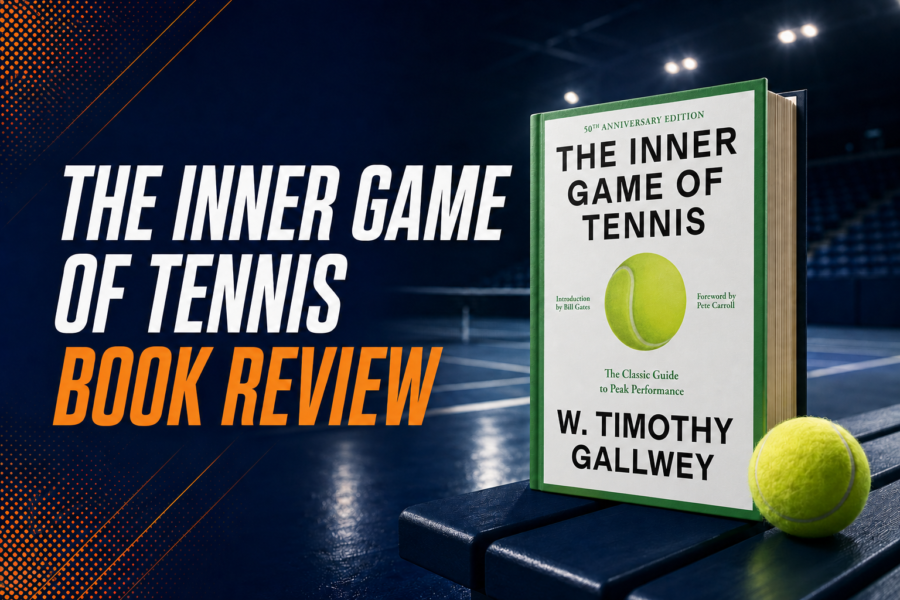
The Inner Game of Tennis is most useful for players who understand what to do but become tense, distracted or overly critical when trying to do it. W. Timothy Gallwey’s central framework treats self-interference as a performance problem and emphasizes focused, nonjudgmental awareness rather than constant technical instruction.
It is not a complete stroke manual, match-tactics guide or modern sport-psychology textbook. Its value lies in a clear mental model that can help a player notice unhelpful internal commentary and direct attention back to the task.
The Inner Game of Tennis at a Glance
| Detail | Information |
|---|---|
| Author | W. Timothy Gallwey |
| Original publication | 1974 |
| Current featured edition | 50th Anniversary Edition |
| Publisher | Random House |
| Publication date | June 4, 2024 |
| Length | 192 pages |
| Anniversary additions | Updated epilogue, introduction by Bill Gates and foreword by Pete Carroll |
| Main focus | Attention, self-interference, learning and performance under pressure |
| Best for | Players and coaches interested in the mental side of skill execution |
| Main limitation | It is principle-led and anecdotal rather than a technical manual or research review |
The book’s influence extends beyond tennis, but this review focuses on its usefulness to players and coaches. Readers wanting a broader overview of sport-specific concentration, confidence and emotional control should use it alongside The Mental Game of Tennis.
What Is The Inner Game of Tennis About?
Gallwey separates performance into an outer game and an inner game. The outer game concerns the opponent, the ball and the demands of the point. The inner game concerns doubt, judgment, distraction and the effort to control movements that the body may already know how to perform.
The book presents two named aspects of the performer. Self 1 is the verbal, evaluative voice that gives instructions and passes judgment, while Self 2 represents the body’s learned and largely automatic capacity to act. These are teaching metaphors, not clinical or neuroscientific categories.
The argument is not that thought is always harmful. Planning, tactics and technical understanding still matter. The problem occurs when conscious commentary tries to manage every detail of a fast, learned movement during execution.
The Book’s Main Ideas
Reduce Interference Instead of Forcing Performance
Gallwey’s core model suggests that performance can fall below a player’s existing potential when self-interference increases. Excessive correction, fear of error and muscular tension can interrupt a movement that is more fluid in practice.
This idea will be familiar to players whose serve works during warm-up but becomes mechanical on a break point. Dealing with Pressure in Tennis explores the wider competitive context in which that change can occur.
Observe Without Immediately Judging
The book encourages accurate observation before attaching labels such as good, bad, terrible or perfect. A player might notice that three forehands landed long instead of turning the pattern into a judgment about personal ability.
This approach does not mean ignoring mistakes. It means separating useful information from the emotional reaction that can make the next attempt tighter or less attentive.
Trust Learned Movement
The Self 1 and Self 2 framework asks the player to give the body a clear task and then allow the learned movement to happen. Images, targets and sensory cues take priority over a long stream of mechanical instructions during the swing.
That principle is most applicable after a movement has been taught and practiced. A complete beginner may still need explicit instruction, demonstrations and feedback before there is a stable movement pattern to trust.
Use Focused Attention
Gallwey describes a state of relaxed concentration in which attention is engaged without being forced. In tennis, this may involve watching the ball closely, noticing its rotation, hearing contact or tracking where it crosses the net.
Modern readers may recognize similarities with mindfulness and attentional-cue practices, but the book is not a clinical mindfulness program. How Can Mindfulness Help Tennis Players? gives that adjacent topic its own practical context.
Change Habits Through Awareness
The method favors observing an existing habit clearly, forming a picture of the desired action and allowing repeated attempts to supply feedback. It places less emphasis on criticizing the old pattern into submission.
This can be useful when a player has accumulated too many instructions and no longer knows which one to follow. It should not be interpreted as proof that technical coaching is unnecessary.
What The Inner Game of Tennis Does Well
It Explains Overthinking in Simple Language
The two-selves model gives players an accessible way to describe the conflict between conscious control and automatic execution. A simple model can be easier to use during a match than a long list of psychological terms.
Its strength is practical recognition. Players can often identify the moment when observation turns into self-criticism or when one technical reminder becomes five simultaneous commands.
It Connects Learning and Competition
Many mental-game resources focus only on match-day nerves. This book also considers how judgment and attention affect practice, habit change and the relationship between a coach and player.
That makes it relevant to coaches who want feedback to create awareness rather than dependency. It also fits players who practice well but struggle to transfer their skills into scored points.
Its Principles Are Easy to Test on Court
The reader does not need a complicated tracking system to explore the central ideas. A player can compare a block of serves dominated by internal technical instructions with a block organized around one external target and neutral observation.
The result should still be evaluated honestly. A more comfortable mental state is useful, but it does not prove that every shot improved or that one attentional method suits every player.
It Remains Relevant to Pressure and Self-Talk
Critical internal commentary, outcome anxiety and attentional disruption remain common problems in tennis. Tennis Mindset: Master Positive Self-Talk offers a complementary approach for players who need to make their internal language more constructive.
Gallwey’s emphasis is slightly different. Rather than replacing every negative judgment with praise, the book often directs attention away from judgment and toward clear observation.
Limitations of The Inner Game of Tennis
The Framework Is a Metaphor, Not a Full Theory of the Mind
Self 1 and Self 2 are memorable, but human attention, emotion and motor learning are more complex than a two-part model. Readers should use the terms as a practical lens rather than as literal anatomy or a complete account of cognition.
The book grew from coaching observation and illustrative stories. It should not be presented as if every claim were established by controlled tennis research.
It Is Not a Stroke-Production Manual
Readers seeking detailed grip, footwork, swing-path or tactical instruction will need another resource. Reducing interference cannot replace learning an appropriate movement or understanding the situation in which a shot should be used.
The strongest combination is often sound instruction, purposeful practice and a mental process that allows the trained skill to appear under pressure.
Some Examples and Language Reflect Their Era
The book was first published in 1974. The anniversary edition refreshes the package and adds new introductory material, but the core text still comes from an earlier coaching context.
That historical character is part of its appeal, though readers looking for current sport-science terminology or contemporary professional-tennis analysis may find it less complete.
It Does Not Solve Every Cause of Poor Performance
Misses can come from inadequate technique, fatigue, unsuitable tactics, lack of preparation or an opponent’s pressure. Not every error is caused by inner commentary.
Persistent anxiety or distress also deserves appropriate support rather than a demand to think differently. The book is a performance resource, not mental-health treatment.
Who Should Read The Inner Game of Tennis?
| Reader | Why it may fit | Important limitation |
|---|---|---|
| Club player who overthinks | Offers a simple method for shifting from judgment to observation | Does not diagnose the underlying technical error |
| Competitor who tightens under pressure | Connects conscious interference with execution | Needs match practice, not reading alone |
| Coach | Encourages awareness-based questions and less instruction overload | Must still teach technique and adapt to the learner |
| Experienced player changing a habit | Helps organize attention around images and feedback | A flawed movement may still require expert correction |
| Reader interested in performance psychology | Provides an influential, accessible framework | It is not an academic survey of current research |
Players whose main problem appears before competition can pair the framework with Beat Pre-Match Anxiety In Tennis. Someone seeking only diagrams, drills or modern tactical patterns should begin with a more technical resource.
How to Apply the Ideas Without Overcomplicating Them
Choose One Observable Cue
Select something that can be noticed without judgment, such as ball rotation, contact sound or the height of the ball over the net. Keep the cue consistent for a short practice block.
The goal is not to force concentration. It is to give attention a clear place to return when commentary starts expanding.
Describe the Result Precisely
Replace a global label with a neutral observation. “The last two serves landed long” provides more usable information than “the serve is awful.”
Neutral does not mean indifferent. The result still matters, but the description avoids turning one outcome into an identity statement.
Use an Image or Target Before the Motion
Picture the intended ball path or choose a visible target, then allow the trained motion to respond. Avoid adding new mechanical instructions during the swing.
Technical analysis can happen between practice blocks with a coach or video. Execution and diagnosis do not have to compete for attention at the same instant.
Review the Pattern After Several Attempts
One successful shot does not validate a method, and one miss does not disprove it. Compare a meaningful group of attempts for accuracy, pace, tension and repeatability.
This turns the book’s broad principle into a testable practice habit without pretending that attention alone controls every result.
The Inner Game of Tennis Compared With Other Tennis Books
The Inner Game of Tennis is more reflective than Brad Gilbert’s Winning Ugly. Gilbert focuses heavily on match preparation, opponent management and practical competition, while Gallwey focuses on the player’s relationship with attention and execution.
Ian Westermann’s Essential Tennis covers a wider mix of technique, strategy, improvement and mindset. Gallwey’s book is narrower but more concentrated on self-interference.
For coaches wanting a large bank of on-court exercises, The Tennis Drill Book serves a different purpose. The Inner Game is better used as a philosophy of attention and learning than as a session plan.
Is The Inner Game of Tennis Worth It?
The book is worth considering for a player or coach who repeatedly encounters overthinking, harsh self-judgment or tight execution. Its most durable contribution is a practical distinction between observing performance and trying to control every part of it consciously.
Its limitations should remain visible. The framework is simplified, the evidence is largely illustrative and the book does not replace technical instruction, tactical study or qualified psychological support.
Used in that balanced way, it remains a strong entry point into the mental side of tennis. It is most valuable when one idea is tested in practice rather than when its terminology becomes another set of instructions to manage during a point.
Frequently Asked Questions
Is The Inner Game of Tennis suitable for beginners?
Yes, especially for understanding attention and self-judgment. A beginner should pair it with clear technical instruction because the book is not a complete guide to learning every stroke.
Is the book only about tennis?
Tennis supplies the situations and examples, but the publisher and anniversary material position the principles as applicable to learning and performance beyond sport. Tennis players will still get the most direct context.
What are Self 1 and Self 2?
They are Gallwey’s teaching metaphors. Self 1 represents the verbal, judging and instructing part of the performer, while Self 2 represents learned, embodied execution.
Does the book say players should stop thinking?
No useful interpretation requires abandoning planning or awareness. The emphasis is on reducing intrusive judgment and excessive conscious control during a learned movement.
Does the 50th Anniversary Edition contain new material?
The 2024 Random House edition is listed with an updated epilogue, an introduction by Bill Gates and a foreword by Pete Carroll. The central framework remains the one associated with the original 1974 book.
Can the book help with match anxiety?
Its attention and nonjudgment principles may provide a useful practice framework, but it does not guarantee relief and is not clinical treatment. The ideas should be tested in realistic competition situations rather than treated as a guaranteed solution.