
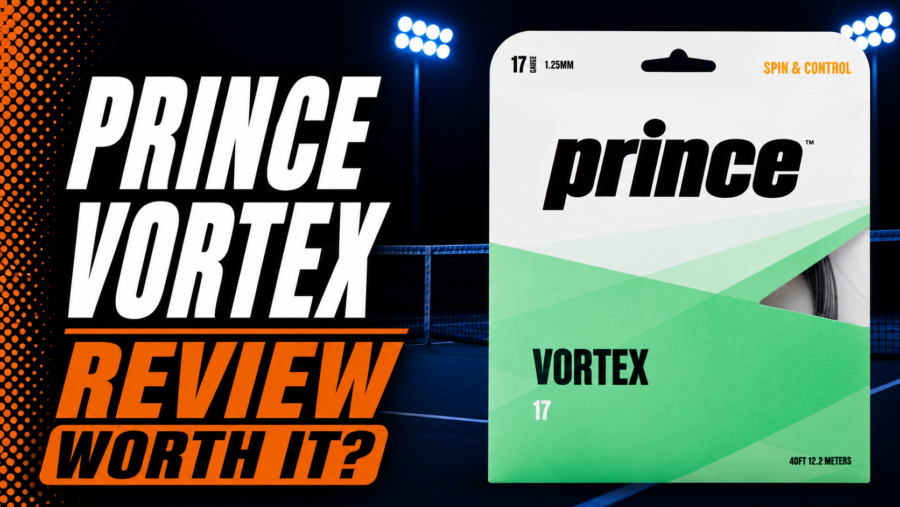
Prince Vortex is a six-sided co-polyester tennis string developed for spin, control and a more elastic response than a traditional firm polyester. Its hexagonal profile gives the ball multiple edges to interact with, while softening agents are intended to make the monofilament more forgiving.
Vortex occupies the rounded middle ground of Prince’s Vortex family. It is shaped more conventionally than the three-sided Vortex Triad and supplies a slightly softer, livelier response than many control-first co-polyesters.
The string targets intermediate and advanced players with long, fast swings who create their own pace and want to shape the ball aggressively. It is not designed to generate effortless depth for beginners. Players unsure about polyester can begin with the Tennis String Finder.
Prince Vortex Rating
| Category | Rating |
|---|---|
| Power | 6/10 |
| Spin | 9/10 |
| Comfort | 7.5/10 |
| Control | 8.5/10 |
These ratings compare Vortex with the wider string market. Its defining strengths are spin and control, while its comfort is above average only within the polyester category.
Prince Vortex Specifications
| Specification | Details |
|---|---|
| String type | Shaped co-polyester monofilament |
| Composition | Co-polyester with softening agents |
| Shape | Hexagonal, with six sides |
| Surface | Smooth finished shaped profile |
| Common gauges | 16 / 1.30mm and 17 / 1.25mm |
| Documented colors | Black, Red and Green, depending on market |
| Set length | Approximately 12.2m |
| Reel length | Approximately 200m, depending on market |
Color and package availability varies by region. Gauge and construction should take priority over color when comparing listings.
Material and Construction
Vortex is a single co-polyester monofilament rather than a multifilament bundle. Prince modifies the polyester formulation with softening agents intended to increase elasticity and reduce the rigid feel associated with traditional polyester.
The string is extruded with a hexagonal profile. Six edges create more geometric interaction with the ball than a round string, supporting topspin and slice when the player supplies sufficient racket-head speed.
Shape alone does not create spin. The mains must also slide and return effectively, and the player needs an upward or across-ball swing path. Notching and tension loss can reduce snapback as the bed ages.
The surface is not consistently documented as having a separate named coating. Claims about bite should be attributed to the hexagonal profile and string movement rather than an unverified low-friction treatment.
Prince Vortex Performance
Power
Vortex is a low-powered string in the broader market. Its monofilament construction and controlled response place pace generation primarily on the player’s swing.
The softening agents make it somewhat livelier than the firmest co-polyesters, but they do not turn it into a power string. Long, fast swings are needed to activate the stringbed and drive the ball through the court.
Lower reference tension and the thinner gauge can increase pocketing and launch. Beginners and compact swingers should not rely on those adjustments to make Vortex behave like a multifilament.
Players who already generate substantial pace can use the restrained response to accelerate confidently. This is the performance context in which its power level becomes an advantage.
Power rating: 6/10
Spin
Spin is Vortex’s defining strength. The six-sided profile supplies multiple edges for ball interaction, while the controlled response lets advanced players swing rapidly without excessive launch.
The 17 / 1.25mm version generally provides quicker snapback and easier ball interaction. The 16 / 1.30mm gauge gives greater stability and may work better in very open patterns.
The string should produce its best rotation while fresh. As notching develops and tension falls, mains may return less efficiently and launch can become less consistent.
Players should distinguish geometric bite from automatic spin. Vortex supports topspin, slice and kick serves, but racket-head speed and swing path remain essential.
Spin rating: 9/10
Control
Vortex provides strong control for players with fast swings. Its restrained power and shaped monofilament structure create a predictable response when the player accelerates through contact.
The string is well suited to aggressive baseliners who want to aim high over the net and bring the ball down with rotation. It also supports directional changes and sharp angles.
The response is slightly more elastic and muted than some firm control polys. Players who prefer a very crisp, locked-in bed may find Vortex less direct.
Control can decline with tension loss. A bed that remains physically intact should not be assumed to preserve its original launch or response indefinitely.
Control rating: 8.5/10
Comfort and Feel
Vortex is comfortable relative to many co-polyester monofilaments. Prince’s softening agents are intended to improve elasticity, producing a more pocketed and slightly muted response.
That comparison must remain category specific. Vortex is still a polyester monofilament and is considerably firmer than natural gut or a soft multifilament.
The feel can suit players who want shaped-poly spin without the most rigid impact. Flexible rackets and sensible tension can complement this quality.
Players with persistent arm discomfort should not assume that a softer co-poly is an appropriate full-bed solution. Material, tension, racket stiffness and individual history all matter.
Comfort rating: 7.5/10
Durability and Tension Maintenance
Vortex provides good resistance to breakage. The 16 / 1.30mm monofilament is particularly suitable for open patterns and players who wear through thinner strings.
The hexagonal edges can round with use, and intersections will eventually notch. The 17 gauge provides greater response but less physical material to resist repeated friction.
Physical durability is separate from useful playability duration. Independent and retailer evaluations consistently identify tension loss as a more important limitation than breakage.
As elasticity and snapback decline, the bed can feel either firmer or more erratic, and launch may rise. Players should restring according to performance changes rather than waiting automatically for the string to snap.
Choosing the Right Gauge
Vortex’s two main gauges offer a straightforward choice.
| Gauge | General characteristics |
|---|---|
| 16 / 1.30mm | Greater stability, resistance and control in open patterns |
| 17 / 1.25mm | Faster response, easier spin access and more pocketing |
The 16 gauge is best for string breakers and very open patterns. The 17 gauge is the more responsive option for denser patterns and players who restring before polyester becomes unresponsive.
Full Bed or Hybrid Setup
Full Bed
A full bed maximizes Vortex’s shaped-string spin, control and consistent material response. It best suits experienced polyester users with long, fast swings.
Because it remains a firm monofilament, players should use a polyester-appropriate reference rather than copying a high nylon tension.
Prince Vortex in the Mains With Softer Crosses
Vortex mains preserve the hexagonal bite and controlled character. Natural gut or multifilament crosses add power and comfort, creating a more forgiving option for players who still want shaped-poly mains.
The Vortex edges can notch a soft cross quickly. A durable, smooth cross and regular inspection are important.
Softer Mains With Prince Vortex in the Crosses
Natural gut or multifilament mains emphasize power, pocketing and feel. Vortex crosses add control, but a shaped cross can restrict and abrade the soft mains more than a smooth round co-poly.
For gut or premium multifilament mains, a round low-friction polyester is generally the more efficient snapback partner. Vortex crosses make sense only when the player accepts the added friction and wants a firmer response.
General Tension Guidance
Vortex should generally begin below the reference used for nylon or multifilament in the same racket. The exact adjustment depends on gauge, pattern, frame stiffness and experience with polyester.
Players seeking more pocketing can make a modest reduction. Those who need a firmer launch should adjust in small steps rather than stringing an already firm material excessively high.
The 16 gauge and open patterns may feel more substantial, while 17 gauge and dense patterns can tolerate a slightly different reference. Avoid copying another player’s number without matching the full setup.
The Tennis String Tension Calculator can help establish a general starting point within the racket manufacturer’s approved range.
Who Should Use Prince Vortex?
Vortex is best suited to:
- Intermediate and advanced players with long, fast swings
- Spin-focused baseliners
- Players who generate their own pace
- Users seeking a softer-feeling shaped co-polyester
- Players who restring according to polyester playability
- String breakers who need the 16 / 1.30mm option
Who Should Avoid Prince Vortex?
Vortex is less suitable for:
- Beginners with compact or slow swings
- Players seeking effortless depth
- Anyone who needs natural-gut or multifilament comfort
- Players who keep polyester installed until it breaks
- Users who want the longest possible tension stability
- Players seeking a smooth cross for expensive soft mains
Pros and Cons
| Pros | Cons |
|---|---|
| Excellent spin potential | Low free power |
| Strong control on fast swings | Tension loss limits useful life |
| Hexagonal profile creates geometric bite | Still firm compared with soft strings |
| Above-average comfort for co-polyester | Edges can abrade soft hybrid partners |
| Useful 16 and 17 gauges | Shape and snapback decline with wear |
| Good physical resistance | Not appropriate for many beginners |
Prince Vortex Compared With Other Strings
Vortex vs Prince Vortex Triad
Prince Vortex Triad has three sharper sides and an even more specialized bite. Triad provides exceptional spin and surgical control, while regular Vortex has a six-sided profile and a somewhat rounder overall response.
Vortex vs Prince Vortex Triad Hybrid
Prince Vortex Triad Hybrid pairs triangular mains with a thin, round co-polyester cross. The hybrid is engineered for main-string movement and spin, while regular Vortex provides one material in both directions.
Vortex vs Solinco Hyper-G
Solinco Hyper-G is a four-sided control polyester with a crisp, predictable response. Both target spin, while Vortex is more muted and uses six sides.
Vortex vs Volkl Cyclone
Volkl Cyclone is a ten-sided co-polyester with strong bite and value. Vortex feels softer and uses a simpler six-sided profile, while Cyclone typically feels crisper.
Final Verdict
Prince Vortex is a value-oriented shaped co-polyester for players who create their own power. Its hexagonal profile supports heavy spin, while softening agents make the impact more forgiving than many traditional polyester monofilaments.
The string remains low powered and performance sensitive. Its resistance to snapping may outlast its tension, elasticity and snapback, so regular assessment is essential.
For intermediate and advanced baseliners who want spin, control and a slightly muted feel, Vortex is a credible choice. The 17 / 1.25mm gauge emphasizes response, while 16 / 1.30mm adds the stability and resistance needed by frequent string breakers.
Frequently Asked Questions
What type of string is Prince Vortex?
It is a shaped co-polyester monofilament made with softening agents.
How many sides does Prince Vortex have?
Regular Prince Vortex has a hexagonal profile with six sides.
Is Prince Vortex powerful?
No. It is a controlled, low-powered string that works best with long, fast swings.
Is Vortex comfortable?
It is above average for a co-polyester, but it remains firmer than natural gut or multifilament.
Which gauge should most players choose?
The 17 / 1.25mm version offers greater response and spin access. String breakers and open-pattern users should consider 16 / 1.30mm.
How does Vortex differ from Vortex Triad?
Vortex has six sides, while Vortex Triad has three sharper sides and a more specialized spin-and-control response.
Can Vortex be used in a hybrid?
Yes. It works most logically in the mains with a softer cross. Its edges can increase wear on multifilament or natural gut.