
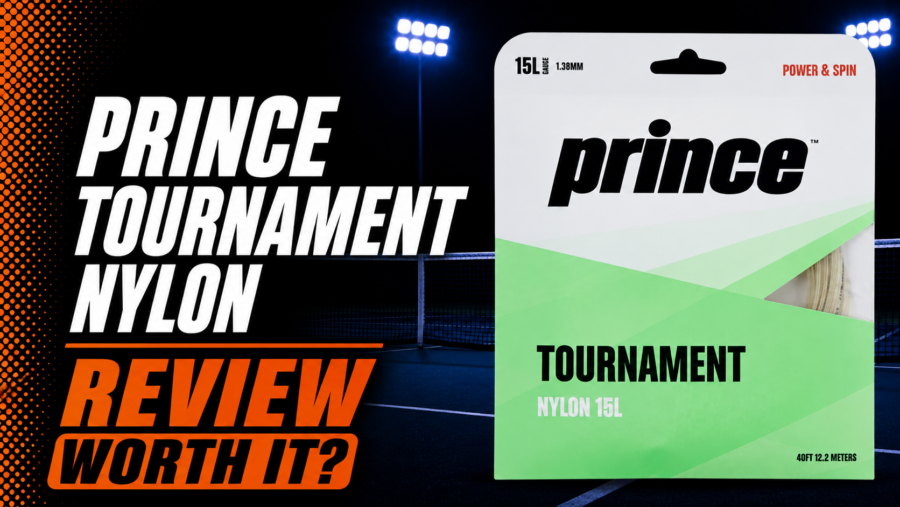
Prince Tournament Nylon is a traditional 15L / 1.35mm nylon string designed around simplicity, durability and low cost. It is one of Prince’s most basic synthetic options and targets recreational players, beginners, teaching programs and frequent stringers who need dependable value.
Its name should not be confused with polyester tournament strings or natural gut. This is a thick, round nylon construction that provides easier power and greater comfort than polyester, but less sophistication than a premium multifilament.
Tournament Nylon makes the most sense when affordability and resistance matter more than maximum spin or refined feel. Players comparing basic materials can also use the Tennis String Finder before choosing it.
Prince Tournament Nylon Rating
| Category | Rating |
|---|---|
| Power | 7.5/10 |
| Spin | 5/10 |
| Comfort | 7/10 |
| Control | 6.5/10 |
These ratings place Tournament Nylon within the broader string market. Its thick gauge improves stability and resistance, while its nylon material remains livelier than most polyester strings.
Prince Tournament Nylon Specifications
| Specification | Details |
|---|---|
| String type | Traditional nylon string |
| Construction | Solid nylon core with a basic outer wrap |
| Profile | Round and smooth |
| Common gauge | 15L / 1.35mm |
| Common colors | Natural or Clear |
| Set length | Approximately 12.0m to 12.2m |
| Reel length | Approximately 200m |
Regional listings sometimes round the diameter differently, but Prince’s current European and Taiwanese information supports 15L / 1.35mm as the established specification.
Material and Construction
Tournament Nylon uses a conventional solid-core nylon design. The central monofilament supplies strength and a stable response, while a basic nylon wrap protects the core and modifies feel.
It does not use polyester, natural gut or a bundle of hundreds of premium microfibers. Its straightforward construction is one reason the string remains inexpensive and practical for high-volume use.
The surface is smooth and round. There are no shaped edges, rough ridges or named low-friction coatings intended to create modern polyester-style snapback.
The 1.35mm diameter is thicker than the common 1.30mm and 1.25mm sizes used by many performance strings. More material improves resistance to wear but reduces elasticity, feel and main-string movement.
Prince does not promote a complex proprietary technology for Tournament Nylon. Claims should focus on proven material characteristics and value rather than assigning it features that belong to Duraflex, Powerfoil or another Prince family.
Prince Tournament Nylon Performance
Power
Tournament Nylon supplies accessible power compared with polyester. Nylon stretches and returns energy more readily, helping beginners and recreational players find depth without exceptional racket-head speed.
The thick 1.35mm gauge restrains that liveliness. It feels firmer and less responsive than a thin synthetic gut or premium multifilament, so the power is useful rather than explosive.
Independent laboratory listings show high energy return for this model, which does not support describing it as an especially low-powered string. Perceived depth will still depend on tension, racket head size and swing speed.
Players who need maximum assistance may prefer a thinner or more elastic multifilament. Tournament Nylon prioritizes the balance between usable rebound and resistance.
Power rating: 7.5/10
Spin
Spin is limited by the thick, smooth construction. Tournament Nylon lacks shaped edges and does not snap back like a low-friction co-polyester.
Players can still produce topspin and slice through technique. The string does not create rotation independently, and heavy spin tends to move the mains out of position.
The 1.35mm gauge also reduces the space and flexibility available for rapid string movement. This is useful for stability but not ideal for maximum ball bite.
Players whose game depends on aggressive topspin will usually find a thinner or spin-focused string more effective. Tournament Nylon suits flatter strokes and moderate rotation better.
Spin rating: 5/10
Control
Control is adequate for recreational and developing players. The thick gauge creates a stable contact response, while the solid core provides consistent feedback when the stringbed is fresh.
The string is more elastic than polyester, so fast, full swings may produce a higher launch than advanced players expect. Calling control its unquestioned standout feature would ignore this material difference.
Players can adjust tension within the racket manufacturer’s range to manage trajectory. Excessively high tension may reduce comfort without turning nylon into polyester.
Control also changes as the strings move and tension declines. Frequent straightening and a gradually livelier launch are normal signs of wear in a basic nylon bed.
Control rating: 6.5/10
Comfort and Feel
Tournament Nylon is more comfortable than most firm polyester strings but less plush than natural gut or a premium multifilament. Its simple solid core creates a crisp, relatively direct feel.
The thick gauge reduces some of the elastic pocketing available from thinner nylon. This can feel stable and clean to one player but basic or firm to another.
For beginners, occasional players and teaching programs, the impact response is generally more forgiving than a performance co-polyester installed at an unsuitable tension.
Comfort still depends on racket stiffness, tension, technique and physical condition. No string should be treated as a medical solution for existing arm pain.
Comfort rating: 7/10
Durability and Tension Maintenance
Tournament Nylon’s 1.35mm diameter provides good physical resistance for an inexpensive nylon string. It contains more material than common 16 and 17 gauges and is less likely to snap quickly under moderate recreational use.
It is not as abrasion-resistant as a thick polyester monofilament. Heavy topspin can notch the intersections, move the mains and eventually cut through the nylon.
Useful playability duration is separate from breakage. Nylon typically retains a more elastic response than polyester, but gradual tension loss and permanent displacement can change control before the string snaps.
Available laboratory summaries indicate respectable tension stability for a value nylon. That does not support guaranteeing a fixed number of hours because swing style, pattern and storage conditions vary widely.
Replace it when notching becomes deep, the strings will not remain aligned, trajectory changes materially or feel becomes inconsistent. Recreational players should also avoid leaving the same installation in a racket indefinitely simply because it remains unbroken.
Choosing the Right Gauge
Tournament Nylon is most consistently sold in one thick gauge.
| Gauge option | Availability | General characteristics |
|---|---|---|
| 15L / 1.35mm | Established specification | Greater resistance and stability, with less feel and movement |
| Thinner alternative | Not consistently offered for this model | Choose another Prince nylon if a more responsive gauge is required |
The fixed 1.35mm version is appropriate for open patterns, shared rackets and players who prioritize cost per restring over refined response.
Full Bed or Hybrid Setup
Full Bed
A full bed is the clearest and most economical use of Tournament Nylon. It provides consistent material, straightforward stringing and a balanced response for beginners or recreational players.
This setup is preferable to an unnecessary polyester bed for players who do not swing fast enough to benefit from firm co-polyester control.
Tournament Nylon in the Mains With Softer Crosses
Tournament Nylon mains preserve its stable, durable character. A softer multifilament cross can add pocketing and comfort, although the added cost may reduce the value advantage.
This direction can suit a player who has a reel of Tournament Nylon but wants a slightly more forgiving result. The softer crosses may fray first.
Softer Mains With Tournament Nylon Crosses
Natural gut or multifilament mains provide greater power, touch and comfort. Tournament Nylon crosses can reduce cost and add firmness without the severity of polyester.
The basic nylon cross may create more friction than a premium smooth hybrid string. Players should monitor main-string notching and movement.
General Tension Guidance
Tournament Nylon can generally begin near the racket manufacturer’s middle recommended tension because it is a conventional nylon string. There is no reason to copy an unusually low polyester reference automatically.
Players seeking more depth and comfort can move modestly lower within the approved range. Those seeking a firmer launch can make a small increase while monitoring impact feel.
The thick gauge already creates a relatively stable response. Large tension increases can make the stringbed unnecessarily rigid without producing polyester-like spin control.
The Tennis String Tension Calculator can help account for racket head size, pattern and material. Record each setup so later adjustments remain meaningful.
Who Should Use Prince Tournament Nylon?
Tournament Nylon is best suited to:
- Beginners and recreational players
- Teaching programs and shared club rackets
- Budget-focused players who restring frequently
- Flatter hitters who do not need maximum snapback
- Players seeking more comfort than firm polyester
- Stringers who want a durable, straightforward nylon option
Who Should Avoid Prince Tournament Nylon?
Tournament Nylon is less suitable for:
- Advanced topspin players seeking maximum string movement
- Players who want premium multifilament feel
- Players requiring several gauge choices
- Heavy breakers who need polyester-level abrasion resistance
- Players seeking the sharpest directional control on full swings
- Anyone expecting a basic nylon to reproduce natural gut
Pros and Cons
| Pros | Cons |
|---|---|
| Very affordable | Limited spin potential |
| Good resistance for a nylon string | Basic feel compared with premium strings |
| More comfortable than most polyesters | Only one common thick gauge |
| Accessible power for recreational players | Strings can move out of position |
| Straightforward full-bed or hybrid use | Less control for very fast swings |
| Practical for teaching and shared rackets | Less elastic than thinner multifilaments |
Prince Tournament Nylon Compared With Other Strings
Tournament Nylon vs Prince Topspin
Prince Topspin adds a textured Duraflex construction to target greater ball bite. Tournament Nylon is simpler, smoother and usually the more economical choice.
Tournament Nylon vs Prince Synthetic Gut Duraflex
Prince Synthetic Gut Duraflex uses Duraflex reinforcement and offers several gauges. It provides more refined all-around playability, while Tournament Nylon emphasizes basic resistance and cost.
Tournament Nylon vs Prince Lightning XX
Prince Lightning XX adds Powerfoil and multifilament wrapping for greater power and comfort. Tournament Nylon has the simpler, firmer response.
Tournament Nylon vs Wilson Synthetic Gut Power
Wilson Synthetic Gut Power uses high-energy outer wraps for greater responsiveness. Tournament Nylon is thicker and more basic, with value and resistance as its priorities.
Final Verdict
Prince Tournament Nylon is a straightforward value string rather than a hidden high-performance polyester substitute. Its solid-core nylon construction, smooth profile and 1.35mm gauge deliver accessible power, acceptable comfort and useful resistance at a low cost.
The current article’s control-first description needed more context. The thick gauge adds stability, but nylon remains livelier and less snapback-oriented than polyester. Spin is the clearest performance limitation.
For beginners, occasional players, teaching programs and budget-conscious stringers, Tournament Nylon remains practical. Players seeking premium feel, aggressive spin or multiple gauges should move to a more specialized string.
Frequently Asked Questions
What is Prince Tournament Nylon made from?
It uses a traditional solid-core nylon construction with a basic outer wrap.
What gauge is Prince Tournament Nylon?
The established version is 15L / 1.35mm.
Is Tournament Nylon a polyester string?
No. It is nylon and is generally more elastic and comfortable than firm polyester.
Does Tournament Nylon provide good spin?
It provides enough spin for recreational play, but its thick, smooth profile limits movement and geometric bite.
Is Tournament Nylon durable?
It offers good physical resistance for nylon because of its 1.35mm diameter, though heavy topspin players can still notch and break it.
Is it suitable for beginners?
Yes. Its low cost, accessible power and straightforward response make it appropriate for many beginners.
Can Tournament Nylon be used in a hybrid?
Yes. It can serve as an economical main or cross, although a full bed is its simplest use.