
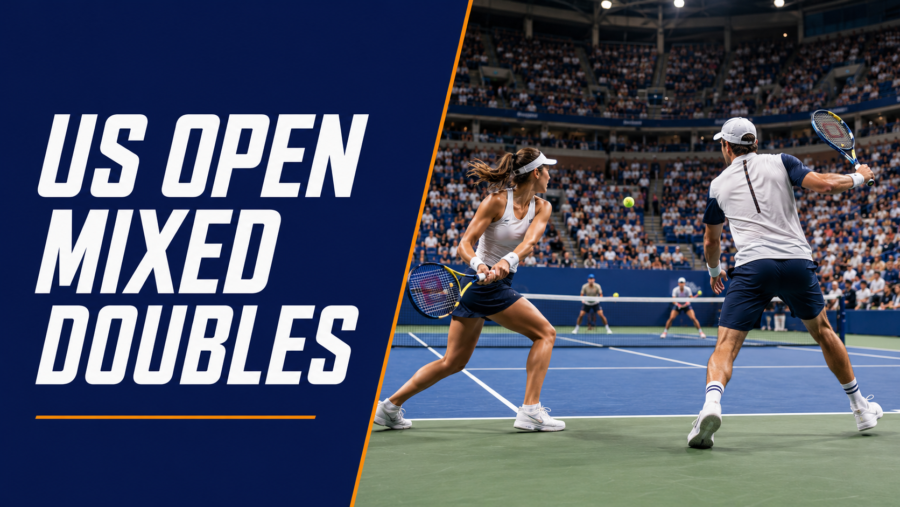
US Open mixed doubles pairs one woman and one man on each team, but the event no longer follows the same week or match format that many fans remember. In 2026, it used a 16-team main draw during Fan Week, short sets in the early rounds, a traditional-set final and a $1 million prize for the championship team.
The tournament introduced an eight-team qualifying event in 2026, with two teams advancing to the main draw. Karolina Muchova and Jakub Mensik won the latest completed championship, defeating Belinda Bencic and Flavio Cobolli 6-3, 1-6, [10-6] in the final.
The rules and entry system have changed significantly since 2025 and could change again. The format below reflects the completed 2026 US Open Mixed Doubles Championship.
What Is Mixed Doubles at the US Open?
Mixed doubles is a doubles event in which every team consists of one woman and one man. Both players share the same court, alternate service games and use ordinary doubles court boundaries.
The tactical foundation is still doubles. Positioning, poaching, return formation and communication matter, as explained in the broader guide to tennis doubles rules. What makes the current US Open event unusual is its compressed schedule, short-set format and entry emphasis on prominent singles and doubles players.
It remains an official Grand Slam championship. The shorter matches do not make it an exhibition, and the winning team is recorded among the official US Open champions.
2026 US Open Mixed Doubles Format
The 2026 competition included qualifying followed by a 16-team, single-elimination main draw. A team had to win every remaining match to advance, with no consolation draw.
| Stage | Field or round | Set format | Deciding-set format |
|---|---|---|---|
| Qualifying | 8 teams competing for 2 places | Short-set format under the published event rules | 10-point match tiebreak in place of a third set |
| Main-draw first round | 16 teams | Best of three, first to 4 games, no-ad scoring | 10-point match tiebreak |
| Quarterfinals | 8 teams | Best of three, first to 4 games, no-ad scoring | 10-point match tiebreak |
| Semifinals | 4 teams | Best of three, first to 4 games, no-ad scoring | 10-point match tiebreak |
| Final | 2 teams | Two traditional tiebreak sets to 6 games | 10-point match tiebreak |
In the short-set rounds, a tiebreak is played if the set reaches 4-4. No-ad scoring means a game at deuce is decided by one point rather than repeated advantages.
The final returns to sets played to six games, with a tiebreak at 6-6. If the teams split those sets, a first-to-10 match tiebreak, won by two points, decides the title. The guide to how tennis tie-breaks work explains the scoring logic behind both ordinary and match tiebreaks.
Why the Final Uses Longer Sets
The short format allows many early-round matches to fit into a compact Fan Week schedule. It also makes every service game more consequential because there is less time to recover from an early break.
The final uses traditional sets to give the championship match a fuller test while retaining a match tiebreak instead of a complete third set. In 2026, that deciding tiebreak separated Muchova and Mensik from Bencic and Cobolli.
How No-Ad Scoring Works
At 40-40, the next point wins the game. There is no advantage point followed by another deuce.
Under doubles no-ad procedure, the receiving team chooses the side from which it will receive the deciding point, subject to any event-specific mixed-doubles rule published for that edition. That decision can create a matchup between particular servers and returners, so teams often discuss it before the game reaches deuce.
If tennis score terminology is unfamiliar, the tennis scoring system provides the foundation for games, sets and matches.
How Teams Qualified in 2026
The 2026 main draw contained 16 teams:
- Six direct entries
- Eight wild-card entries
- Two teams that advanced from mixed-doubles qualifying
Direct main-draw entry was determined from the relevant combined player rankings at the published entry point. Wild cards allowed the tournament to admit teams outside those automatic places.
Qualifying debuted in 2026. Its eight-team field consisted of six direct entries and two wild cards, with direct qualifying entry based on the best combined singles or doubles ranking. The teams played for the final two main-draw positions.
This system is not a permanent rule for all Grand Slams. It was the US Open’s 2026 event structure, and the number of direct entries, wild cards and qualifiers should be verified each year.
When Is US Open Mixed Doubles Played?
The reimagined championship moved into Fan Week in 2025. In 2026, mixed-doubles qualifying took place on August 24, main-draw play began on August 25 and the semifinals and final were completed on August 26.
That placement is before the main singles draw, which began on August 30. The schedule is designed to make it easier for leading singles players to enter without overlapping with their first main-draw singles matches, although preparation and workload decisions remain individual.
The tournament schedule can be difficult to follow because qualifying, mixed doubles and the main draw do not all begin together. The complete US Open guide explains how the wider event fits together.
Is Mixed Doubles the Same as Regular Doubles?
The court dimensions and much of the basic play are the same, but team composition and the 2026 US Open format are different. Men’s and women’s doubles pair two players from the same category and use their own draw sizes, schedules and scoring formats.
The mixed event’s short sets create different tactical pressure. Losing serve at 1-1 can put a team close to losing the entire set, so fast starts and deciding points carry unusual weight.
Mixed teams also have to solve matchup questions without relying on simplistic assumptions about gender. Serve quality, return position, reach, movement, net skill and preferred side vary from player to player. The strongest formation is the one that uses the actual strengths of both partners.
Tactical Features of the Short Format
Returning Becomes Even More Important
A break of serve has greater value in a first-to-four set than in a standard first-to-six set. Teams may use aggressive return positions or planned poaches because a passive return game can disappear quickly.
Deciding Points Reward Clear Communication
No-ad deuce points can decide both a game and the direction of a short set. Partners need to agree on return side, serving pattern and net responsibility before the ball is put in play.
Hand signals can make those plans less obvious to the opponents. The guide to doubles communication signals explains the common calls used by serving teams.
The Match Tiebreak Changes Risk Management
A team can lose the second set yet still be only one short tiebreak from victory. Serving order, return order and first-strike execution become critical because ten points can pass quickly.
Momentum matters, but there is no special scoring rule that carries points from the previous set. The match tiebreak begins at 0-0 and must be won by two points.
US Open Mixed Doubles Prize Money
The 2026 champions received $1 million per team. The official 2026 breakdown listed $500,000 for the runners-up, $250,000 for semifinalists and $120,000 for quarterfinalists, with additional payments connected to the first round and qualifying.
Those figures apply to the team, not automatically to each player separately. How partners divide team prize money may depend on tournament payment procedures and their own arrangements.
Prize money can change every year. It should not be copied forward without checking the current official breakdown.
Who Won the 2026 US Open Mixed Doubles Title?
Karolina Muchova and Jakub Mensik became the 2026 champions. The Czech pair defeated Belinda Bencic and Flavio Cobolli 6-3, 1-6, [10-6] in the Arthur Ashe Stadium final.
Muchova and Mensik had reached the title match by surviving a 10-point match tiebreak against Mirra Andreeva and Andrey Rublev in the semifinals. Their championship ended the two-year winning run of Sara Errani and Andrea Vavassori, who had captured the 2024 and 2025 titles.
The event is only one part of a much longer tournament record. The guide to US Open history and records covers the broader evolution of the championships without duplicating this mixed-doubles format.
A Short History of US Open Mixed Doubles
Mixed doubles has deep roots in the American championships. The official champions list begins in 1892, long before the tournament adopted the US Open name and Open Era structure in 1968.
For decades, mixed doubles was played within the main tournament window using a more conventional Grand Slam draw and standard-set structure. The event produced champions from both singles and doubles backgrounds, including players who built much of their careers around team competition.
The largest modern change arrived in 2025. The US Open moved the championship into Fan Week, reduced the main draw to 16 teams, introduced short sets for the early rounds and raised the champions’ prize to $1 million per team. Eight teams initially earned direct entry through combined singles rankings and eight entered by wild card.
In 2026, the tournament retained the prominent Fan Week model but added an eight-team qualifying competition for two main-draw places. That gave specialist and lower-ranked pairings another path into the championship while keeping the 16-team main draw.
US Open Mixed Doubles FAQ
How Many Teams Play US Open Mixed Doubles?
The 2026 main draw contained 16 teams. An additional eight teams entered qualifying, with two advancing to the main draw.
How Many Rounds Are in the Main Draw?
A 16-team single-elimination draw has four rounds: first round, quarterfinals, semifinals and final. The relationship between field size and round count is explained in the guide to tennis tournament rounds and draws.
Do Mixed-Doubles Matches Use a Full Third Set?
No. In the 2026 championship, a 10-point match tiebreak replaced the third set. This applied to both the short-set early rounds and the traditional-set final.
Are the Sets Played to Four or Six Games?
The 2026 first round, quarterfinals and semifinals used sets played to four games, with a tiebreak at 4-4. The final used traditional sets played to six, with a tiebreak at 6-6.
Will the Format Be the Same Next Year?
Not necessarily. The event changed in both 2025 and 2026. Draw size, entry routes, match format, dates and prize money should all be checked against the official rules for the current edition.