
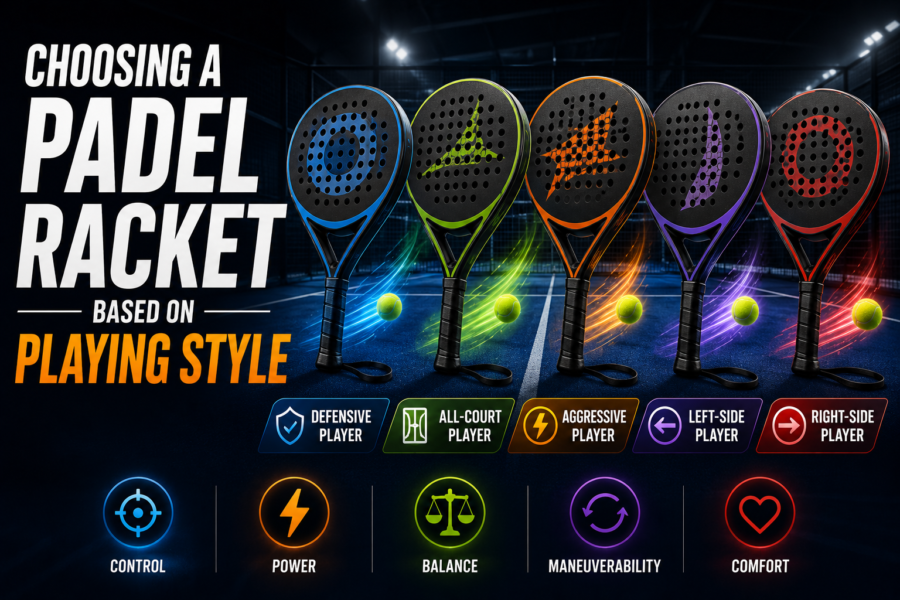
While skill level is important, playing style is often the factor that ultimately determines which padel racket feels best on court. Two players of the same ability can have completely different needs depending on how they construct points, defend under pressure, and attack opportunities.
Some players prefer long rallies and tactical consistency, while others look to dominate points with aggressive volleys and powerful smashes. The ideal racket should complement your strengths and make your natural game easier to execute.
Understanding which racket characteristics suit your playing style can help narrow down your choices far more effectively than simply looking at price or professional endorsements.
Best Rackets for Defensive Players
Defensive players rely on consistency, patience, and court coverage rather than outright power. Their game is built around retrieving difficult balls, extending rallies, creating opportunities through placement, and forcing opponents into mistakes.
For this style of play, control-oriented rackets are usually the best option. Round-shaped designs with lower balance points provide greater maneuverability and precision, making it easier to handle difficult defensive shots under pressure.
A larger sweet spot is particularly valuable because defensive players often hit from uncomfortable positions near the back glass or while stretching to reach difficult balls. Forgiving rackets help maintain consistency even when contact is less than perfect.
Fast maneuverability is another major advantage. Defensive players frequently react to hard smashes, quick volleys, and fast transitions, so a racket that moves quickly through the air can significantly improve reaction speed.
The ideal defensive racket typically features:
- Round shape
- Low balance
- Large sweet spot
- Soft or medium EVA core
- Comfortable handling
- Excellent maneuverability
These characteristics help players defend effectively while maintaining control and consistency throughout long rallies.
Best Rackets for Aggressive Players
Aggressive players look to dictate points whenever possible. They attack short balls, finish points at the net, and use powerful smashes and volleys to put opponents under constant pressure.
For these players, power becomes a priority. Diamond-shaped rackets are often the preferred choice because their higher balance points and weight distribution generate more momentum through the ball during attacking shots.
High-balance setups help create explosive smashes and more penetrating volleys, making it easier to finish points decisively. Stiffer constructions with carbon faces and harder EVA cores also provide the direct response and power advanced attacking players often seek.
Aggressive players usually prioritize:
- Maximum power
- Explosive smashes
- Strong volleys
- Stability during attacks
- Direct ball response
While these rackets can be less forgiving than control-oriented models, they reward clean technique with exceptional offensive potential.
Players who spend most of their time looking for winners and attacking opportunities often benefit significantly from power-focused designs.
Best Rackets for All-Court Players
All-court players need versatility above everything else. Their style involves balancing defense, attack, consistency, and tactical variation depending on the situation.
Because they do not specialize exclusively in one area, all-court players typically perform best with balanced rackets that provide a blend of power, control, comfort, and maneuverability.
Teardrop-shaped rackets are often considered the ideal all-court option because they offer strong performance across every phase of the game. They generate enough power for attacking situations while maintaining sufficient control for defensive exchanges and precise placement.
Many all-court players prefer:
- Teardrop shapes
- Medium balance
- Medium EVA cores
- Balanced power and control
- Good maneuverability
- Versatile shot-making capability
The biggest advantage of these rackets is adaptability. Whether defending from the back of the court, volleying at the net, or attacking with overheads, a balanced racket performs reliably in every situation.
For many recreational players, all-court rackets represent the safest and most versatile choice.
Best Rackets for Left-Side Players
In padel, left-side players are often expected to generate more offensive pressure. While responsibilities vary depending on the partnership, the left-side player frequently takes charge of attacking opportunities and finishing points.
Because of this role, many left-side players prefer rackets that provide additional power and stability. Diamond-shaped and aggressive teardrop rackets are especially popular because they enhance overhead performance and attacking volleys.
Power on smashes becomes particularly important. Higher-balance rackets help generate greater racket head momentum, allowing players to hit more explosive overheads and produce heavier shots from attacking positions.
Left-side players commonly look for:
- Power-oriented designs
- Higher balance points
- Strong volley performance
- Stability during attacks
- Aggressive overhead capabilities
Advanced players occupying the left side often gravitate toward premium carbon constructions and harder cores because they maximize offensive potential.
The goal is to find a racket that helps convert attacking opportunities into winning shots.
Best Rackets for Right-Side Players
Right-side players often focus more on consistency, defense, point construction, and creating opportunities for their partner. While they still attack when necessary, control and reliability are usually higher priorities than maximum power.
Control-oriented rackets with larger sweet spots are especially effective because they improve consistency during long rallies and defensive situations. Round and balanced teardrop rackets are particularly common among right-side players.
Maneuverability also plays a major role. Quick reactions are essential when defending hard drives, handling fast volleys, and maintaining control during extended exchanges.
The ideal right-side racket often features:
- Excellent control
- Large sweet spot
- Good maneuverability
- Defensive stability
- Comfortable handling
- Consistent response
These characteristics help players maintain accuracy and composure while building points patiently and supporting their partner’s attacking opportunities.
For most right-side specialists, consistency and reliability are ultimately more valuable than maximum power. The best racket is one that allows them to execute their tactical role confidently throughout the match.