
How Does the Tennis World Ranking Work?
When we talk about the “greats” of tennis, names like Novak Djokovic, Roger Federer, and Rafael Nadal immediately come to mind. These are players who not only won numerous Grand Slam titles but also accumulated huge amounts of ATP points, allowing them to stay at the top of the world rankings for many years.
Although the system has evolved over time, the tennis world ranking still serves as a key indicator of how well players have performed during a given season. Rankings also play a crucial role in tournament seedings and determine which events players are eligible to enter. In short, the world ranking is extremely important in professional tennis.
But how exactly does the tennis ranking system work? Let’s break it down.
What Is the Tennis Ranking?
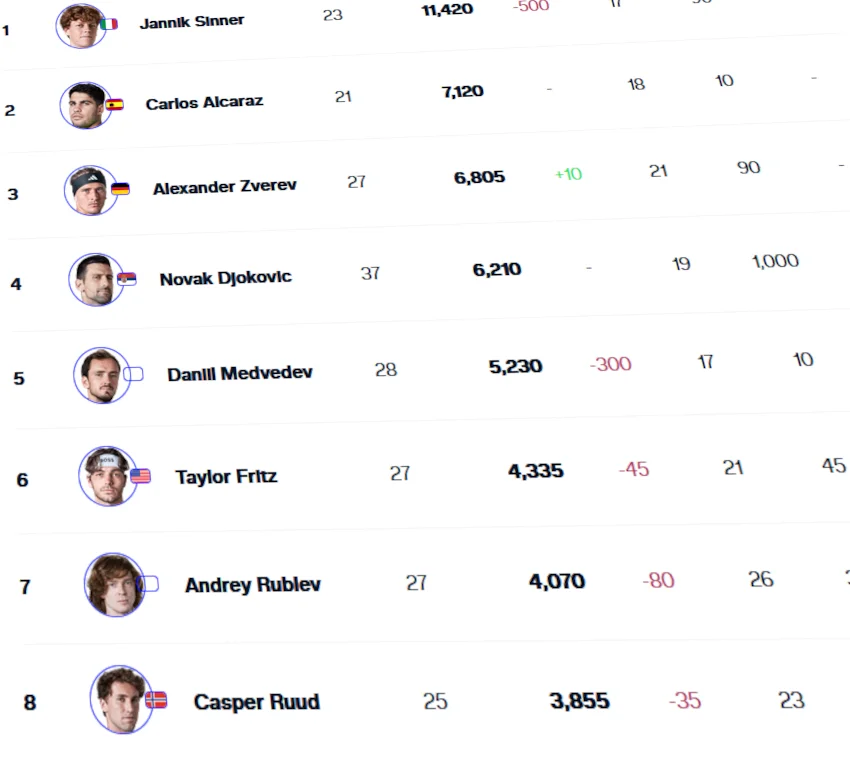
The tennis ranking reflects how well a player has performed over the past 12 months, based on the points they have earned in tournaments. The player with the most points is ranked world No.1 and is considered the best player in the world until someone else surpasses them.
Embed from Getty ImagesIn professional tennis, rankings are governed by two main organizations:
- ATP (Association of Tennis Professionals) for men
- WTA (Women’s Tennis Association) for women
Both organizations publish rankings for singles and doubles. At the moment, there is no official ranking system for mixed doubles.
How Do Tennis Rankings Work?
Both the ATP and WTA update and publish their rankings every Monday, with a few exceptions during the season.
Rankings are calculated using a rolling 52-week system. This means that only results from the previous 12 months are counted. Once points are older than 52 weeks, they drop off and are replaced by new results.
- ATP singles rankings are based on a player’s best 19 results from the past 52 weeks
- WTA singles rankings are based on a player’s best 16 results from the same period
If a player earns the same number of points as the previous year at a specific tournament, their ranking may remain unchanged. If they earn fewer points, they may drop in the rankings, and if they earn more, they can move up.
The number of points awarded varies by tournament level. In most cases, the tournament name reflects the points given to the winner:
- Grand Slam champions earn 2,000 points (both men and women)
- ATP 500 winner earns 500 points
- WTA 250 winner earns 250 points
How Does the ITF Ranking Work?
The ITF (International Tennis Federation) ranking system is different from the ATP and WTA and is often the starting point for aspiring professional players.
Embed from Getty ImagesThe ITF World Tennis Tour provides entry-level and mid-level international tournaments where players begin their professional careers and work toward qualifying for higher-level events and Grand Slams.
ITF rankings are based on points earned from ITF-sanctioned tournaments over a 52-week period. A player’s best 14 tournament results are counted toward their ITF ranking. Rankings are updated weekly, and more recent results carry greater importance than older ones.
The ITF also produces rankings for national teams in competitions such as:
- Davis Cup (men)
- Billie Jean King Cup (women)
These rankings are updated after each competition round and are used for group placements and seedings.
How Does the ATP Ranking Work?
The ATP ranking is determined entirely by tournament performance. This is how players like Roger Federer managed to remain world No.1 for a record 310 weeks, including 237 consecutive weeks.
Embed from Getty ImagesATP ranking points come from:
- The four Grand Slams (Australian Open, French Open, Wimbledon, US Open)
- Eight mandatory ATP Masters 1000 tournaments
- Seven additional best results from events such as ATP 500, ATP 250, Monte Carlo Masters, ATP Cup, Challenger, and ITF tournaments
The final tournament of the season is the ATP Finals, featuring the top 8 ranked players. Although it is technically considered a bonus event, the points earned still count toward a player’s overall ranking and can significantly affect year-end positions.
How Does the WTA Ranking Work?
The WTA ranking system follows a similar structure. Players earn points from:
- Six WTA 1000 tournaments (such as Indian Wells, Miami, Madrid, Beijing)
- The four Grand Slams
After these events, the ranking also includes a player’s seven best results from other tournaments, including:
- WTA 500
- WTA 250
- WTA 125
- Selected ITF events
Like the ATP, the season-ending tournament is the WTA Finals, which features the top 8 ranked women. Points earned at the WTA Finals also count toward the overall ranking and can be decisive in final standings.
Embed from Getty ImagesThe tennis world ranking system ensures that consistency, performance, and results over an entire year are rewarded, making it one of the most accurate ways to measure success in professional tennis.