
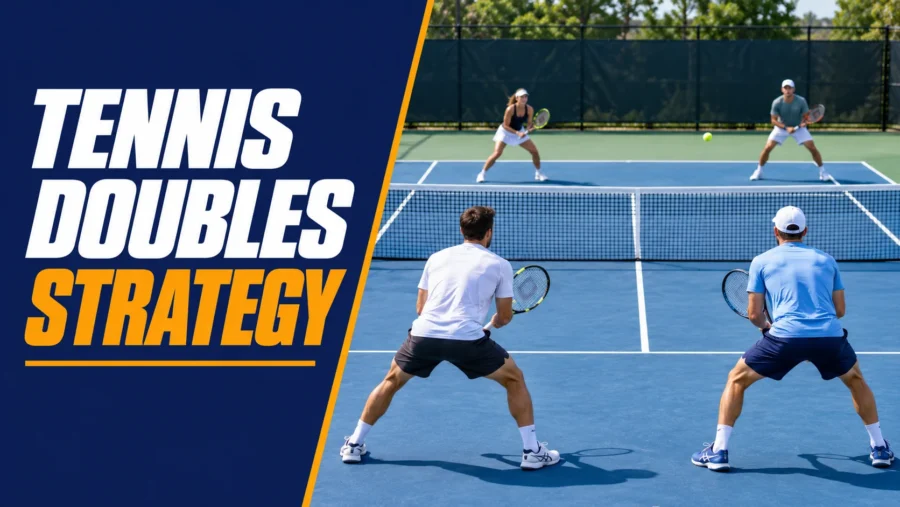
Good tennis doubles strategy is built around position, communication and high-percentage targets. The strongest default is to keep the ball away from the opposing net player, move forward together when you earn a short ball and make the other team hit difficult volleys or overheads rather than chasing low-margin winners.
This guide focuses on tactics, not the order of serving and receiving. If you need the court boundaries, rotation or scoring first, begin with the complete tennis doubles rules.
The Four Priorities of Doubles Strategy
Most club doubles points can be organized around four priorities:
- Start the point with a serve or return that gives your partner a useful position.
- Protect the middle and make opponents create sharper angles.
- Move as a pair so you do not leave a large gap between partners.
- Attack balls above net height and defend balls below it.
The goal is not to stand at the net at any cost. It is to arrive in an offensive position behind a ball that prevents the opponents from passing comfortably.
Basic Doubles Positioning
One Up, One Back
The conventional starting formation puts the server or returner near the baseline and their partner at the net. It is familiar and gives one player immediate pressure around the service line.
Its weakness is the diagonal gap between partners. If the baseline player is pushed wide while the net player stays still, the middle opens. The pair should shift toward the ball together, with the net player protecting the likely crosscourt lane.
Two Up
Both partners move toward the net, ideally around the service line or closer, after a strong serve, return or approach. This position takes time away and makes the opponents pass or lob under pressure.
Do not rush blindly. Split step as the opponent strikes, keep the first volley controlled and close together until the ball earns a better finishing position.
Two Back
Both players begin near the baseline. This is useful against powerful servers, aggressive net teams or opponents who repeatedly attack the returner’s partner.
Two back is a defensive formation, but it is not passive. Use a deep crosscourt ball, dipping shot or lob to neutralize the attack, then move forward together when a shorter reply appears. The older idea of using two back against an all-out offensive team remains useful when it buys time to absorb pace.
Where Should the Net Player Stand?
The serving partner generally begins between the center service line and doubles sideline, several feet from the net. The exact position changes with the server’s target, the returner’s tendencies and the net player’s reach.
Move closer when the opponent is stretched and likely to float the ball. Give yourself more reaction time when the opponent is balanced and driving hard. Shift with the ball so that a wide serve pulls you slightly toward the alley while a serve down the T lets you guard the middle more aggressively.
The middle is often the net player’s best territory because it reduces the opponent’s safe crosscourt window. The guide to poaching in doubles explains how to cross decisively without abandoning the alley at random.
High-Percentage Shot Targets
Return Crosscourt
The crosscourt return travels over the lower middle of the net and has more court available. It also stays away from the opposing net player when struck with enough width or dip.
Against a big first serve, shorten the backswing and prioritize a neutral ball. This detailed guide to returning a tennis serve covers return position and preparation.
Hit Through the Middle
A ball through the center reduces the opponents’ available angles and may create uncertainty about who should take it. Aim low between two net players or deep between two baseline players.
The tactic is especially useful against an aggressive team because it asks them to volley up or communicate under pressure. It is safer than forcing a narrow alley from a defensive position.
Attack the Feet
When an opponent is moving forward or standing near the service line, a dipping ball at the feet forces a low contact. The next shot is often more attackable than the first.
Lob With a Purpose
A deep lob can push an aggressive net player back, break up a two-up formation and create time to recover. A low, hopeful lob from a poor position is likely to become an overhead, so use height and depth rather than aiming barely above the opponent.
The full guide to the lob in tennis explains offensive and defensive uses of the shot.
Serve Strategy in Doubles
Serve placement should connect to the partner’s movement. Before the point, agree on whether the net player is staying, poaching or faking.
- A serve down the T reduces the returner’s angle and can feed the middle poach.
- A body serve can jam a returner who uses a large swing.
- A wide serve opens the court but also creates a sharper crosscourt return angle.
- A reliable spin serve is usually more useful than a first serve hit too hard to place.
The server should recover according to the plan. If the partner poaches, the server covers the vacated side rather than watching the volley.
Return Strategy in Doubles
The first job is to make the return. Missing while attempting a perfect pass gives the serving team a free point and prevents your partner from influencing the rally.
Against a strong net player, consider three options: a low crosscourt return, a firm ball through the middle or a high deep lob. Show more than one pattern so the net player cannot time every poach.
On a weaker second serve, step forward and take the ball earlier when your technique allows. The goal is not always a winner; a deeper return can pin the server behind the baseline and let your team claim the net.
Standard, Australian and I-Formation
Standard Formation
The net player starts on the side opposite the server’s target court. It is simple, keeps normal coverage responsibilities clear and works well when the returner is not repeatedly exploiting one direction.
Australian Formation
The server and net player begin on the same side of the center line, with the net player across from the returner. The setup encourages a return down the line and can change a returner’s preferred crosscourt pattern.
Use it when a returner is hurting you with the same crosscourt ball or when the server wants the next forehand from a particular side. Decide in advance whether the net player stays or crosses.
I-Formation
The net player crouches near the center line while the server stands close to the middle. After the serve, the net player moves to an agreed side and the server covers the other.
This formation hides the final coverage longer but requires clear signals and a server accurate enough to support the plan. The site’s guide to doubles hand signals shows how partners can communicate direction without advertising it.
Adjusting Against an Aggressive Team
If an attacking team is controlling the net, use two back when you need more reaction time and vary low targets with deep lobs. The aim is to earn a better position before moving forward together. The dedicated guide to defeating offensive doubles teams covers that matchup in more detail.
Communication Between Partners
Talk before the point and use short information during it. Useful calls include “mine,” “yours,” “switch,” “bounce” and “leave.”
After a point, discuss the pattern rather than blame the final miss. A pair that agrees on serve location, return target and net movement will cover the court better than two stronger singles players improvising independently. Choosing compatible roles is part of finding the right doubles partner.
Moving Together: The Rope Principle
Imagine a rope connecting you and your partner. When one player moves wide, the other shifts in the same direction. When one moves forward behind a strong ball, the other closes as well.
The spacing is not fixed, and one player may be closer to the net. The principle prevents one partner from attacking alone while the other leaves a large diagonal gap.
Common Doubles Strategy Mistakes
Guarding the Alley Too Early
The alley feels vulnerable, but covering it completely gives away the larger middle area. Protect the higher-percentage crosscourt and middle lanes until the opponent proves they can make the narrow pass.
Poaching Without a Recovery Plan
A poach must be decisive and coordinated. If the net player crosses, the server covers behind; otherwise one passing shot exposes the entire court.
Staying at the Service Line
The service line can be a useful split-step position during transition, but standing there for multiple shots often leaves difficult half-volleys. Move closer behind a good volley or retreat if the opponents have gained control.
Trying to Finish Below the Net
A low contact usually calls for a controlled volley, reset or deep neutral ball. Save the aggressive downward finish for a ball above net height.
Using the Same Formation Every Point
Patterns help your partner, but predictability helps the opponents. Change the net player’s movement, serve location or starting formation without abandoning high-percentage fundamentals.
Three Doubles Drills That Build Tactics
Serve, Return and First Volley
Play only the first four shots. The server names a target, the returner aims crosscourt and the net players work on position. Award a bonus point when the serving team executes the called pattern.
Two-Up Versus Two-Back
Start one team at the net and one at the baseline. The baseline team scores by passing, lobbing or earning a short ball; the net team scores by maintaining low, controlled volleys.
Middle-Only Game
Mark a central target channel with cones. A ball through the channel earns a bonus point. This teaches teams to reduce angles and communicate over middle balls.
Final Takeaway
Effective doubles is coordinated tennis. Serve and return to a plan, protect the middle, move with your partner and attack only when the ball and position justify it. Against an offensive team, use two back when needed, keep the ball low and mix in deep lobs, then transition forward together when you have earned control.