
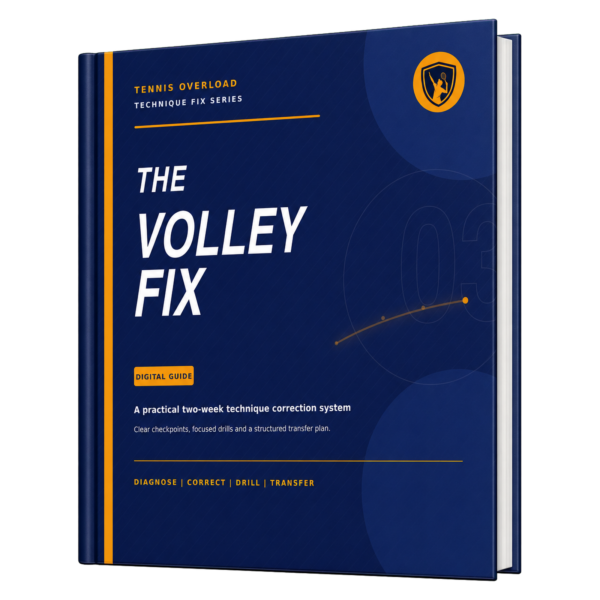
Correct Late and Unstable Volleys and Build More Control at the Net in 14 Days
The Volley Fix is a practical two-week correction system designed to improve timing, racket-face control, contact and movement at the net. It helps you diagnose why your volleys break down and transfer the correction into approaches, passing-shot situations and point play.
Format: 12-page downloadable PDF.
Stop Trying to Fix Every Volley With Your Hands
Volleys often fly long because the racket face opens or the swing becomes too large. They may hit the net because the racket head drops, or land short because the player stops at contact. Against faster balls, poor split-step timing and unnecessary racket movement leave little time to react.
The Volley Fix helps you evaluate ready position, split-step timing, preparation, contact, racket-face stability and recovery. You then train one correction through feeds, transition patterns, passing-shot games and points.
What You Will Learn
- How to organise an effective ready position at the net
- How to time the split step as the opponent strikes
- How to prepare without taking the racket behind the body
- How to use a continental grip on forehand and backhand volleys
- How to meet the ball in front and to the side
- How to control volleys that fly long or hit the net
- How to create depth without using a large swing
- How to handle low volleys without scooping the ball
- How to strengthen the backhand volley
- How to recover the racket and feet after every contact
- How to connect the approach, split step and first volley
- How to make better decisions against passing shots
Who This Guide Is For
- Players whose volleys regularly fly long or hit the net
- Players who use too much backswing at the net
- Players who react late against fast passing shots
- Players who struggle with low volleys
- Players with an unreliable forehand or backhand volley
- Players who do not recover after the first volley
- Players who want to improve their transition from the baseline to the net
Who It Is Not For
- Players expecting improvement without practising at the net
- Anyone seeking treatment for wrist, elbow, shoulder, knee or back pain
- Players looking only for advanced doubles tactics
- Anyone wanting a personalised technical assessment
- Coaches intending to distribute one purchase to multiple students
Instant Digital Delivery
After checkout, your PDF download link will appear on the confirmation page and in your purchase email. Open the guide on your phone, tablet or computer, or print one personal practice copy.
Personal-Use License
This purchase is licensed to one customer for personal training. You may use the guide on your own devices and print a personal copy.
Sharing, resale, redistribution, public uploading, reproduction or distribution to students, teams and organisations is not permitted.
FAQ
Is the guide suitable for beginners?
Yes. It starts with ready position, grip, split-step timing and compact contact before progressing to transition patterns and pressure.
Which grip does the guide teach?
The guide uses the continental grip as the foundation for both forehand and backhand volleys.
Does it cover low volleys?
Yes. It explains why low volleys pop up or hit the net and includes drills for using the legs, controlling the racket face and sending the ball through a longer target.
Do I need a practice partner?
A partner is useful for feeds, rapid reaction volleys and passing-shot games. Ready-position work, shadow movements, wall volleys and video audits can also be completed alone.
Does it cover serve-and-volley?
It includes approach, split-step, first-volley and serve-and-volley point constraints. The guide is also useful for players who reach the net through normal rally situations.
How long is each session?
Most technical blocks take approximately 25 to 45 minutes.
Is this a physical book?
No. It is a downloadable 12-page PDF.
Educational and Safety Notice
This guide provides general tennis education. Volley technique varies according to grip, physical characteristics, tactical intent and ball situation. Stop if an exercise causes pain. Persistent pain, weakness, swelling or altered movement should be assessed by an appropriately qualified professional.
Build More Control and Confidence at the Net
Improve your timing, stabilise the racket face and train your volleys until the correction survives movement, faster balls and scoring pressure.